Double Car Garage Dimensions: Essential Sizes & Layouts
July 28, 2026
9 High-End Outdoor Shade Ideas For Luxurious Living
July 30, 2026
If your living room has that one window that looks beautiful at sunset but turns into a glare strip the moment the TV comes on, you're already dealing with the problem layered window treatments solve best. The right stack gives you daytime softness, nighttime privacy, and a cleaner finish than a single blind or curtain can usually manage on its own.
The catch is that layering only works when the functional part of the system is specified correctly. Get the base layer wrong, and the outer drapery becomes decoration hanging in front of a problem you never fixed.
What Layered Window Treatments Actually Do for Your Space
A layered window treatment is more than one treatment on the same window, usually a functional inner layer and a decorative outer layer. In practice, that often means a cellular, roller, or solar shade closest to the glass, then drapery or panels outside it. The most common combinations include cellular shades with drapery, Roman shades with drapery, roller shades with drapery, and sheer drapery paired with light-filtering or room-darkening drapery, all standard configurations in the trade Graber's layered treatment examples.
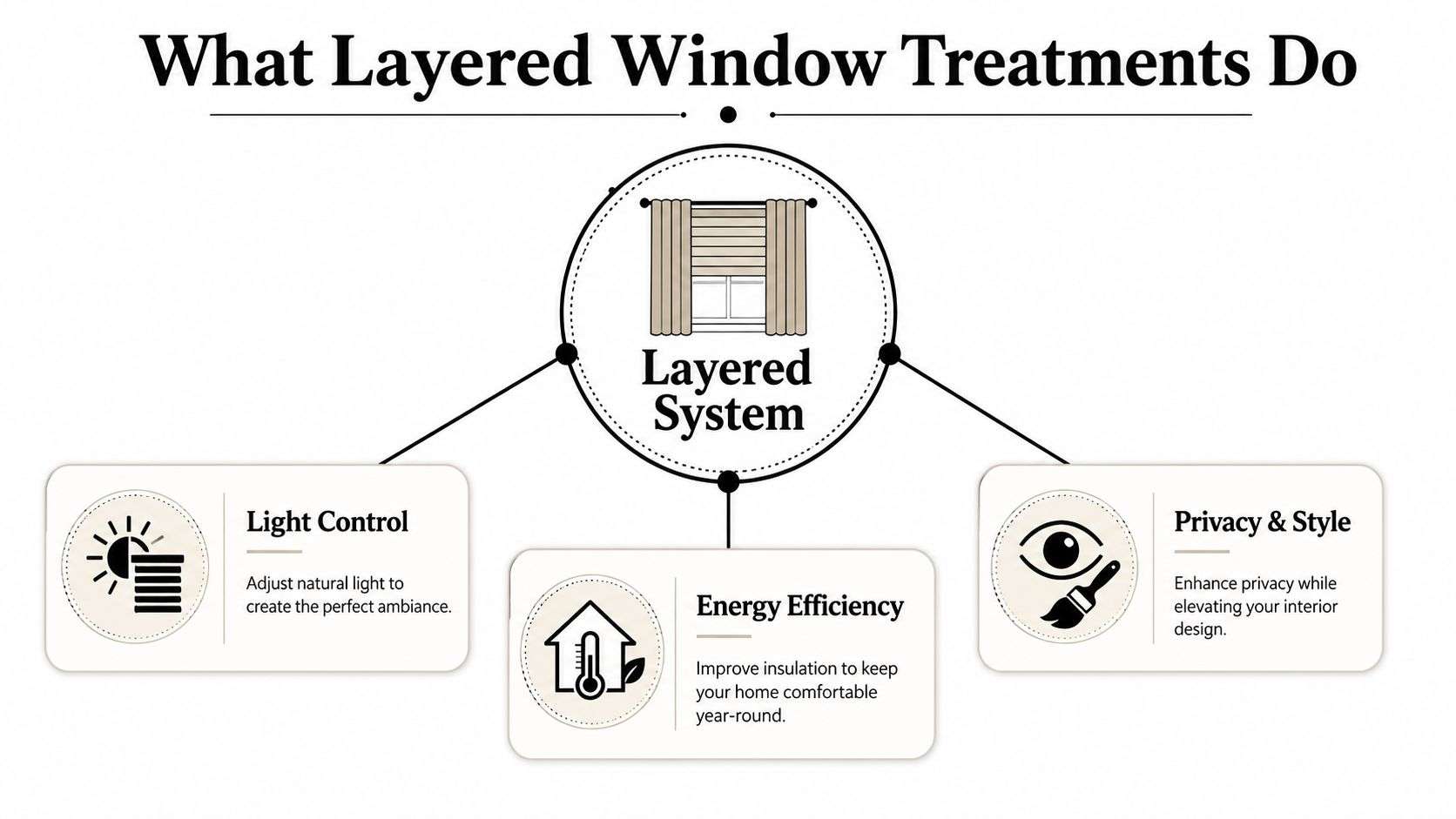
The reason this works is practical, not just decorative. Windows make up about 8% of a home's exterior surface but account for roughly 45% of heat gain or loss, according to ENERGY STAR cited in the window-treatment statistics brief, and the U.S. Department of Energy reports that window attachments can reduce annual household HVAC energy use by about 15% versus vinyl blinds window treatment statistics. DOE-cited PNNL testing also found cellular shades delivered 13.3% cooling savings versus vinyl Venetian blinds, which is why a shade plus drapery is more than a style move, it's a real efficiency strategy window treatment statistics.
That's why so many homes now treat layering as normal, not special. One industry survey reported that 58% of consumers layer sheer curtains with blackout shades for light control, which lines up with what you see in new builds, renovations, and commercial interiors that need a finished look without losing function window coverings market data.
Practical rule: if the inner layer can't handle glare or privacy on its own, the outer layer is only doing half the job.
The simplest way to think about layered window treatments is this, the base layer handles the daily operating problem, and the outer layer handles softness, proportion, and the finished edge. If you're trying to reduce glare with tinted screens on adjacent glass or nearby glazing, that can help, but it doesn't replace the control you get from a properly specified shade and drapery stack reduce glare with tinted screens.
For homeowners comparing styles, the basic pattern is straightforward: shades or blinds do the work, curtains or drapery finish the room. If you want a visual example of how soft layers sit over a base treatment, see curtains with sheers.
Choosing the Right Base Layer and Decorative Combination
I see the same mistake often on site visits. Someone picks the fabric they like first, then tries to force it to do a job it was never sized for. The result looks polished at a glance, but the window still throws glare, holds heat, or leaves privacy gaps where it matters most. Start with the exposure, then choose the base layer around how much light and heat that opening takes.
Start With Exposure, Not Style
South- and west-facing windows need a tighter base layer spec because they take the hardest sun. Design guidance for layered treatment light-control guidance points to less than 5% openness for stronger glare control, with 3–5% openness for sunny rooms and 7% for shaded or north-facing spaces when daylight is the priority. The outer drapery can soften the room, but it will not fix a sheer or solar shade that is too open for the exposure.
That is why I treat the base layer as the working part of the system. In a room that gets hard afternoon sun, a solar shade with the right openness is usually a better choice than a purely decorative sheer. If the room needs insulation and a softer stack, cellular shades usually make more sense, especially in bedrooms or in spaces where the goal is to reduce temperature swings as well as light.
Humidity changes the decision too. In Tampa Bay and similar climates, I avoid fabrics that trap moisture or hold a heavy finish against the glass, because they can age badly near sun-facing windows. Light-filtering construction with stable weave quality usually performs better than delicate layers that look good in a showroom but sag, discolor, or feel limp once they are installed in real heat.
Match the Pairing to the Room
Some pairings hold up better than others. Solar shades with lined drapery work well in living rooms because they preserve view access while cutting glare. Cellular shades with blackout panels are the better call for bedrooms where light control matters more than daytime softness. Sheer or light-filtering layers with room-darkening overlays work in media spaces where flexibility matters more than full blackout all the time.
Fabric choice should follow that decision, not lead it. If you are comparing construction options, a practical guide to different types of shades helps you sort out which inner layer belongs in the stack before you spend money on the outer treatment. Once that base layer is set, the decorative fabric can be chosen for hand, drape, and finish instead of being asked to carry the whole load.
If you want a sheer that holds up cleanly behind a drapery panel, start with Atlanta's source for premium sheer fabrics. That matters in layered work, because the inner layer still has to hang straight, move well, and stay visually quiet under the outer treatment.
The decorative layer should frame the window. It should not have to solve the room's light problem.
Hardware Spacing and Mounting Order for Clean Operation
Layered projects often struggle in execution. The fabrics may look right on a sample board, but once the brackets, rods, and stack depth are all in the same wall zone, the system starts fighting itself. Clean operation depends on mounting order, spacing, and hardware planning, not just the material choices.
Set the Distances Before You Order
The working benchmark I use is simple. Allow about 2–3 inches between the window glass and the first inside-mounted treatment, and 3–4 inches between the first and second layers so the hardware clears each other and the stack can move freely layered treatment hardware guidance. If you skip those clearances, you get rubbing, crooked hang lines, and drapery that doesn't sit correctly when open.
That spacing also protects the sightline. A layered stack should feel custom-fit, not crowded. If the stack depth is too tight, the outer panels will sit too close to the inner shade and the whole window reads as bulky, especially in smaller rooms.
Mount Functional First, Decorative Second
The order matters. The functional layer goes closest to the glass, then the decorative layer sits outside it. That sequence is what keeps the system usable every day, especially when you're choosing a double rod or track setup from makers such as Kirsch or Finestra.
A good installation sequence looks like this:
- Set the inside mount first: Position the base shade so it has room to travel and doesn't strike the glass or trim.
- Confirm the outer rod location: Make sure the curtain rod clears the inside layer without catching the stack when the panels are drawn.
- Check wall space carefully: If the outer rod can't extend cleanly beyond the window, the whole composition will feel pinched.
For custom projects, I've found that the best results come from measuring the wall, not just the window opening. If there isn't enough side clearance for hardware and stack-back, layering becomes an argument with the room.
Practical rule: if the hardware has to be forced into place, the room will feel forced too.
For a visual reference on track planning, see double curtain tracks. That's especially useful when the goal is smooth operation with one layer doing the work and the other layer framing the window without interference.
Motorization and Smart Control for Layered Systems
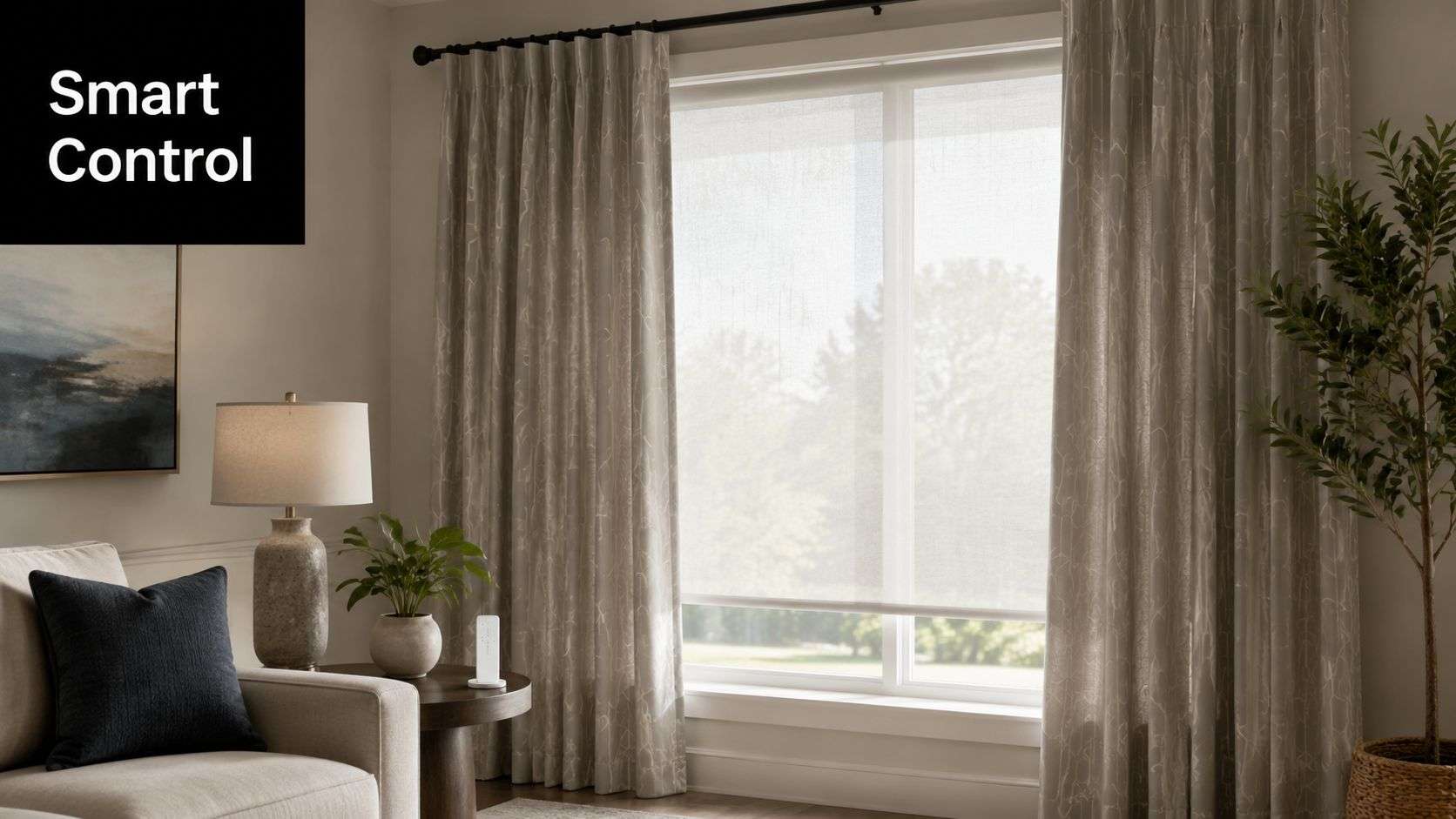
Motorization changes the conversation because it shifts the question from “Can I open this?” to “Which layer should be automated?” In layered systems, that's a real design choice, not an extra feature. On most jobs, automating the inner functional shade while leaving the outer drapery manual gives the cleanest result.
Inner Layer Only or Whole Stack
If you motorize only the base shade, you preserve the look of the drapery and keep the system simpler. That's usually the right answer in retrofit projects where power access is limited and fishing new lines through finished walls would add unnecessary complexity. If the window is a large glass wall or a sliding patio door, coordinated control becomes more valuable because the scale makes manual operation awkward.
Motorizing the entire stack can make sense in high-end spaces, but it adds cost, wiring decisions, and more points of failure. In many homes, the drapery should stay a visual frame while the shade does the daily work.
What To Plan For in Real Homes
Retrofit work is where power access becomes the deciding factor. Battery-powered options can solve a lot of problems when you don't want to open walls, but you still need to think through where the pack lives and how often it will be serviced. New construction gives you more flexibility, especially if the window package is being coordinated with the electrical plan.
For homeowners looking at automation, the advantage is consistency. The shade opens and closes the same way every time, which matters in bedrooms, media rooms, and sun-exposed living areas. It also keeps the decorative fabric free to do its job, instead of forcing a manual panel to double as the performance layer.
The Drapery Company works with motorized solutions from Hunter Douglas and Graber for clients who want convenience without giving up a layered look. For a deeper look at coordinated systems, electric curtain track is worth reviewing before you commit to a stack plan.
Room by Room Scenarios for Tampa Bay Homes and Commercial Spaces
In Tampa Bay, the room type matters as much as the style. Humidity, bright sun, and coastal air all change how fabrics, linings, and hardware behave. A layered stack that feels elegant in a dry climate can become fussy here if the materials aren't chosen for the environment.
Bedrooms Need Quiet Darkness and Stable Materials
For bedrooms, I'd start with cellular shades and pair them with blackout drapery. The shade handles the daily light control and insulation, while the drapery adds depth and helps the room feel finished. In humid rooms, moisture resistance matters, so I'd avoid delicate fabrics that don't hold their shape or tolerate regular use.
Inside mounts should be measured carefully so the shade doesn't scrape the glass or gather unevenly. If the room is used in a vacation rental or hospitality setting, the hardware also needs to be durable enough for repeat operation without constant adjustment.
Living Rooms Need Glare Control Without Losing the View
For living rooms, solar shades with low openness paired with sheer or light-filtering drapery are usually the smartest balance. The shade cuts TV glare and harsh direct sun, while the drapery keeps the room soft and upscale. In a larger coastal home, that combination also lets you maintain views without making the room feel exposed.
If you want to preserve a more formal finish, lined drapery is often better than a bare panel. It hangs more cleanly and gives the window a fuller profile. In commercial lounges or club spaces, this pairing also photographs well because it keeps the room bright but controlled.
Patios and Outdoor Living Areas Need Tougher Construction
For outdoor drapery, the fabric has to work harder. Coastal breezes, UV exposure, and moisture all punish weak materials, so the best choice is an outdoor-rated drapery that resists mold and mildew and holds its color longer than interior fabric. Hardware should be sturdy, and the installation should allow the panels to move freely without dragging in damp conditions.
For restaurants, covered patios, or resort-style homes, outdoor drapery can create a luxury feel without making the space stuffy. It's still a layered mindset, just with materials that can survive the setting. If the goal is a premium result, the fabric has to look custom and still stand up to weather.
When Not to Layer and How to Maintain Your Treatments
Layering is not always the answer. Small windows, tight condos, and rooms with limited wall space often perform better with a single, well-chosen treatment than with a crowded stack that steals light and makes the room feel heavier than it is. One practical guide even notes that windows under 30 inches wide may not need layering at all blindsgalore layering guidance.
Know When Simpler Is Better
If the room can't support the hardware, don't force it. You need mounting depth for the inside layer, wall space for the outer rod, and enough clearance that both treatments can move without colliding. In a compact apartment or a narrow breakfast nook, a single high-quality shade may outperform a layered stack in both appearance and day-to-day use.
That's especially true when sightlines matter. A clean single treatment can keep a small room from feeling overbuilt, while still giving you the privacy and light control you need.
Keep the Fabric and Hardware in Working Order
Maintenance is part of the investment. Drapery repair, curtain repair, and curtain or drapery hemming can restore a custom treatment that still has good structure but needs fit adjustments or seam work. If the fabric has shifted, the hem is dragging, or a panel no longer hangs correctly, repair is usually smarter than replacement.
For cleaning and upkeep, a practical reference is how to clean Roman shades, since the same basic care mindset applies to layered systems. In commercial settings, especially hotels and clubs, regular service matters even more. For large properties that need periodic maintenance, professional drapery cleaning for hotels is a useful benchmark for how seriously fabric care should be treated.
The Drapery Company's onsite workroom handles alterations, restyling, and maintenance for both residential and commercial projects, which matters when a stack needs to be resized instead of replaced. In humid climates, that kind of follow-through keeps layered treatments looking intentional instead of tired.
If you're planning layered window treatments for a home, condo, office, or hospitality space, The Drapery Company can help you sort out the base layer, hardware clearance, motorization, and final fabric choice without guessing. Visit The Drapery Company to schedule a consultation and get a custom plan built around your windows, your climate, and the way you use each room.