West-Facing Window Glare: How to Control It in Tampa Bay
October 26, 2026
Motorized Shades Maintenance: A Practical Care Guide
October 27, 2026
No drapery fabric is truly mildew-proof. Some fabrics resist it far better than others: solution-dyed acrylic, polyester and nylon give mildew very little to feed on, while cotton, linen and rayon invite it. What decides the outcome is the combination of fiber, finish, lining, cleanliness and the moisture level in the room. In Tampa Bay, where warm, damp air is the default for much of the year, you need to get all of those right.
We fabricate every drapery panel in our Tampa Bay workroom, and we have spent more than 30 years watching which fabrics hold up in local homes and which ones start to spot, smell or sag. This guide covers what the science says, which fibers to favor, where linings and finishes help or hurt, and how to keep the fabric dry enough that mildew never gets started.
TL;DR
- Synthetic fibers such as polyester, acrylic and nylon generally resist mildew, but dirt and humidity can still let it grow on them.
- Cotton, linen and rayon are the most vulnerable choices for damp rooms, so use them with care in Florida.
- Keep indoor humidity below 60%, ideally 30% to 50%, and keep air moving behind and around the drapery.
- Lining, weight, hem length and the way a panel hangs matter as much as the face fabric.
- If mildew keeps returning, treat the room’s moisture problem, not just the curtain.
Why “mildew resistant” does not mean “mildew proof”
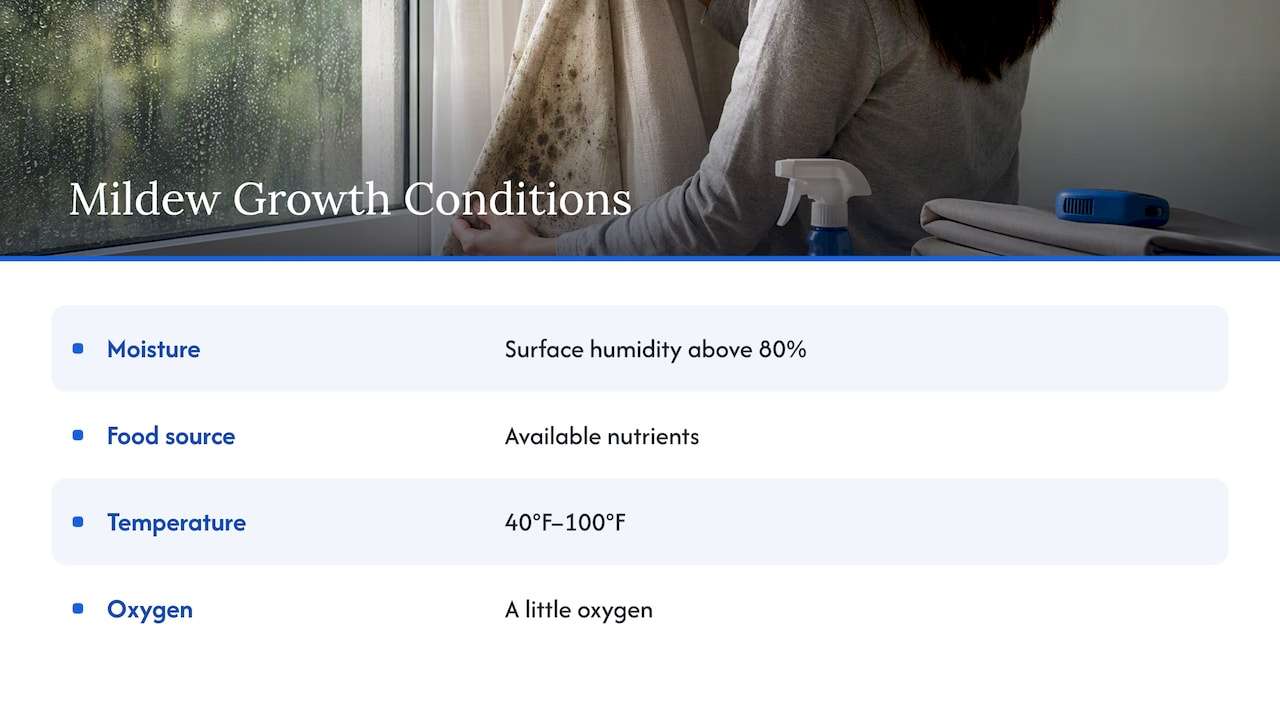
Mildew is a mold that grows on surfaces when four things line up: moisture, a food source, a tolerable temperature and a little oxygen. The U.S. Department of Energy’s Building America program lists surface humidity above 80%, available nutrients, temperatures between 40°F and 100°F and oxygen as conditions sufficient for mold on most surfaces. A Tampa living room sits inside that temperature range all year.
A fabric’s job is to remove as many of those four conditions as it can. Fibers that absorb little water dry quickly, and fibers that are not themselves a food source give mold nothing to digest. But the fabric cannot control the room, and it cannot stop dust, cooking residue, skin oils and pollen from settling on it.
The Smithsonian’s Museum Conservation Institute makes this point clearly: polyester and nylon absorb little moisture, yet soiling, organic residues, stains and high humidity can still encourage mildew, and warmth and poor ventilation add to the risk. University of Missouri Extension says the same thing from a household angle: clean acetate, acrylic, polyester and nylon generally resist mildew, but dirt can supply the food for growth on any fiber.
Even manufacturers that build their reputation on resistance are careful here. Sunbrella, for example, describes its fabrics as inherently mold- and mildew-resistant, while noting that dirt and debris left on the fabric can still allow growth. Treat “resistant” as a head start, not a guarantee.
How the main fibers behave in damp conditions
The National Park Service states that all fibers can support microorganism growth, but cotton, linen, ramie, jute and rayon are especially vulnerable, and wool and silk are susceptible to specialized fungi. An older, widely cited drapery-fabric guide from Alberta, Canada rates cotton poor and linen fair for mildew resistance, which matches what we see in the field.
Here is how that translates into choices for a Tampa Bay home.
| Fiber | Mildew behavior | How we use it locally |
|---|---|---|
| Polyester | Absorbs little moisture; resists mildew when kept clean | Workhorse for living rooms, bedrooms, lanai doors and commercial spaces |
| Acrylic (solution-dyed) | Resists mildew and fading; dries fast | First choice for sunrooms, outdoor drapery and humid exposures |
| Nylon | Low moisture absorption; usually blended | Appears in blends and sheers for strength |
| Cotton | Most vulnerable of the common fibers | Best in lined, well-conditioned rooms with good airflow |
| Linen | Fair resistance, but absorbs moisture and holds creases | Beautiful in air-conditioned rooms; avoid near damp walls |
| Rayon and viscose | Especially vulnerable | Rarely recommended for Florida windows |
| Silk and wool | Susceptible to specialized fungi in very humid air | Reserve for climate-controlled formal rooms |
The table is a starting point, not a verdict. A cotton-polyester blend in a room with a well-sized air conditioner may outlast a pure synthetic hung against a sweating window. That is why the room matters as much as the label.
What about natural fibers you love?
Many of our clients want linen’s texture and cotton’s softness, and we can build with them. The trade-off is honest: you accept a higher maintenance burden and a stricter humidity rule. For rooms that run damp, we often steer toward a linen-look polyester or a textured acrylic, which keep the visual character without the same vulnerability. Our page on fabrics for Tampa Bay’s humid climate goes deeper on specific options, and our guide to Florida drapery fabrics for sun, salt and humidity covers the fading and salt-air side.
Weave, finish and lining: the details that change service life
Fiber is only the first decision. Three more matter in humid homes.
Weave and weight. A tight, dense weave traps dust more slowly at the surface but dries more slowly when damp. An open, airy weave dries faster and lets air pass through. Heavy, multilayer drapery that sits tight against cold glass is the likeliest to hold moisture at its back.
Finishes. Stain, crease and water-repellent finishes are common. The National Park Service notes that textile finishes affect performance, and some can degrade fabric or complicate later treatment. A finish that repels water at the surface is useful, but it is not the same as an antimicrobial treatment, and it will not rescue a damp, dusty panel.
University of Missouri Extension identifies water-repellent sprays and labeled fabric fungicide products as possible protection, with the instruction to follow product labels and precautions. We would add one practical note: test any treatment on a hidden hem first, and never apply one to a fabric whose care instructions forbid it.
Lining. A lining protects face fabric from sun and gives drapery body, but it also adds a layer where moisture can sit. In humid rooms we specify linings that match the fiber family of the face fabric, so the whole panel dries at a similar rate. We also recommend leaving enough clearance so the lining does not press against the glass.
The drapery-fabric guide from Alberta reminds us that fiber choice must be judged on more than mildew: cleaning method, abrasion resistance, fading, dimensional stability, fire resistance, drape and strength all vary by construction and finish. A fabric that wins on mildew and loses on sun fading is a bad bargain on a west-facing Tampa window.
Humidity is the real variable
You can choose the best fabric available and still grow mildew if the room stays damp. The numbers are worth knowing.
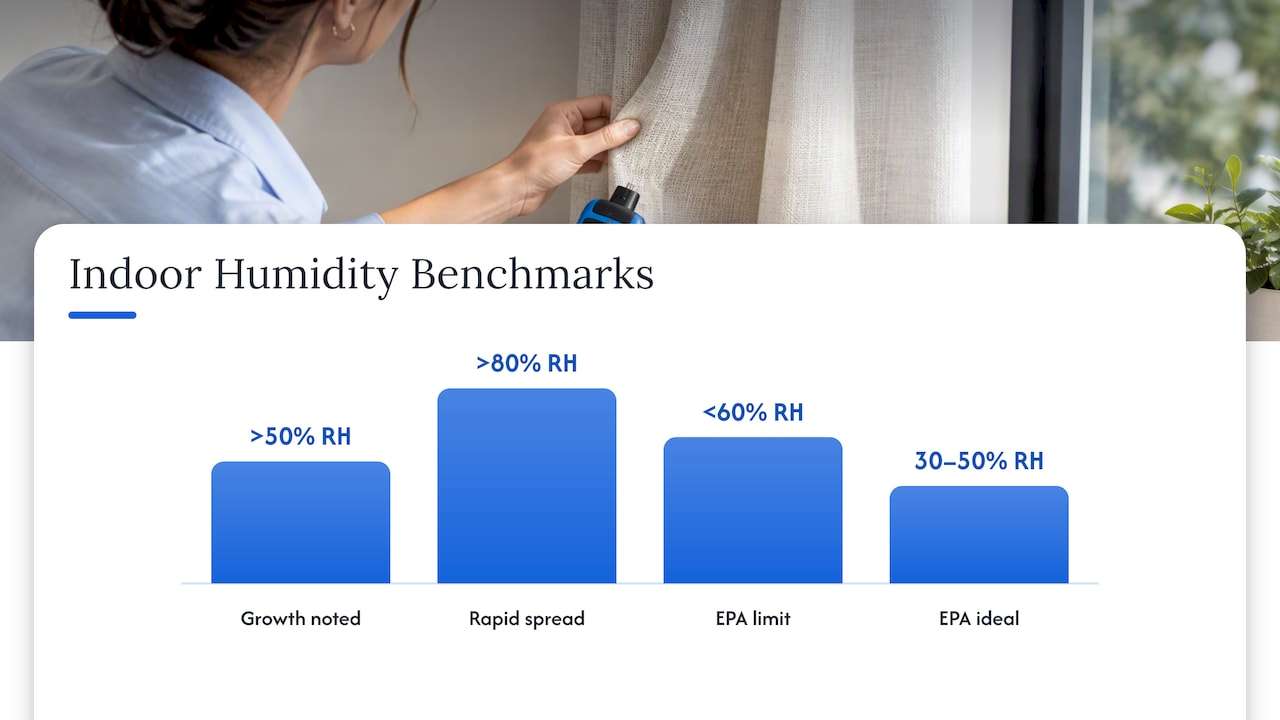
The National Park Service reports that on textiles, growth is noted above 50% relative humidity and spreads rapidly above 80%, with activity generally beginning above 75°F and worsened by stagnant air. The EPA recommends keeping indoor humidity below 60%, ideally between 30% and 50%, measuring it with a humidity meter, and acting quickly when condensation appears on windows, walls or pipes.
In practice, that means a few habits:
- Buy a hygrometer. An inexpensive meter in the room tells you what is actually happening, rather than what the room feels like.
- Run the air conditioning properly. The Smithsonian warns that humid air cooled without dehumidification can end up with very high relative humidity. Building Science Corporation adds that oversized or undersized cooling equipment can worsen humidity control, and that indoor humidity in a space held at 75°F should not exceed 60%.
- Do not open windows to fix it. In hot-humid climates, Building Science Corporation explains that uncontrolled ventilation can bring in more moisture. Outdoor air should come in controlled and dehumidified.
- Move the air. The EPA recommends air-conditioning or dehumidification, outdoor-vented appliances, bathroom exhaust during showers and increased air movement. A ceiling fan helps drapery dry between humid spells.
- Watch the glass. Condensation on a window is a signal that the glass surface is cold and the room air is damp. Our readers who want a deeper look at controlling indoor humidity and window condensation will find practical numbers there, though keep in mind Tampa’s problem is usually summer cooling, not winter cold.
Bathrooms and kitchens need their own plan
Steam is the most concentrated moisture source in a house. If a drapery or a fabric shade hangs in or near a bathroom, run the exhaust fan during and after showers, and consider whether fabric belongs there at all. Many bathroom windows do better with moisture-proof hard treatments; see our picks for bathroom window treatments and small bathroom window covering ideas. For the room itself, this homeowner guide on preventing bathroom mold covers ventilation and leaks.
Cleaning and maintenance that keep mildew away
Because dirt is the food source, cleanliness is the most overlooked part of mildew resistance. A light routine does most of the work.
- Dust regularly. Vacuum the panels with a soft brush attachment every few weeks, and always check the top, the folds and the hem, where dust and moisture collect.
- Follow the care label. Some drapery fabrics are machine washable and others are strictly dry-clean or spot-clean. Sunbrella says its drapery fabrics are machine washable, subject to the specific care guide. Lined and interlined custom panels often should not be washed at all.
- Dry fast. The EPA says drapes and other furnishings should be dried promptly after cleaning, and that wet furnishings generally should be dried within 24 to 48 hours to avoid mold growth.
- Clean before storing. University of Missouri Extension advises cleaning fabrics before storage, keeping them dry, and avoiding stored starch unless it contains a mildew inhibitor.
- Look behind the panel. Once a month, pull the drapery aside and check the window frame, sill and wall for dampness or spotting.
If you find mildew already
For light, surface-level spotting, the Smithsonian’s guidance is conservative: remove the textile from the damaging environment, dry it carefully, and use gentle HEPA vacuuming after testing a small area. It does not recommend wholesale washing or dry cleaning. For valuable or heavily lined custom drapery, that restraint makes sense. If the panels are widespread-stained, smell musty after cleaning, or you or a family member have respiratory sensitivities, stop handling them yourself and call a professional workroom or a mold specialist. We repair, re-hem and refit drapery, and we can tell you quickly whether a panel is worth saving.
When the room, not the curtain, is the problem
If mildew returns on a resistant fabric, the cause is almost never the fabric. The Smithsonian recommends checking insulation, pipes, floors, ceilings and blocked vents when mildew occurs, then improving circulation with fans, dehumidifiers or air-conditioning that actually lowers humidity.
Signs that you have a structural or HVAC issue rather than a fabric issue:
- Mildew shows up on several different items in the same room.
- Window frames or the wall behind the drapery are damp or stained.
- A hygrometer reads above 60% for days even with the air conditioning running.
- A closed room or a closet smells musty.
- The ceiling shows staining, which can point to roof or attic moisture. Homeowners tracing that kind of problem can read about attic moisture and mold.
Fix those first, then choose fabrics. Putting a new drapery on a damp wall just moves the damage to a more expensive item.
A short checklist for choosing fabric
Whether you are furnishing a home, a rental portfolio or an office, run through these questions with your designer or fabricator:
- Exposure. Is the window in direct sun, near a pool door, a bathroom or a kitchen, or beside a humid garage entry?
- Climate control. Does the room stay air-conditioned and dehumidified when no one is home, such as in a second home or vacant unit?
- Fiber. Are the face fabric, lining and trim all in compatible, low-absorbency fibers?
- Cleaning. Can the panel be vacuumed, spot-cleaned or laundered? Who will do it, and how often?
- Light and privacy. Do you need blackout, light filtering or UV protection, and does the lining add a moisture layer?
- Alternatives. Would a hard treatment, such as shutters or a moisture-tolerant shade, serve the window better than fabric?
That last point is real. For the dampest locations, a treatment that you can wipe down is sometimes smarter than any drapery. Our overview of durable window treatments that last compares materials, and our guide to drapes and curtains explains how construction changes the way each performs.
Our perspective: fabric is architecture, humidity is the weather
We often tell clients that custom drapery is architecture with fabric instead of drywall. Like any structure, it fails where water gets in, and in Tampa Bay water arrives as vapor, every day, for most of the year.
Because we fabricate every product in our own workroom, we choose the fabric, the lining, the fullness and the hem together rather than ordering a finished panel and hoping. That control is what lets us build for humid conditions on purpose. We might pair a solution-dyed acrylic with a matching lining for a sunroom, keep a linen-look polyester away from the glass in a coastal condo, or tell a client frankly that a bathroom window should not carry fabric at all.
We do not promise that any fabric will never mildew, and we would be wary of anyone who does. What we promise is a recommendation that fits your room, your budget and how you actually live, along with professional measurement, installation and removal of your old treatments as a courtesy.
— The Drapery Company
Talk to a Tampa Bay workroom
If you are replacing drapery in a humid room, or planning a whole-home project, we will come to you. Our team handles in-home consultations, measurement and installation for homes, and commercial window treatments for offices and property managers who need coverage at scale. Start with our in-home consultation and installation page, or see our draperies and commercial window treatments. If existing panels are tired but sound, we also handle drapery repair, curtain repair and hemming. For a quote, contact us through our main site.
FAQ
What is the most mildew resistant fabric for drapes?
Solution-dyed acrylic and polyester are the most dependable choices for humid rooms, because they absorb little moisture. Clean acrylic, polyester and nylon generally resist mildew, but dirt can still support growth. Keep them clean and the room dry for the best results.
Can cotton or linen curtains be used in Florida?
Yes, in rooms that stay air-conditioned and ventilated. Cotton and linen are among the more vulnerable fibers, and the National Park Service lists them as especially susceptible. We recommend them for lined, climate-controlled living spaces rather than bathrooms, lanai doors or vacant homes.
What humidity level is safe for curtains?
The EPA recommends keeping indoor humidity below 60%, ideally 30% to 50%. Textile growth can begin above 50% and spreads quickly above 80%. A simple humidity meter shows you where your room stands.
Can I wash mildewed drapery?
It depends on the construction and the care label. The Smithsonian does not recommend wholesale washing or dry cleaning of affected textiles, and suggests drying carefully and vacuuming gently with a HEPA filter after a spot test. For lined custom panels or heavy growth, bring the item to a professional.
Do anti-mildew sprays work?
Water-repellent sprays and labeled fabric fungicide products are sometimes used for protection, and University of Missouri Extension says to follow the product label and precautions. They are no substitute for humidity control and cleaning. Test on a hidden area first.
Sources
- Mold and Mildew on Textiles, Museum Conservation Institute
- Conserve O Gram 16/1: Causes, Detection, and Control, National Park Service
- Appendix K: Curatorial Care of Textile Objects, National Park Service
- How to Prevent and Remove Mildew, University of Missouri Extension
- Sunbrella consumer support
- All about drapery fabrics, Alberta
- Moisture Control for Residential Buildings, U.S. Department of Energy Building America
- A Brief Guide to Mold, Moisture, and Your Home, EPA
- Mold Course Chapter 2, EPA
- Bugs, Mold and Rot, Building Science Corporation
- Window condensation and indoor humidity
- How to prevent bathroom mold
- Attic moisture and mold