30 Years of Proof: Florida Drapery Fabrics for Sun, Salt, Humidity
September 16, 2026
Skip Ladders: Motorized Hard to Reach Window Treatments for Homeowners
September 18, 2026
Most Tampa commercial projects land between $100 and $400 per window installed for manual blinds and shades, and $300 to $900 or more per window for motorized systems, depending on size, fabric, and control type. Per-square-foot planning benchmarks run roughly $10 to $30 for manual options and $30 to $60 or higher once motors and wiring enter the picture. The real number for your building comes from a walkthrough, not a chart, so the smartest next step is scheduling an on-site measurement with a Tampa Bay specialist before you build a budget around any single figure.
TL;DR:
- Custom-sized windows, fire-rated fabrics, and specialty shapes can significantly increase overall costs, often requiring detailed upfront planning.
- Motorized shades typically add $150 to $400 per shade, with installation costs ranging from $30 to $60 per square foot, and batteries can reduce wiring expenses.
- Volume discounts in Tampa are accessible once ordering 50 or more identical windows, especially if sizes are standardized early in the project.
- Accurate quotes depend on detailed site measurements, fire rating, hardware specifics, and project scope, including removal of existing treatments and electrical work.
- Complying with Florida building codes and occupancy requirements, especially for electrical and fire safety standards, can trigger additional permit and inspection costs.
How Much Do Commercial Blinds Cost in Tampa by Product Type?
Every product category carries its own price architecture, and the differences show up fast once you start comparing quotes. Manual roller and sunscreen shades, the workhorse of Tampa office buildings, typically run $12 to $25 per square foot installed, with premium blackout or designer fabrics pushing that to $18 to $35. Aluminum venetian blinds tend to land in the $150 to $300 per window range for standard commercial installs, while heavy-duty, fire-rated, or motorized versions of the same blind often climb to $300 to $600 or more per window on a completed project.
Faux-wood and plantation shutters sit at the higher end of the manual category because of the labor involved in fitting frames and louvers to commercial openings, especially in retrofit buildings where wall depth and header clearance vary window to window. Draperies price differently altogether, since fullness ratios, track length, and fabric yardage drive the number more than window count does. A boardroom with floor-to-ceiling glass and a lined, pattern-matched drapery will cost more than ten standard office windows combined, and that is normal.
Several factors push a quote higher or lower than the baseline:
- Custom sizing for nonstandard openings, arched windows, or oversized storefront glass adds fabrication time and material waste.
- Premium or specialty fabrics, including solar screens with higher openness factors or acoustic-dampening liners, raise per-square-foot cost.
- Dual-shade assemblies, pairing a sunscreen with a blackout shade on the same window, commonly add 40 to 60 percent to per-window cost, a common ask for conference rooms that need both daylight and total blackout for presentations.
- Outside mounts versus inside mounts change bracket hardware and sometimes require additional trim work.
- Specialty shapes, like triangular transoms or curved storefront runs, require templating that standard product lines don’t accommodate.
If you’re budgeting a 12 by 8 foot storefront window at $20 per square foot for a mid-grade sunscreen, that’s a 96 square foot opening running roughly $1,920 installed, before considering dual-shade upgrades or motorization. Multiply that logic across your floor plan and you’ll get closer to a real number than any generic per-window average can give you.
Is Motorization Worth the Extra Cost?
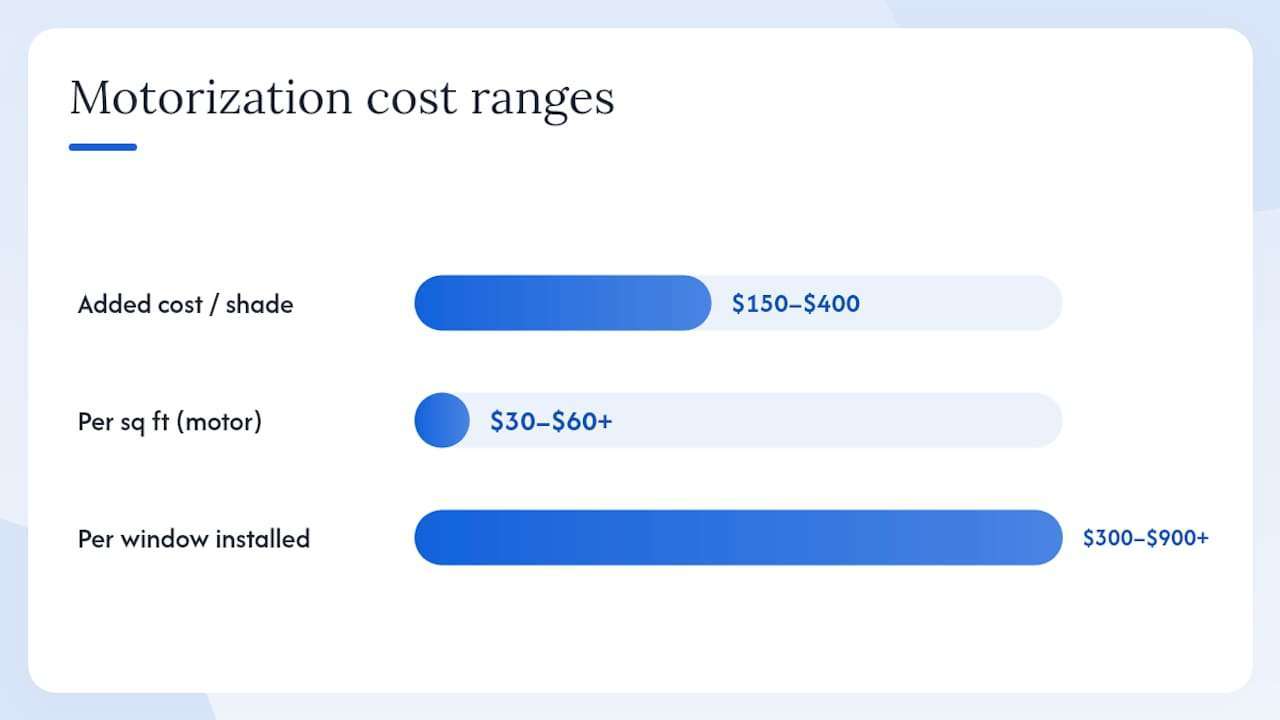
Motorized shades generally add $150 to $400 per shade over manual equivalents for mid-size commercial installs, and per-square-foot pricing for motorized roller shades often runs $30 to $60 or more once motors and controls are included. Battery-powered motors keep installation cost lower because there’s no electrical work involved, while wired, hardwired systems add electrician labor and conduit runs, particularly in retrofit buildings where power isn’t already routed to the window line.
- Battery motors: lower upfront install cost, no wiring, ideal for retrofits and buildings without accessible power near the window.
- Wired/hardwired motors: higher install cost due to electrical labor, but better suited for large-scale automation tied to a building management system.
- Per-window planning range: roughly $300 to $900+ installed, depending on fabric, size, and control complexity.
Fast fact: University testing on automated shading systems found that shades programmed to track sun position can meaningfully cut HVAC energy use by reducing solar heat gain during peak sun hours.
That’s the piece facility managers underestimate. Motorization isn’t just convenience. It’s a lever against HVAC cycling, especially in a Tampa building with large west-facing glass baking through afternoon heat. Evaluate it as a lifecycle cost, not a line-item upgrade, and the payback math looks a lot better.
What Commercial Specs Actually Drive Up the Price?
Commercial buildings carry requirements residential jobs never touch, and these specs are exactly where budgets get blown if they aren’t nailed down at the quote stage. Certain occupancy types and insurance policies require fire-retardant or inherently fire-resistant fabrics to meet NFPA-related standards, and those materials cost more upfront, even though they tend to lower lifecycle risk and insurance friction over the life of the building.
- Fire-rated fabrics: higher initial material cost, but often required for healthcare, education, or high-occupancy commercial spaces.
- Heavy-duty hardware: reinforced brackets and commercial-grade headrails hold up to higher use cycles than residential-grade parts.
- Extended warranties and service programs: multi-year coverage on motors and fabrication adds a small premium but protects against downtime on high-traffic installations.
- Retrofit vs. new construction: retrofits often cost more per window due to access limitations, existing header conditions, and the need to work around occupied space, while new construction allows cleaner installation and simpler compliance documentation.
Specify your fire rating and occupancy classification before bidding starts. It’s the single easiest way to avoid a mid-project change order.
How Do Volume Pricing and Project Timelines Work?
Standardizing your window specifications early is the fastest route to real savings on a multi-unit or multi-floor project. Larger, standardized orders reduce manufacturing changeover costs, and Tampa fabricators commonly extend meaningful volume discounts once you’re ordering 50 or more identical windows.
- Standardize sizing where possible. Grouping windows by matching dimensions lets a fabricator run batches instead of one-off cuts, which is where the discount comes from.
- Plan for lead time. Custom commercial fabrication in Tampa typically needs several weeks from final measurement to delivery; batch runs on standard sizes shorten that window compared to fully custom, one-off shapes.
- Budget for add-ons. Removal and disposal of old treatments, electrical hookups for motorized systems, scaffolding or lift rental for multistory buildings, and any permit-related paperwork all show up as line items on a complete commercial quote, not extras tacked on later.
Regional pricing also plays a role. Southeast markets, including Tampa, often run lower on basic manual products than national coastal averages, but once you add custom fabrication and motorized hardware, the gap narrows considerably. That’s exactly why a local quote matters more than a national price chart.
How Do You Get an Accurate Quote From a Tampa Provider?
A useful on-site measurement report should document finished window dimensions (not rough opening), mounting type, fabric specification including openness factor and fire rating where required, control type, hardware specs, and warranty terms in writing. Anything vaguer than that invites substitution later in the fabrication process.
Ask these questions before you sign anything:
- What’s the realistic lead time from final measurement to installation?
- Is fabrication done onsite, or outsourced to a third party?
- What’s the warranty length, and does it cover motors separately from fabric and hardware?
- Do you offer ongoing maintenance or service response for motorized systems?
- Can you show examples of similar commercial projects completed in Tampa?
- What happens if a fabric or hardware item is discontinued mid-project?
- Is removal and disposal of existing treatments included in the quote?
- What documentation do you provide for fire-rated or NFPA-relevant materials?
- How are motorized units powered, and is electrical work included or separate?
- What’s your process if measurements need adjustment after installation begins?
Pro Tip: Ask for a physical fabric sample and a written acceptance spec before production starts. Specifying exact fabric names and colors in the contract, not just “similar to sample,” prevents a provider from substituting a comparable material if your original choice goes out of stock mid-project.
What Permits or Codes Apply to Florida Commercial Window Coverings?
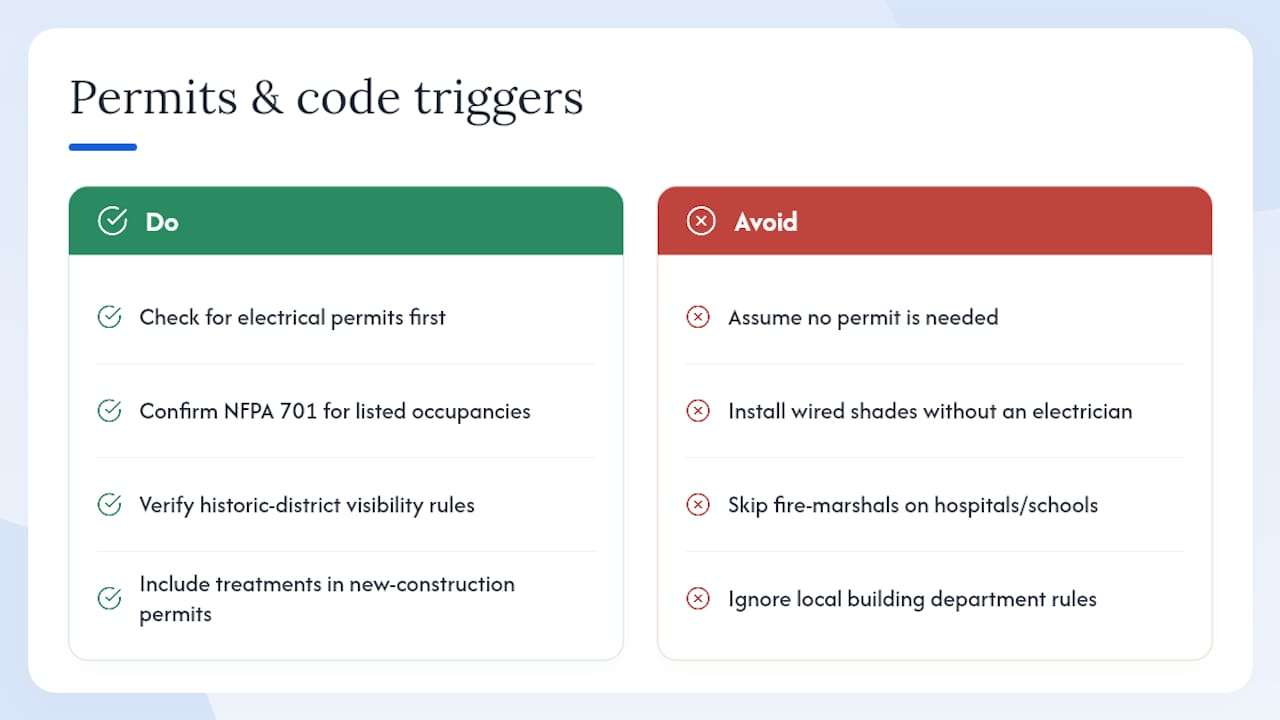
Florida commercial properties fall under the Florida Building Code, and while interior window treatments themselves rarely require a standalone permit, several related factors can trigger compliance review. Any project involving electrical work for wired motorized shades typically requires an electrical permit, since a licensed electrician is running new circuits or tying into existing panels. If your building falls under a fire code jurisdiction with specific occupancy classifications, hospitals, schools, assisted living facilities, or high-rise offices among them, your fire marshal may require documentation proving the fabric meets NFPA 701 flame-resistance standards before installation is approved.
Historic districts and certain commercial corridors in Tampa and surrounding municipalities may also have exterior visibility requirements affecting shutters or solar screens visible from the street, so it’s worth checking with your local building department if your storefront falls in a designated area. New construction projects generally fold window treatment specs into the broader building permit and inspection process, while retrofits on occupied buildings usually don’t require a separate permit unless electrical or structural work is involved.
None of this should be guesswork on your end. A provider familiar with Tampa Bay commercial work will know which of your specific building type, occupancy class, and location triggers a permit requirement and which don’t, and will flag it before quoting rather than after installation.
Our Take: 30 Years of Fabricating Commercial Window Coverings in Tampa
Professional installation and removal of old treatments typically come standard, not as an upsell. What we’ve seen across thousands of Tampa Bay projects is simple: buildings that specify fire ratings, control type, and warranty terms upfront finish faster and cheaper than ones that don’t.
— The Drapery Company
Ready to Get a Real Number for Your Building?
Every range in this article is a planning tool. The actual figure for your property comes from a walkthrough, and these processes generally include on-site measurement, onsite fabrication for quality control, and professional installation with old-treatment removal included as a courtesy, not billed separately.
Typical commercial window treatment services include:
- On-site measurement and written specification, including fabric, control type, and hardware
- Custom fabrication options
- Motorized shade options with battery or wired control systems
- Warranty and service program details provided in writing before signing
- Removal and disposal of existing window treatments
If you’re ready to move past estimates and get a quote built around your actual windows, request a commercial window blinds and shades consultation or explore motorized blinds and shades options for buildings weighing the energy and convenience upgrade. If financing a larger capital project is part of your planning, Tampa Bay business owners have also found value comparing SBA 504 loan options against traditional financing before committing to a full building rollout.
Sources
- Commercial Roller Shades: Buyer’s Guide & Costs — DGFloors
- Window Blinds Pricing Guide: Factors Affecting Cost and Budget Tips — VelaBlinds
- Automated window shades show potential for significant energy savings — Illinois Tech
- Office window blinds price and cost guide 2026 — CurrentCost
FAQ
What Is the Average Cost for Commercial Window Coverings in Tampa?
Manual options typically run $100 to $400 per window installed, while motorized systems run $300 to $900 or more, depending on fabric, size, and hardware.
How Much Should I Expect to Pay for Roller Shades?
Manual sunscreen roller shades generally cost $12 to $25 per square foot installed, with premium fabrics reaching $18 to $35 and motorized versions running $30 to $60 or higher.
How Much Do Window Blinds Cost Per Square Foot?
Standard commercial blinds typically translate to $150 to $300 per window installed for common sizes, though heavy-duty or fire-rated versions can run $300 to $600 or more per window.
How Expensive Is It to Cover a Window for a Commercial Building?
It depends heavily on size, fabric, and control type, but a standard office window generally falls between $100 and $900 installed, with fire-rated, motorized, or dual-shade assemblies pushing toward the higher end.
Does The Drapery Company Offer Free Estimates for Commercial Projects?
Free on-site consultation and measurement for Tampa Bay commercial projects are typically offered, along with written specifications before fabrication begins.