
Tampa Window Treatment Trends for 2026: What Homeowners Are Choosing
October 20, 2026
In a Tampa condo, you usually choose the interior of your window treatments, but the association controls what the outside world sees. Most of the rules come from three places: your declaration, the board’s current rules and regulations, and Florida’s condominium statute. Read all three before you order anything, because a custom treatment that breaks a rule is expensive to redo.
This guide explains where the rules come from, what boards commonly require, what happens if you miss one, and how to order custom treatments that pass approval the first time.
TL;DR
- Unit owners are generally responsible for decorating the inside of the unit, including draperies, shades and curtains. The association controls the exterior appearance of the building.
- Many Tampa-area associations require white or white-backed window treatments facing out. Rules vary by building, so get yours in writing.
- Anything that changes the exterior, such as shutters or window replacement, typically needs board approval and often a permit.
- Florida law lets boards fine owners up to $100 per day, capped at $1,000 per violation, but only after notice and a hearing opportunity.
- Custom window coverings sold in the U.S. must meet federal cord safety rules, so cordless or motorized options are the simplest path.
Where condo window rules actually come from
There is no single “Tampa condo window treatment law.” Instead, several layers stack up.
The Florida statute. Section 718.113 of the Florida Statutes makes the association responsible for maintaining common elements, except for limited common elements the declaration assigns to the owner. It also gives boards authority over hurricane shutter specifications, including color and style, which must comply with the building code. Windows and exterior glass are often treated as common or limited common elements, which is why boards care about them.
Your declaration. This is the building’s founding document. It sets out what you own, what the association owns, and what you may change.
The rules and regulations. This is the document that matters most day to day. Boards can adopt new reasonable rules by vote, and Florida condominium law advisers note that this document is often updated more frequently than the declaration. If you only read the declaration, you may miss the rule that applies to you. Ask the management office for the latest version and for any board minutes that changed window or exterior rules.
Contractor and decorator policies. Many buildings publish separate rules for vendors. These can matter as much as the rules about the product itself (more on that below).
What boards typically regulate
Interior decorating is mostly yours
In most buildings the interior is the owner’s domain. One Pelican Bay-area condo’s decorator rules, for example, state that each unit owner is responsible for decorating inside the unit, naming draperies, window shades and curtains among the items. Another Tampa building’s rules and regulations require owners to maintain the interior of their units and charge owners for damage caused to the building or other units. Those are individual buildings, so treat them as examples of how rules read, not as a universal standard.
What shows from outside
This is where most problems start. Windows are part of the building’s face, so associations commonly set a uniform look from the street, the pool deck and neighboring towers.
The common requirements are:
- White or off-white facing. Many associations require anything visible from outside to be white or white-backed. A Florida arbitration order involving a Hunter’s Creek condominium shows how a dispute over window coverings can end up before the state’s arbitration division. Replacing non-compliant blinds with white ones is a typical fix when a unit is sold or renovated.
- Approved styles. Some buildings allow only certain types, such as blinds or lined drapery, and prohibit foil, towels, sheets or paint on glass.
- Hardware and mounting. Rules may address how a treatment attaches, especially in concrete-ceiling high-rises.
If the rule says “white,” ask whether white-backed lining on a colored drapery face satisfies it. Do not assume. Get the answer in writing from the manager or architectural review committee.
Shutters, windows and anything structural
Soft treatments are one thing. Hardware that changes the building’s exterior is another. The Pelican Bay decorator rules mentioned above indicate that modifications affecting exterior appearance, including replacing windows or installing shutters, require prior board approval and often a building permit. That may involve engineering for multi-family structures.
The City of Tampa is explicit that condominiums need a commercial permit even though they have residential occupancy, so the single-family residential review process does not apply. If your plan involves exterior shutters or new glazing, ask the association and the city’s construction services office before you sign a contract.
Hurricane protection is a particular area of change. Recent legislative changes (SB 1178, effective July 1, 2025) expanded board authority on hurricane protection and clarified that upgrades the association requires are common expenses, while non-required upgrades are the owner’s cost. Read the current statute and your board’s latest notices to see how this affects you. Our guide to hurricane-proof window shutters in Tampa Bay explains the product side.
What happens if you break a rule
Boards do not need to be adversarial, but they have real enforcement tools. Under Florida Statute 718.303(3), as summarized by a condominium law adviser, an association may fine up to $100 per day, with an aggregate maximum of $1,000 per violation. Before imposing a fine, the association must give 14 days’ written notice and allow a hearing before a committee of people who are not board members.
That summary dates from 2013, so confirm the current wording on the statute itself before relying on a figure. The practical lesson is the same: a violation notice gives you time to respond, and fixing the issue quickly is far cheaper than a dispute.
The larger cost is usually replacement. A made-to-measure treatment cannot be returned, so a rejected order means paying for new fabric, new fabrication and a second installation. Approval first, order second.
Contractor rules: the part owners miss
Even when your treatment is allowed, the installer has to follow building rules. Associations in dense buildings often set requirements such as:
- Certificates of insurance with minimum liability limits. The Pelican Bay rules cited above reference figures in the $250,000 to $500,000 range, but your building sets its own.
- Pre-registration of contractors and subcontractors with the management office.
- Limited work hours, for example 8 a.m. to 5 p.m., Monday to Friday.
- Elevator reservations and protection of common areas.
Ask for the vendor policy at the same time you ask for the rules and regulations. Give your installer the paperwork early so their schedule fits the building’s windows for deliveries and elevator use.
A step-by-step approval path
- Request the documents. Ask for the declaration, current rules and regulations, any architectural guidelines, and the contractor policy.
- Find the window language. Look for terms like “window coverings,” “draperies,” “exterior appearance,” “uniformity,” “balcony,” and “hurricane protection.”
- Write down what is visible from outside. Color, backing, material, and whether the rule covers sliding balcony doors as well as windows.
- Choose treatments that meet it. A white-backed or white-faced treatment on the street side, with your chosen color or pattern inside, usually solves the conflict between design and uniformity.
- Submit a sample or specification if the board wants one. Even when not required, a fabric swatch and a written description reduce back and forth.
- Order after approval. Not before.
- Schedule installation within the building’s rules. Insurance certificate, hours, elevator.
Choosing treatments that satisfy both the rule and the room
A rule requiring a uniform exterior does not force you into a dull interior. In practice the best condo solutions are layered.
Shades with a white exterior face. Roller, cellular and Roman shades can be made so the side facing the glass meets a white rule while the room side carries your color. See our range of custom window shades.
Drapery over a compliant under-layer. A white shade or sheer sits against the glass and satisfies the exterior rule. Lined drapery on the room side adds softness, acoustic comfort and light control. A lined pair also helps reduce light and heat entering through the glass.
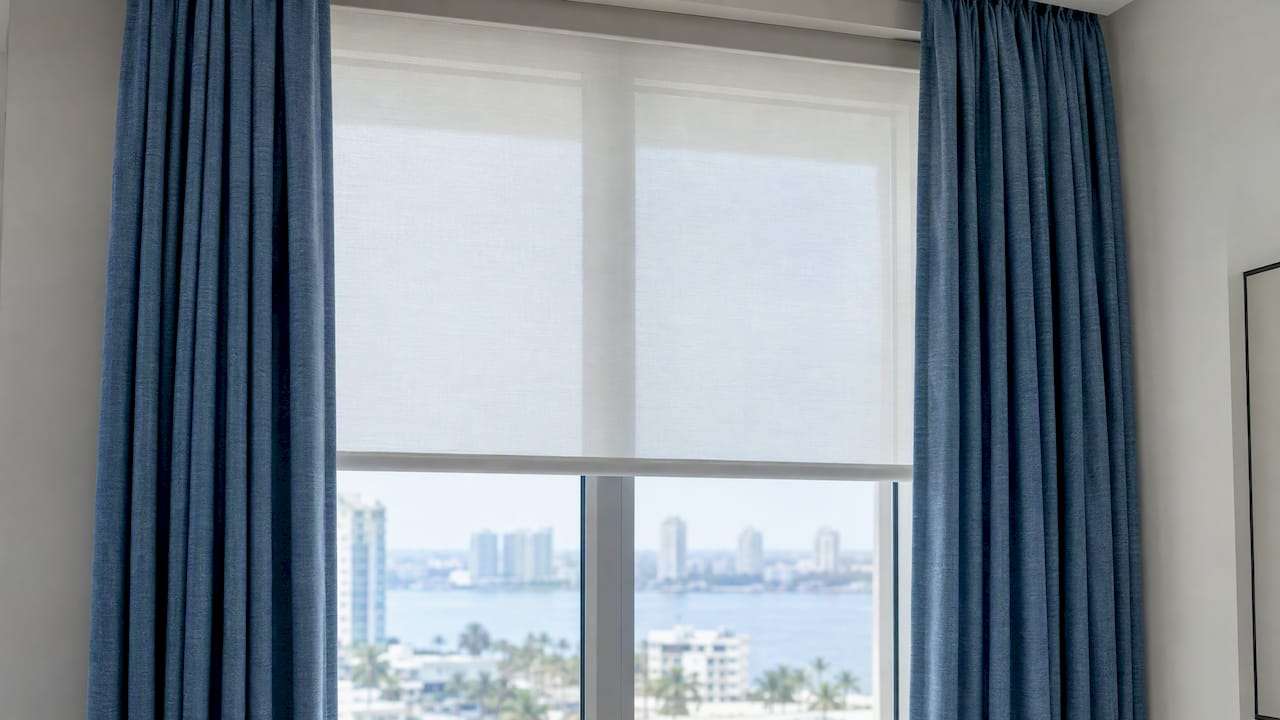
Blinds, shades and shutters. For buildings that specify a type, our blinds, shades and shutters page shows what we can fabricate.
Privacy. Condo windows face neighbors across courtyards and towers. Our guide to window treatments for privacy covers light-filtering options that keep a view without exposing the room.
If your unit is waterfront, see also our notes on custom treatments for Tampa’s waterfront properties, where sun, salt air and privacy all push in different directions.
Cord safety is a rule too
Independent of your association, federal law governs how custom window coverings are built. The Consumer Product Safety Commission’s final rule on operating cords treats accessible cords as a strangulation hazard, and the CPSC announcement deemed window covering cords a substantial product hazard. The standard took effect on May 30, 2023, so custom products sold now should have no accessible cords, or only very short ones.
For you, this means cordless lift systems or motorization are the straightforward choice, and a reputable fabricator will not sell you a long-cord product. Our cordless Roman shade guide and motorized blinds and shades page show the options. If you are considering motorization, it helps to plan power early. This overview of prewiring motorized shades explains how wire runs are planned, though in a condo you will need to confirm with the association whether wiring into walls or ceilings is allowed.
Our perspective: treat the rules as a design brief
We have fabricated window treatments for more than 30 years, and every product is made in our Tampa Bay workroom. That matters in a condo, because the right answer is often a made-to-measure detail: a white backing sewn to the right fullness, a bracket that fits a concrete ceiling, or a hem that clears a sliding door track.
Here is how we think about condo rules:
- The rule is a constraint, not a verdict on your taste. Almost every uniformity rule can be met with a smart layering plan.
- Ask before you spend. The cheapest treatment is the one approved the first time.
- Fit decides performance. Poor measurements, not fabric, cause most failures in tall or wide glass.
- Removal is part of the job. Old, non-compliant blinds have to come down, and we remove old treatments as a courtesy when we install.
Our list of common mistakes covers other errors we see in Tampa homes, from mounting heights to ignoring sun exposure.
— The Drapery Company
Working with us on a condo project
We offer in-home consultations, professional measurement and installation, and custom design for Tampa Bay homes and commercial spaces. Bring your association’s rules and we will build the plan around them. Learn more about our in-home consultations and installation, or call (813) 949-3100. Property managers and boards outfitting common areas can see our commercial window treatments.
FAQ
Can my condo association tell me what color my window treatments must be?
Often, yes, for what is visible from outside. Boards can adopt reasonable rules, and many require white or white-backed treatments for a uniform exterior. Check the current rules and regulations, not just the declaration.
Do I need board approval for blinds or curtains?
It depends on your documents. Interior decorating is usually the owner’s responsibility, but if the rules address exterior appearance, you may need approval or at least need to follow the specified color. Exterior hardware such as shutters or window replacement typically requires approval and may require a permit.
How much can a condo board fine me?
Under Florida Statute 718.303(3), as summarized by a condominium law adviser, up to $100 per day, capped at $1,000 per violation. The association must give 14 days’ written notice and a chance to be heard first. Verify the current statute, since the summary dates from 2013.
Are corded blinds still allowed?
New custom window coverings must meet the CPSC cord standard that took effect May 30, 2023, which means no accessible long cords. Cordless and motorized options meet that goal without difficulty.
Sources
- Florida Statutes, Section 718.113
- Florida Condominium Association Advisors on 718.303(3)
- Interior decorator and contractor rules, Pelican Bay condominium
- The Vineyard condominium rules and regulations
- Florida DBPR arbitration order, Villanova at Hunter’s Creek
- City of Tampa residential plan review
- SB 1178 summary, Daytona business lawyers
- CPSC final rule, Federal Register
- CPSC news release
- Prewiring motorized shades
Recommended
- Top Window Treatment Mistakes Tampa Homeowners Should Avoid
- Enhance Your Tampa Home with the Best Window Treatments: a Comprehensive Guide to Functionality, Style, and Energy Efficiency
- Essential Factors to Consider When Selecting a Residential Window Treatment Specialist in the Lutz / Tampa, Florida Area