Motorized Shades for Arched Windows: A Luxury Guide
July 1, 2026
Blackout Curtains vs Room Darkening
July 3, 2026
You're often at this stage after the fabric has been chosen, the paint is finished, and the room finally feels close. Then the last detail decides whether the window treatment looks well-fitted or slightly off. That detail is the track.
A flawless drapery line doesn't begin with pleats or hems. It begins with support, placement, clearance, and hardware that suits the architecture. In Tampa Bay homes, that also means respecting humidity, salt air, concrete, drywall, condo rules, and the weight of lined panels, blackout drapery, or outdoor drapery that has to perform as beautifully as it looks.
The Unseen Foundation Of Elegant Window Treatments
In a well-designed room, the curtain track disappears. What remains is proportion, movement, and the quiet impression that everything fits exactly as it should. The drapery opens smoothly, stacks neatly, and frames the glass without fighting the wall, the ceiling line, or the furnishings.
That level of finish comes from the hidden structure behind the fabric. A poor curtain track installation can make premium textiles look ordinary. A precise installation gives even a restrained treatment a custom architectural presence. If you're comparing traversing drapery to decorative panels, it helps to understand what drapery is and why its support system matters as much as the fabric itself.
The hardware side of the industry has grown because clients now expect more from window treatments than simple coverage. The drapery hardware market is valued at USD 6.88 billion in 2026 and is expected to reach USD 10.15 billion by 2035, driven by urbanization and demand for smart motorized systems, according to this drapery hardware market outlook. That projection tells you something practical. More projects now involve motorization, cleaner ceiling lines, heavier blackout fabrics, and hardware that has to operate with polish, not just function.
Why The Track Deserves Design Attention
A track choice affects more than installation.
- Sightline control: The right placement can visually heighten a room and reduce the appearance of a low header.
- Fabric behavior: Ripplefold, pinch pleat, blackout, sheer layering, and outdoor drapery each place different demands on glide and support.
- Long-term serviceability: A properly mounted track is easier to maintain, easier to repair, and less likely to require curtain repair, drapery repair, or adjustment after the room is complete.
A beautiful drapery treatment should never announce the hardware. It should announce the room.
In high-end residential interiors and polished commercial spaces, the track is the foundation that lets every other finish read correctly. If the line is off by even a small margin, the eye catches it immediately.
Selecting Your Ideal Curtain Track System
The right system depends on architecture first, fabric second, and convenience third. Most disappointing installations happen when those priorities get reversed. People choose hardware by appearance alone, then discover the stack is bulky, the drapery brushes a vent, or the outdoor drapery hardware corrodes faster than expected.
This visual comparison helps sort the main options quickly.

Ceiling-Mounted For Height And Restraint
Ceiling-mounted tracks are the cleanest choice when you want drapery to feel architectural. They work especially well in contemporary homes, condos with large expanses of glass, hospitality spaces, and rooms where you want the eye pulled upward.
They also solve practical issues. If the window frame is shallow, if decorative trim is minimal, or if you're trying to conceal an uneven header line, a ceiling mount often gives the calmest result. In spaces with blackout needs, this mounting style can also help reduce light gaps.
Wall-Mounted For Flexibility And Traditional Balance
Wall-mounted systems suit rooms with crown, soffits, or conditions that make ceiling attachment less desirable. They're often the best answer when the wall construction is stronger than the ceiling finish, or when the design calls for a more traditional relationship between the window and the drapery.
Wall mounting also allows more flexibility around decorative top treatments, including valances. If the client plans future curtain hemming or drapery hemming because furnishings may change, a wall-mounted system can be simpler to access and adjust.
Practical rule: Choose wall-mounted tracks when the wall can provide the better anchor and the room benefits from a little visual separation between the ceiling and the drapery line.
Recessed Tracks For The Minimalist Finish
A recessed or pocket track is the most refined look when executed properly. You see fabric emerging from the ceiling rather than hardware attached below it. In luxury construction and major remodels, that's often the preferred finish.
But recessed systems are less forgiving than they appear. They demand clean framing, careful planning around stack location, and strong fixing points where the load concentrates. If the recess was framed as an afterthought, the result usually shows.
Motorized Systems For Daily Ease
Motorization is no longer reserved for oversized windows. It's valuable in bedrooms, media rooms, waterfront homes, hospitality suites, and any setting where convenience, privacy, or solar control matters. If you're weighing aesthetics against automation, modern systems can deliver both, especially with a dedicated electric curtain track designed for quiet travel and clean integration.
Motorized tracks are especially useful when the drapery is tall, heavy, or difficult to reach. They also reduce wear that comes from repeatedly pulling premium fabric by hand.
Material Matters In Florida And Outdoors
In Tampa Bay, material choice is never cosmetic. Humidity, salt exposure, and sun can punish low-grade hardware. Aluminum remains the preferred material for many premium curtain track installations because it offers durability without excessive visual bulk. That matters for indoor drapery and even more for outdoor drapery in covered lanais, cabanas, and poolside entertaining areas.
For outdoor drapery, choose hardware with corrosion resistance and keep expectations realistic about maintenance. Moisture, wind movement, and airborne residue all increase service demands. Fabric may eventually need curtain repair, and hems may need attention sooner outdoors than they would in a climate-controlled interior.
A polished result comes from matching the system to the setting:
- Large condo glass walls: Ceiling-mounted or motorized systems usually read best.
- Classic formal rooms: Wall-mounted tracks can support a more traditional drapery composition.
- Bay windows and curved architecture: Curved track systems preserve the line without awkward breaks.
- Covered outdoor living spaces: Aluminum-based hardware is usually the safer long-term choice.
Precision Measurement For A Flawless Custom Fit
A beautiful track can still produce a disappointing result if the measurements are off by an inch. In high-end work, that inch shows up immediately. Panels cover glass when they should clear it, hems hover awkwardly, and the room loses the long, refined line clients expect.

Start with the opening, then measure the room around it. A proper order depends on finished height, return, stack back, hardware projection, and the way the drapery will live in the space. For a solid baseline, use this window curtain measurement guide. Then adjust for the specific track, fabric weight, heading style, and mounting surface.
Width Must Include Stack Back
Clients usually focus on the glass. Installers focus on where the fabric goes when it is open.
Track width should account for stack back on both sides so the drapery clears as much glass as possible and does not crowd the frame. The exact allowance depends on panel fullness, fabric bulk, whether the system is hand-drawn or motorized, and how much wall is available beyond the opening. Sheers stack tighter than interlined drapery. Ripplefold behaves differently from pinch pleat. On wide condo openings, those differences matter.
This is also where nearby conditions can ruin an otherwise correct measurement. Check for thermostats, switches, return vents, lanai door handles, and art locations before finalizing the width. Clients investing in a finished room often coordinate drapery with furniture layout and professional wall art placement, so stack back cannot be planned in isolation.
Height Controls The Room's Proportions
Track height changes how the entire wall reads. Mount too low and the window feels smaller. Mount too high without enough panel length or architectural justification and the treatment can look disconnected.
For many wall-mounted installations, the track sits above the window frame rather than hugging it. In taller spaces, I often measure from the ceiling line or crown relationship first, then work back to the window. That approach produces a cleaner visual line, especially in formal rooms and large waterfront condos where compressed proportions stand out.
Floor finish matters too. Stone, wood, and carpet all read differently at the hem. A slight float gives a crisp, precise finish. A soft break works in more traditional interiors. A puddle is intentional decoration and should be specified that way from the start, not created by a loose measurement.
Ceiling Mounts Require A More Exact Survey
Ceiling-mounted tracks leave less room for correction once drilling starts. Measure the full run, confirm bracket positions against joists or approved anchors, and check the slab or ceiling plane in more than one spot. In condos, concrete ceilings and post-tension conditions may limit where fasteners can go. In remodels, drywall often hides uneven framing that can telegraph through a long recessed or surface-mounted track.
Use a laser, but do not trust a single reference line. Cross-check left, center, and right heights, then confirm the floor drop in each position. Older homes around Tampa Bay routinely vary enough to affect hem length and track alignment.
Measure For Performance, Not Just Appearance
Precise measuring also protects the fabric after installation. Panels cut too long collect dirt and wear at the leading edge. Panels cut too short look corrected, even after expert hemming. In humid Florida interiors and covered outdoor areas, that margin matters because fabric can relax differently over time depending on lining, exposure, and use.
The best measurements account for how the system will operate six months from now, not just how it looks on install day.
The Art Of Secure Mounting And Professional Installation
A well-made track should disappear into the experience of the room. Panels open with little effort, stack where they were designed to stack, and sit perfectly level against the architecture. That result comes from disciplined installation, not from the track alone.
In high-end work, mounting is a structural exercise first and a finishing exercise second. Humidity, substrate condition, fabric weight, and daily use all change the hardware choice. A light ripplefold in a guest room asks less of the wall than a motorized blackout system spanning a condo glass wall in Clearwater or a recessed track carrying interlined drapery in a Tampa dining room.
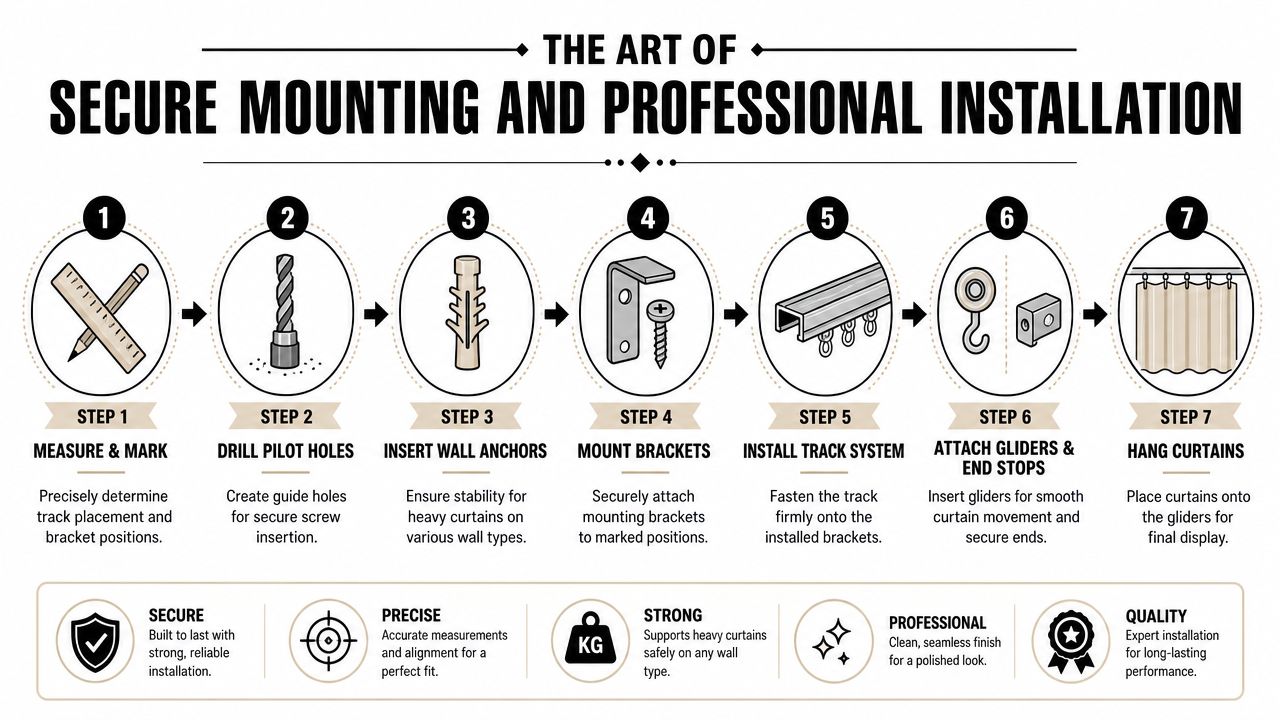
The tool list matters, but judgment matters more. Use a laser, stud finder, proper bits, anchors rated for the substrate, and driver bits that fit the screw head cleanly. Then stop before overdriving fasteners. Brackets distorted by too much torque can create drag, noise, and premature carrier wear.
If you've ever compared drapery tracks with decorative rods, it helps to see the difference in mounting logic. This guide on how to hang a curtain rod is useful because rods and tracks share the same core requirement: the support has to suit the load and the wall.
Wall-Mounted Installation That Lasts
Wall-mounted tracks fail for predictable reasons. The installer fastens only to drywall, spaces brackets too far apart, ignores the weight of lined fabric, or leaves the end of the track under-supported. The room may look finished on day one, then the profile starts to dip, the screws loosen, and the drapery no longer travels cleanly.
Bracket spacing should follow the track manufacturer's guidance and the actual load being carried. Heavier treatments, wider spans, and frequent operation call for tighter support intervals and better anchoring. Track length should also account for stack back so open panels do not crowd the glass or cover controls and trim.
A clean wall installation usually follows this order:
- Lay out the full run first: Mark the entire line before a single hole is drilled.
- Confirm structure: Hit wood backing where possible, or use anchors matched to drywall, masonry, or plaster conditions.
- Drill controlled pilot holes: This keeps finishes cleaner and reduces cracking on brittle surfaces.
- Set brackets and recheck level: First, last, and center points should agree before the track goes up.
- Test the carriers under hand pressure: Any bind in an empty track needs correction before fabric is added.
End Support And Visual Balance
End support deserves more attention than it usually gets. Brackets placed too far in from the ends can leave the profile vulnerable to deflection. Brackets placed awkwardly near the returns can interfere with carriers or crowd the drapery stack. The cleanest installations support the ends properly while preserving the intended line of the treatment. A professional bracket placement video shows the principle clearly.
Visual alignment matters just as much in refined interiors. A track can be technically level and still feel wrong if it ignores crown, casing, millwork reveals, or the adjacent art program. Installers who work carefully around furnishings often borrow principles similar to professional wall art placement, where sightlines, spacing, and relation to adjacent elements determine whether the room feels composed or unsettled.
A level line creates visual order.
Before committing screws, check the open stack position against switches, thermostats, speakers, and access panels. That review avoids expensive corrections later, especially in condos and commercial spaces where wall devices are fixed and drilling options may be limited.
A video demonstration can help if you want to see the mounting sequence in motion.
Ceiling Work And Difficult Surfaces
Ceiling-mounted tracks demand stricter discipline because correction is harder once the holes are in place. In Florida projects, that often means working into concrete slabs, concealed framing, metal channels, or limited backing inside a soffit. Each condition changes the bit, anchor, drilling method, and allowable fastener location.
Moisture also affects long-term performance. In humid interiors and covered outdoor areas, corrosion resistance matters. Stainless or properly coated hardware holds up better than bargain fasteners, especially near the coast, where salt air can shorten the life of standard components.
Heavy drapery, motorized systems, and wide commercial spans raise the stakes further. Those installations need accurate alignment, secure load transfer, and hardware selected for repeated operation rather than occasional residential use. A track mounted correctly protects the fabric investment and preserves the quiet, controlled movement clients expect from a premium system.
Navigating Advanced Scenarios And Common Challenges
Most basic guides assume a straight wall, an uncomplicated substrate, and light fabric. Real projects rarely cooperate. Bay windows, recessed pockets, condo ceilings, and commercial spans all introduce failure points that aren't obvious until after the holes are drilled.

Recessed Tracks Need Reinforcement At The Stack
Many DIY installations often go wrong at this stage. Standard bracket spacing logic doesn't fully account for the point where the curtain gathers and places concentrated force on the track. Recessed systems demand an extra fixing point at the curtain stack, even though many guides stop at general spacing. That high-load zone is where the track is most likely to deflect or crack the ceiling without it, according to this recessed curtain track installation demonstration.
If you're planning a flush track inside a pocket, treat the stack location as a structural decision, not a finishing detail.
- At the stack side: Reinforce aggressively because that's where repeated load concentrates.
- At long spans: Don't assume a clean ceiling recess means sufficient support exists above it.
- At motorized pockets: Leave proper access for servicing, not just installation.
Ceiling Grid Is Not Structural Support
This matters in condos, offices, medical space, hospitality renovations, and any project with suspended ceilings. Tracks should not be treated as if acoustic tile or grid alone is a reliable mounting base for a long span. The correct approach is support above the grid, tied back to structure or appropriate bracing.
That distinction is often missed in consumer content, and it's one of the reasons commercial installations drift out of alignment over time. If a space has a ceiling system rather than a true structural surface, verify the support path before specifying the track.
The finished ceiling may hide the structure, but it doesn't replace it.
Curves, Corners, And Long Runs
Curved windows need a track that bends cleanly without creating friction points. The bend radius, carrier type, and return geometry all matter. In bay windows, a poorly formed curve causes the drapery to stall at the transition, which clients notice immediately.
For unusually long spans, the challenge isn't only weight. It's cumulative alignment. A slight error at the first bracket becomes visible at the far end. In commercial settings, add traffic, frequent operation, and occasional rough handling, and those small errors turn into service calls.
Service Issues Often Begin At Installation
Later problems often look like fabric issues when the cause is hardware.
- Dragging edges: Sometimes indicate the track isn't level.
- Uneven hems: May be blamed on drapery hemming when the suspension line is the underlying issue.
- Snagging carriers: Often come from a distorted join, a rough cut, or a stressed curve.
- Premature wear: Can appear as curtain repair or drapery repair, even though the root cause is improper support.
That's why advanced curtain track installation is less about adding more hardware and more about placing support exactly where the load lives.
When To Entrust Your Vision To A Professional
Some projects are straightforward. Many are not. If the treatment is heavy, motorized, recessed, unusually wide, mounted over difficult substrates, or subject to condo and commercial requirements, professional installation is the wise path.
The standard is simple. The drapery should operate smoothly, stack correctly, sit level, and remain secure over time. If achieving that result depends on hidden backing, long-span alignment, special anchors, curved forming, access coordination, or code-conscious planning, the job has moved beyond casual DIY.
This is especially true with multi-story glass, hospitality projects, covered outdoor rooms, and residences where custom drapery is only one part of a larger finish schedule. In those environments, trades need to coordinate. The same principle applies in other detail-driven services, whether you're reviewing residential Christmas light setup for a complex exterior or arranging specialty interior finishes. The visual result depends on disciplined installation, not just good materials.
If you're in Tampa, Lutz, Clearwater, or St. Petersburg and want a finish that looks deliberate from every angle, a professional drapery installer saves time, protects the treatment, and avoids expensive corrections later. For local help, start with a drapery installation service near you and evaluate experience with residential, condo, and commercial work alike.
For homeowners, designers, and commercial clients who want custom window treatments installed with precision, The Drapery Company serves the Tampa Bay area with expert measuring, fabrication, and installation for draperies, motorized systems, outdoor drapery, and complex track applications. If your project calls for a polished result without compromise, schedule a consultation and get the hardware, fit, and finish right from the start.