

Motorized Shades Cost: What Homeowners Should Budget
August 17, 2026
The Best Energy Efficient Window Treatments by Climate
August 19, 2026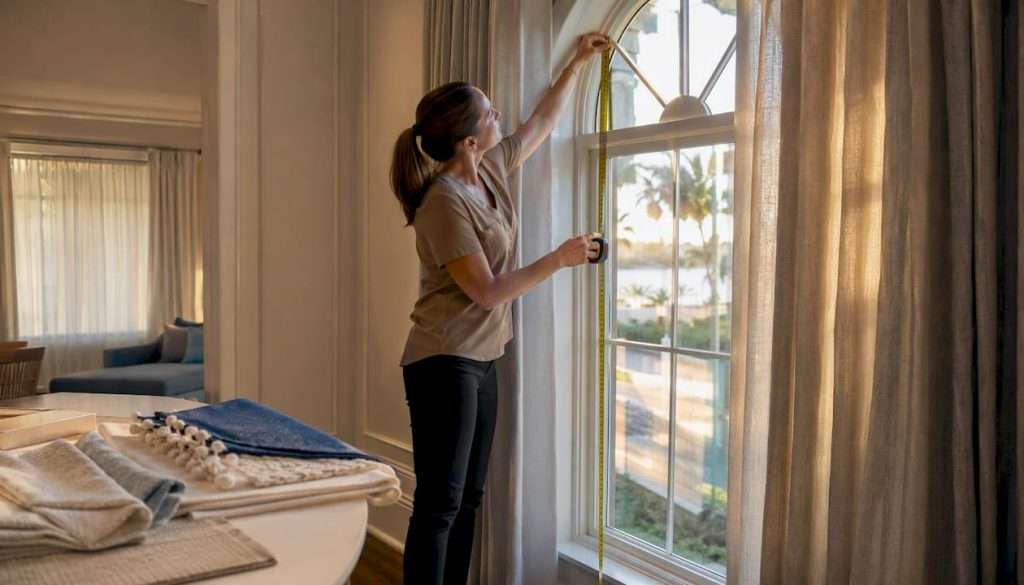
Custom drapery typically runs $200 to $2,500 per window, with most Tampa Bay homeowners landing between $400 and $900 per window for mid-weight fabric, standard lining, pinch pleats, and professional installation. A full room with three to four windows usually falls in the $1,800 to $3,000 range once you factor in fabrication, hardware, and labor.
That price covers more than fabric. A real custom drapery quote bundles the yardage itself, lining or interlining, the sewing and finishing work, your chosen header style (pinch pleat, ripple fold, grommet), the rod or track system, and the labor to measure and hang everything. Skip any one of those and you’re pricing a different product than what you’ll actually receive.
Here’s what that spread looks like in practice:
- Low end ($200-$400/window): Stock-weight fabric, basic rod-pocket or grommet header, standard rod, no lining.
- Mid-range ($400-$900/window): Better fabric (cotton blends, linen), pinch pleat header, cotton lining, upgraded rod or simple track.
- High end ($900-$2,500/window): Custom-made curtains in premium or patterned fabric, interlining for body and light control, decorative hardware, motorization, or oversized/specialty windows.
The anchor number to remember: most full-service custom drapery projects average $300 to $4,000 per window depending on size and materials, according to cost-tracking data from HomeGuide — a wide range that makes line-item breakdowns essential rather than optional.
What’s usually not included unless you specifically ask: motorization, removal and disposal of your old treatments, and repairs to the wall or window frame underneath. If a quote doesn’t mention these, assume they’re extra.
Key Takeaways
Custom drapery cost typically involves five stacked components: fabric, lining, labor, hardware, and installation. Normalizing every quote to a per-window basis is the recommended way to compare vendors fairly.
| Point | Details |
|---|---|
| Typical price range | Expect $200 to $2,500 per window, with most mid-range projects landing between $400 and $900. |
| Biggest cost driver | Panel count, fullness ratio, and pattern repeat move the total more than any other single factor. |
| Motorization premium | Motorized tracks typically add $400 to $1,200 per window including installation. |
| Compare quotes correctly | Convert every bid to per-window and per-panel math before deciding which is the better value. |
| Draperycompany advantage | Onsite fabrication in the Tampa Bay Area means transparent line-item quotes with measurement, installation, and old-treatment removal included. |
Table of Contents
- How a Custom Drapery Total Is Built
- What Actually Drives the Price Up or Down
- Add-Ons and Upgrades That Change Your Quote
- Sample Quotes: How Three Real Budgets Break Down
- How Long Does a Custom Drapery Project Take?
- Is Custom Drapery Worth the Extra Cost?
- Practical Ways to Lower Your Custom Drapery Cost
- What to Prepare for an Accurate Quote
- A Real Tampa Bay Drapery Project, Priced and Delivered
- What I’d Prioritize When You’re Comparing Quotes
- Get an Accurate Custom Drapery Quote from Draperycompany
- Sources
- FAQ
How a Custom Drapery Total Is Built
A drapery quote is really five smaller numbers stacked together: fabric, lining, sewing labor, hardware, and installation. Understanding each piece is what lets you compare two wildly different-looking quotes and figure out which one is actually the better deal.

Fabric is priced by the yard, and yardage depends on your window’s width and how full you want the panels to look. Lining (or interlining, for extra body and insulation) adds a second fabric layer priced separately. Sewing and finish covers the workroom labor to cut, hem, and construct the panel to your header style. Hardware includes the rod, track, or motorized system plus brackets and finials. Installation covers the site visit, mounting, and final adjustments.
Here’s how those components typically price out per window:
These ranges come from componentized workroom pricing data and reflect what most fabrication shops charge before regional adjustments.
A worked example: 72" x 84" window
Let’s convert vendor line items into real math using a common window size. A drapery cost calculator uses this formula: Total Yards = (Number of Widths × Cut Length) ÷ 36.
Cut length usually adds 8 to 10 inches for hems and headers, so each cut runs about 92 inches. Two widths at 92 inches divided by 36 gives you roughly 5.1 yards total.
At $18 per yard for a mid-weight fabric, that’s about $92 in material. Add labor at a typical sewing rate of $35 per width (two widths = $70), a $60 lining charge, a $90 standard rod, and a $150 installation fee, and you land close to $460 for that single window, a figure consistent with the calculator’s own worked scenario landing around $890 for a similar window with premium fabric and interlining factored in.
- Fabric: 5.1 yards × $18 = ~$92
- Sewing labor: 2 widths × $35 = $70
- Lining: $60
- Hardware: $90
- Installation: $150
- Total: ~$462
Pro Tip: When you get a quote back, ask the vendor to break it into “per panel” and “per window” totals rather than one lump sum. A shop quoting $1,800 for a bay window with three panels sounds steep until you realize that’s $600 per panel, which might actually beat a competitor’s “cheaper” $500-per-panel quote on a smaller single window.
What Actually Drives the Price Up or Down
Panel count and fabric complexity move a quote more than almost anything else. A single insight from workroom pricing data makes this clear: a modest increase in fullness, say from 2x to 2.5x, can require a large jump in both yardage and sewing labor, because you’re not just buying more fabric, you’re paying to cut, hem, and finish an entire extra width.

Here’s the yardage formula again, because it explains almost every cost jump you’ll see on a quote: Total Yards = (Number of Widths × Cut Length) ÷ 36. Fullness determines how many fabric widths you need per panel.
The big levers, ranked
Fabric price per yard is the most obvious lever, and the spread is enormous. Stock cotton-blends run $10 to $25 per yard. Designer linens, silks, and heavily embroidered fabrics can run $60 to $150+ per yard. On a five-yard job, that’s the difference between a $75 fabric bill and a $500 one, before you’ve touched labor.
Panel count and fullness multiply everything downstream. Fabric width matters too, standard decorator fabric runs 54 inches wide, but many designer fabrics come in 48-inch or even 36-inch widths, meaning you need more widths (and more yardage) to achieve the same fullness.
Patterned repeats are the quiet cost driver most homeowners never anticipate. If your fabric has a large-scale pattern, say a 27-inch vertical repeat, the workroom has to cut each width so the pattern lines up across panels.
Window height changes cut length linearly, which is straightforward, but it compounds with fullness. A floor-to-ceiling window at 9 feet with 2.5x fullness needs dramatically more fabric than a standard 84-inch drop at the same fullness, and that’s before you consider whether the room calls for a dramatic floor-to-ceiling treatment versus a shorter apron-length panel.
Motorization and custom pleating add their own premiums. Motorized tracks typically run $400 to $1,200 per window including installation, and custom pleat styles like ripple fold or goblet pleat carry higher construction labor than a basic rod pocket.
Region matters more than most buyers expect. Regional pricing data shows coastal and metropolitan markets running noticeably higher than interior markets, largely because labor rates and fabric sourcing costs both climb in higher cost-of-living areas. In Florida’s coastal markets, that regional premium is worth building into your budget expectations from the start, especially for larger commercial projects.
Pro Tip: Before you fall in love with a heavily patterned fabric, ask your workroom for the “repeat waste” percentage. A fabric with a large repeat can silently add hundreds of dollars in yardage you never see coming until the final invoice.
If you’re weighing wide expanses of glass, like sliding glass doors or a bank of oversized windows, hardware choice becomes its own cost driver. A wide-window rod system needs additional support brackets and heavier-gauge hardware to prevent sagging, which adds to the hardware line without touching the fabric budget at all.
Add-Ons and Upgrades That Change Your Quote
Once you’ve settled the base build, a handful of common upgrades tend to show up as line items, and knowing their typical range helps you spot whether a quote is padding costs or pricing fairly.
- Blackout lining: Adds roughly $8 to $15 per yard on top of standard lining, mainly used in bedrooms for light control and privacy.
- Thermal interlining: A middle layer for insulation and light-blocking, typically $10 to $20 per yard, often combined with blackout lining for maximum performance.
- Motorization: $400 to $1,200 per window, covering the motor, remote or app control, and specialized installation.
- Premium hardware: Decorative finials, wood or metal rods, and heavy-duty tracks can add $50 to $350 per window over a basic rod.
- Header upgrades: Pinch pleat or ripple fold construction typically costs $30 to $80 more per panel than a basic rod-pocket or grommet header.
Motorization is the single biggest upgrade line item on most quotes, and it’s also where vendors commonly build in the largest markup. Expedited timelines carry their own surcharge too, rush orders often add 10% to 35% to the base price, so if you’re not in a hurry, saying so upfront can meaningfully lower your total.
Hardware upgrades deserve a closer look before you dismiss them as vanity spending. A proper curtain track system costs more upfront than a basic rod, but it distributes weight more evenly across heavy interlined panels and glides smoother over years of daily use, which matters if you’re opening and closing drapes multiple times a day.
Pro Tip: Thermal interlining is one of the few upgrades that pays for itself. Beyond blocking light, it adds a genuine insulating layer against Florida’s summer heat gain through west-facing windows, which can offset a meaningful chunk of the upfront cost through lower cooling bills over the drapery’s service life.
Sample Quotes: How Three Real Budgets Break Down
Seeing three actual quote structures side by side, economy, mid-range, and premium, makes the math click faster than any formula alone.
Economy quote (single window, 45" x 63"): Stock cotton-blend fabric at $12/yard × 3.5 yards = $42. Rod-pocket header, one width per panel, sewing labor at $30/width = $30. Basic tension rod: $25. Installation: $75. Total: $172.
Mid-range quote (single window, 60" x 84"): Linen-blend fabric at $22/yard × 5 yards = $110. Pinch pleat header, cotton lining: $55. Sewing labor, two widths at $40/width = $80. Decorative rod with finials: $110. Installation: $135. Total: $490.
Premium quote (bay window, three panels, 84" drop): Designer patterned silk-blend at $85/yard × 15 yards (including repeat waste) = $1,275. Interlining plus blackout lining: $340. Custom ripple fold header, six widths total at $45/width = $270. Motorized track system: $850. Installation with specialty mounting: $310. Total: $3,045.
Watch for red flags when a real quote lands on your table. A single bundled “materials and labor” line item with no breakdown is the biggest one, it hides whether you’re overpaying for fabric or labor specifically. Vague fullness assumptions (“standard fullness”) without a stated ratio is another, since 2x and 3x fullness can mean a 50% swing in yardage. And any quote missing your actual measurements should stop you cold; a vendor pricing sight unseen is guessing, not quoting.
Here’s typical line-item language you’ll see on a real workroom estimate:
That level of detail is what lets you check the math yourself: multiply widths by cut length, divide by 36, and confirm it matches the stated yardage.
Pro Tip: Always convert every quote to a per-window, per-panel basis before comparing. A “$2,400 for the room” quote and a “$600 per window average” quote for a four-window room are the same number, but only one format lets you compare against a different vendor’s three-window room.
How Long Does a Custom Drapery Project Take?
Most custom drapery projects often take several weeks from initial measurement to final installation, though rush service can compress that timeline for an added fee.
- In-home consultation and measurement (day 1): A professional measures each window precisely, since even a half-inch error can throw off a panel’s finished look.
- Fabric selection and order confirmation (days 1-7): You finalize fabric, lining, header style, and hardware.
- Workroom fabrication (2-4 weeks): Panels are cut, sewn, and finished, onsite fabrication tends to run faster than outsourced production since there’s no shipping delay between cutting and finishing.
- Installation scheduling and mounting (final week): A crew mounts hardware, hangs panels, and does a final adjustment pass.
Professional installation typically includes site measurement verification, removal of any existing hardware, mounting brackets or tracks, hanging and steaming panels, and a final walkthrough to check operation and hem alignment. If you already know how to hang a curtain rod yourself, you can compare that DIY baseline against what a professional installation fee actually covers.
Travel fees or specialty mounting (vaulted ceilings, motorized track wiring, oversized spans) can add to the installation charge beyond a standard flat rate.
Pro Tip: Book six to eight weeks ahead of any date-driven event, holidays, home staging, or a move-in deadline. Workrooms get backed up in fall and spring, and rush fees on top of an already tight timeline rarely feel worth it.
Is Custom Drapery Worth the Extra Cost?
Custom makes sense when your windows are oversized, unusually shaped, or when you need an exact color and fabric match that off-the-shelf panels simply can’t deliver. Ready-made panels solve a different problem: budget and speed for standard-sized, low-stakes windows.
Ask yourself these questions before you decide:
- Are your windows a non-standard size, arched, or unusually tall?
- Does the room need pattern matching across multiple panels or windows?
- Do you need specific thermal, blackout, or acoustic performance?
- Is exact color and fabric matching to existing decor a priority?
- Do you want the drapery to last 10+ years without losing shape?
The tradeoffs run in predictable directions. Ready-made panels cost far less per panel, often $60 to $140, and ship immediately, but sizing rarely matches your exact window, forcing alterations that eat into the savings. Custom panels run $200 to $900 per panel for mid-to-premium work, take weeks to fabricate, but fit precisely and hold their shape and fullness far longer.
Custom delivers clear value on oversized or architecturally unusual windows, where ready-made simply doesn’t exist in the right dimension, and on thermal performance goals where a properly interlined custom panel measurably reduces heat gain. If you’re weighing the full menu of options, a broader look at window treatment types can help frame drapery against blinds and shades before you commit to a direction.
Practical Ways to Lower Your Custom Drapery Cost
You don’t have to sacrifice quality to bring a quote down. A few smart choices upfront can shave a meaningful percentage off the total without leaving you with regret six months later.
- Choose mid-weight fabrics over heavily embellished or large-pattern designer fabrics, you avoid the repeat-waste penalty entirely.
- Reduce fullness slightly, from 3x to 2.5x, on rooms where the fuller look isn’t essential to the design.
- Reuse existing hardware if it’s in good condition and matches your new header style.
- Consolidate multiple windows into one order, most workrooms lower the per-window labor rate on larger jobs.
- Choose a standard hem length and header style rather than a fully custom finish where it won’t be visually obvious.
Checklist before requesting quotes: know your fullness preference, decide if lining is essential, confirm which windows can share a hardware style, and set a firm budget ceiling before your consultation.
Pro Tip: Ask every vendor for a side-by-side per-window breakdown, not just a bottom-line total. This is the single fastest way to spot which specific component, fabric, labor, or hardware, is driving one quote higher than another, and it gives you real negotiating leverage.
What to Prepare for an Accurate Quote
Vendors can only quote accurately with real numbers in hand, so walk into any consultation with this information ready.
Printable checklist:
- Window width and finished drop (or let the pro measure with an accurate tape measure onsite)
- Desired fullness ratio (2x standard, 2.5x to 3x for a fuller look)
- Fabric choice and fabric width, if already selected
- Pattern repeat size, if applicable
- Lining preference (none, standard, blackout, thermal)
- Preferred header style (pinch pleat, ripple fold, grommet, rod pocket)
- Hardware preference (rod, track, motorized)
- Total number of windows in the project
Questions to ask every vendor:
- How many fabric widths per panel does this quote assume?
- What fullness ratio are you using in this estimate?
- Does this price include measurement and removal of my old treatments?
- What are your lead times, and is there a rush fee?
- What warranty do you offer on workmanship and hardware?
Pro Tip: Insist every vendor break their number into per-panel and per-window math, and ask them to list exclusions explicitly (motorization, old treatment removal, travel fees). A vendor who resists this request is often the one with something to hide in the total.
A Real Tampa Bay Drapery Project, Priced and Delivered
A recent Tampa Bay living room project came in with three windows, each roughly 60 inches wide with an 84-inch drop, and the homeowner wanted a cohesive look across all three plus better light control for afternoon sun.

The final selection: a linen-blend fabric at $26 per yard, cotton sateen lining, pinch pleat headers, and decorative metal rods with matching finials. Total yardage across all three windows came to just under 16 yards. Sewing labor was calculated per width across six total widths. The finished invoice, including onsite fabrication, hardware, and installation, landed at $2,940 for the full room, working out to roughly $980 per window, consistent with mid-to-premium range for linen fabric and upgraded hardware.
Service included a full in-home measurement visit, onsite fabrication rather than outsourced sewing, professional installation of the new rods and panels, and removal of the homeowner’s old blinds at no additional charge.
What I’d Prioritize When You’re Comparing Quotes
Fit and fabric durability matter more than any single line item on a quote, and most homeowners underweight both in favor of chasing the lowest bottom-line number. A panel that hangs correctly and holds its shape for a decade beats a cheaper one that sags or fades within two years.
Before you sign anything, make sure every bid you’re comparing assumes the same fullness ratio and fabric width. Two quotes that look $400 apart can actually reflect two completely different products once you normalize the fullness assumption. Ask directly about workmanship warranties too, a shop confident in its construction will usually stand behind it in writing.
Balance the upfront number against expected lifespan.
Get an Accurate Custom Drapery Quote from Draperycompany
Draperycompany fabricates every panel onsite in the Tampa Bay Area, which means the line-item math you’ve just read, fabric, lining, labor, hardware, installation, comes from the same workroom doing the sewing, not a third-party outsourced shop marking up your invoice along the way.

A consultation includes in-home measurement using the same precision approach covered above, a walkthrough of fabric and header options suited to your windows, and a detailed line-item breakdown before you commit to anything. Services extend from standard panels to motorized track systems, oversized and specialty windows like big picture windows, and courtesy removal of your old treatments so you’re not stuck disposing of them yourself. Homeowners across the greater Tampa Bay Area can book a measurement visit and walk away with a real per-window quote, not a rough estimate, so you can compare it directly against anything else you’ve collected. Request your consultation through Draperycompany to get started.
Sources
For readers who want to run their own numbers or verify a vendor’s math, a few resources stand out. The Custom Drapery Cost Calculator is the best tool for working through yardage and labor formulas yourself. HomeGuide’s curtain cost data offers a solid benchmark for per-window pricing across materials, while HomeAdvisor’s window treatment cost data is useful for comparing drapery against blinds and shades at the category level. For granular per-panel and regional labor breakdowns, the drapery workroom price list is the most detailed reference available.
- Custom Drapery Price List: Cost, Prices, and Budgeting 2026 – Current Cost
- How Much Do Curtains Cost? (2026)
- How Much Do Window Treatments Cost? 2025 Data – HomeAdvisor
- Custom Drapery Cost Calculator
- Drapery Workroom Price List: Typical Costs for Custom Curtains 2026 – Current Cost
FAQ
What is the average cost of custom drapery?
Most custom drapery projects average $400 to $900 per window, with a full room typically running $1,800 to $3,000 depending on fabric, lining, and hardware choices.
Is custom drapery worth it?
Custom drapery is worth the premium for oversized, unusually shaped, or architecturally unique windows where ready-made simply doesn’t fit, and for homeowners prioritizing precise color matching or long-term durability over upfront savings.
How much does draping cost?
Draping (fabrication and installation of drapery panels) typically costs $200 to $2,500 per window depending on fabric grade, header style, and whether motorization or specialty hardware is included.
How much do custom-made curtains cost?
Custom-made curtains run $300 to $4,000 per window depending on window size and materials, usually including fabric, hardware, and professional installation in that total.


