HOA Window Covering Rules in Tampa: What You Can Hang
October 22, 2026
Inside Mount Depth: How Deep Your Window Needs to Be
October 26, 2026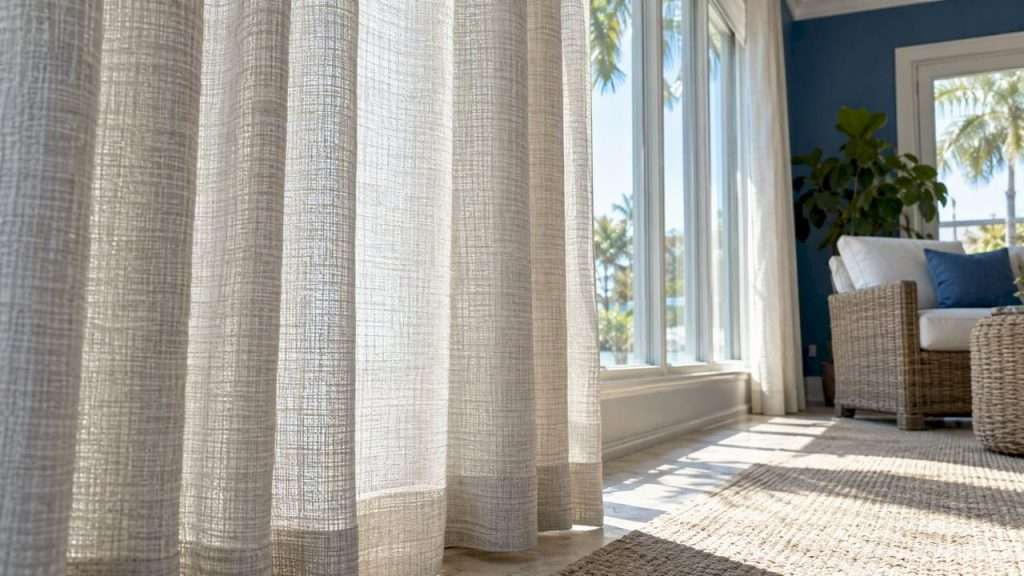
The most fade resistant drapery fabrics are solution-dyed synthetics and contract-grade performance fabrics that carry a documented lightfastness rating. Natural fibers like linen and silk, and fabrics dyed with natural colorants, fade fastest. In Tampa Bay, where a west-facing window can take direct sun for hours every afternoon, the fabric you choose matters less than whether you can verify how it was tested, how it is lined, and where it hangs.
This guide explains how fade resistance is measured, which fibers hold up, why blackout lining is not the same as fade protection, and how to match a fabric to each window in your house.
TL;DR
- Ask for a lightfastness rating. The Association for Contract Textiles (ACT) guidance for drapery calls for a minimum of Grade 4 at 60 hours in AATCC 16.2 or 16.3 testing.
- Solution-dyed synthetics and engineered performance blends generally outlast linen, silk and naturally dyed fabrics in direct sun.
- A lined panel is not automatically a protected panel. Pair a lightfast face fabric with a lining that reflects heat.
- Exposure decides service life. A south or west window in Tampa will age a fabric much faster than a north window in the same house.
- We fabricate every drapery panel in our Tampa Bay workroom, so we can control fabric selection, lining and fullness from the first sample.
What “fade resistant” actually means
No fabric is fade proof. “Fade resistant” describes how slowly a dye changes color under light, and the claim is only as good as the test behind it.
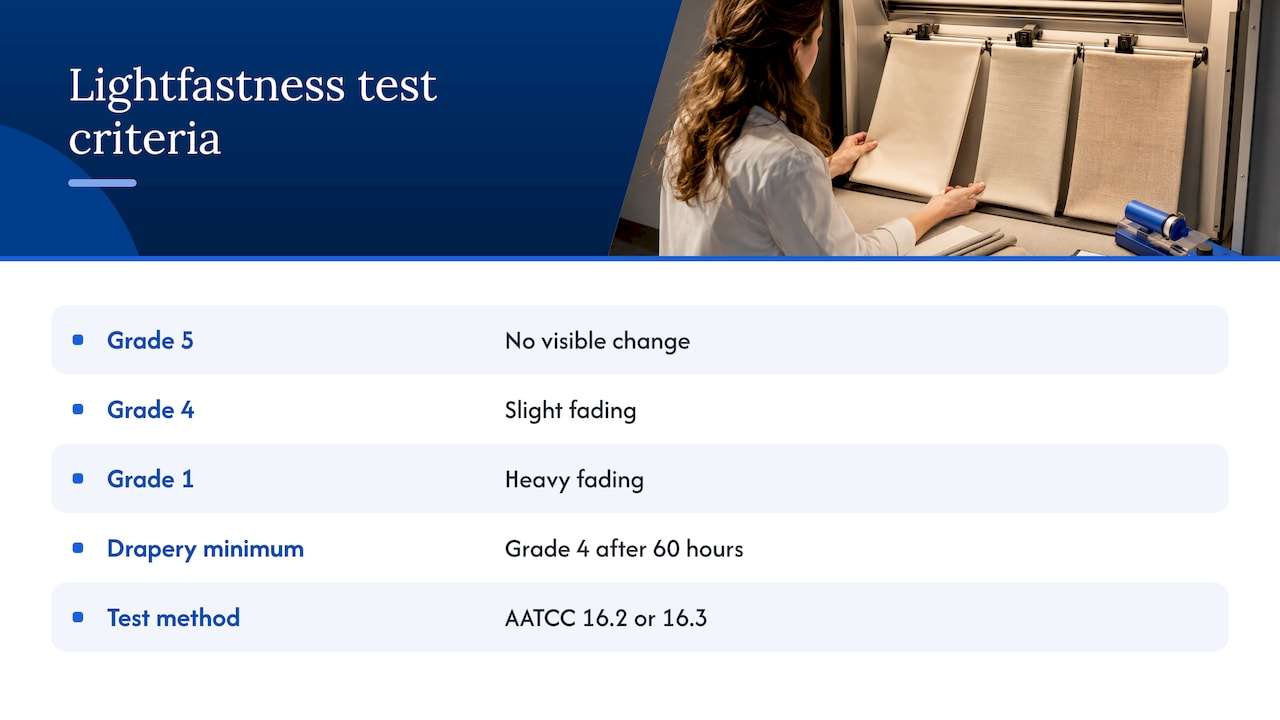
The standard measure is colorfastness to light. A sample is exposed to a controlled light source for a set number of hours, then compared against an unexposed piece using the AATCC Gray Scale. ACT’s colorfastness guidance for woven fabrics uses a five-point scale where Grade 5 means no visible change and Grade 1 means heavy fading. For drapery, the guideline asks for at least Grade 4, which reads as slight fading, after 60 hours under AATCC 16.2 or 16.3.
Two things follow from that.
First, a bare phrase like “fade resistant” on a swatch card tells you very little. A rating with a test method and an hour count tells you a great deal. When we pull samples for a client, we look for that documentation before we look at color.
Second, those hours are not years. Accelerated testing exists to keep manufacturing consistent and to make fabrics comparable. It does not translate into “this drape will last eight years in your living room.” Service life depends on orientation, latitude, glass type and the microclimate around your home. A south-facing window in Tampa will age a fabric far faster than a north-facing one a few feet away in the same house.
Why Tampa Bay is hard on drapery
Fading is a photochemical process. Research from the University of Nebraska–Lincoln on textile photodegradation points to UVA radiation as a primary driver of photochemical change, and the same body of work notes that visible light also contributes. Many homeowners focus only on UV protection, but a fabric that is sitting in intense, bright light for months is also taking damage from the visible part of the spectrum. A university review of ultraviolet absorbers for textiles lists lowering light levels among the standard ways museums and fiber artists slow fading, which is a useful reminder that exposure itself is the variable you can manage.
In Tampa Bay that exposure is high for much of the year. Add heat and humidity, and drapery here deals with more than color loss. Fibers can weaken, linings can yellow, and cheaper trims can fail before the face fabric does. We cover the full set of local conditions in our guide to Florida drapery fabrics for sun, salt and humidity.
Fibers and dyes: what holds color and what does not
The fiber and the dye method together decide how a fabric behaves. Here is how we think about the main options for Florida windows.
| Fabric type | Fade performance in direct sun | Typical trade-off |
|---|---|---|
| Solution-dyed acrylic | Very good, because color is added before the fiber is formed and runs through it | Can feel more technical; fewer luxurious drapes |
| Solution-dyed polyester and engineered performance blends | Very good when rated to contract standards | Quality varies widely, so documentation matters |
| Standard polyester | Good to moderate, depends on dye and finish | Check the test rating |
| Cotton and cotton blends | Moderate, fades noticeably on south and west exposures | Beautiful hand, needs lining |
| Linen | Weaker in prolonged sun | The look many clients want; best on protected windows |
| Silk | Weakest, can lose color and strength | Reserve for rooms with little direct light |
The general principle behind the top of the table is simple: when color is part of the fiber itself, rather than a surface treatment applied afterward, it has less to lose. We recommend asking the mill or supplier whether a given fabric is solution dyed, and for the lightfastness test result in writing.
On the bottom of the table, the Nebraska research is a good illustration of how much dye choice matters. In testing of natural dyes against a standard Blue Wool benchmark, turmeric proved far more fade prone than madder or weld. You will not usually see turmeric in a drapery sample book, but the lesson carries: naturally dyed and natural-fiber fabrics are often lovely and often vulnerable. We see clients surprised by this after choosing a linen for a bright sunroom. It can still be the right choice for a shaded room, but it should be a deliberate one.
Color matters too
Deep, saturated colors show fading more visibly than neutrals, and some pigments are simply less stable than others. A rich red or navy in a western window will show a change in tone long before a sand or greige will. If you love a strong color, put it where the light is gentler, or use it on a lined panel with a well-rated face fabric and accept that the sun-facing edge may soften over time.
Lining is part of the fade strategy
This is the point we correct most often. Many homeowners assume blackout equals maximum protection. Blackout lining blocks light from passing through the panel to the room, but it does not make the face fabric lightfast. The sun still hits the front of the drape first.
A better approach for Florida is layered:
- A lightfast face fabric, selected on its test rating.
- A lining that reflects heat rather than only absorbing it, so it works as a shield for both the face fabric and the room temperature.
- Correct fullness, so the fabric folds evenly and no single stretched area takes all the exposure.
The U.S. Department of Energy’s Building America program describes window attachments as energy-management tools, not only decor, and the effect is real. According to that guidance, well-fitted attachments such as high-efficiency cellular shades can cut annual cooling energy use by roughly 15 to 25 percent when used correctly on south- and west-facing windows. Fit is the operative word. A drape that leaves wide gaps at the sides or top delivers much less benefit, and our onsite fabrication lets us size panels to the actual opening rather than to a stock width.
If cooling costs are part of your reason for changing treatments, our guides on window shades for heat reduction and how to block heat from windows go deeper. For a broader view of how glass itself fits in, a contractor’s overview of energy-efficient window benefits shows why treatments and glass work best as a pair: better glass reduces how much heat arrives, and well-chosen drapery manages what still gets through.
Matching fabric to exposure, room by room
The same house needs more than one answer. Here is how we typically sort a Tampa Bay home.
West and south windows
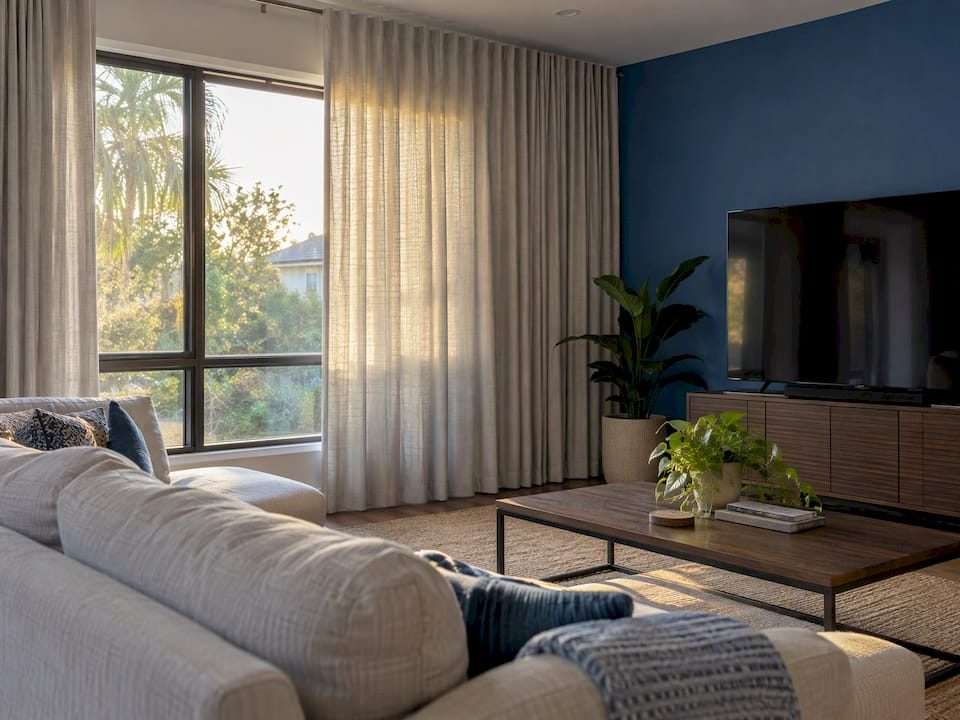
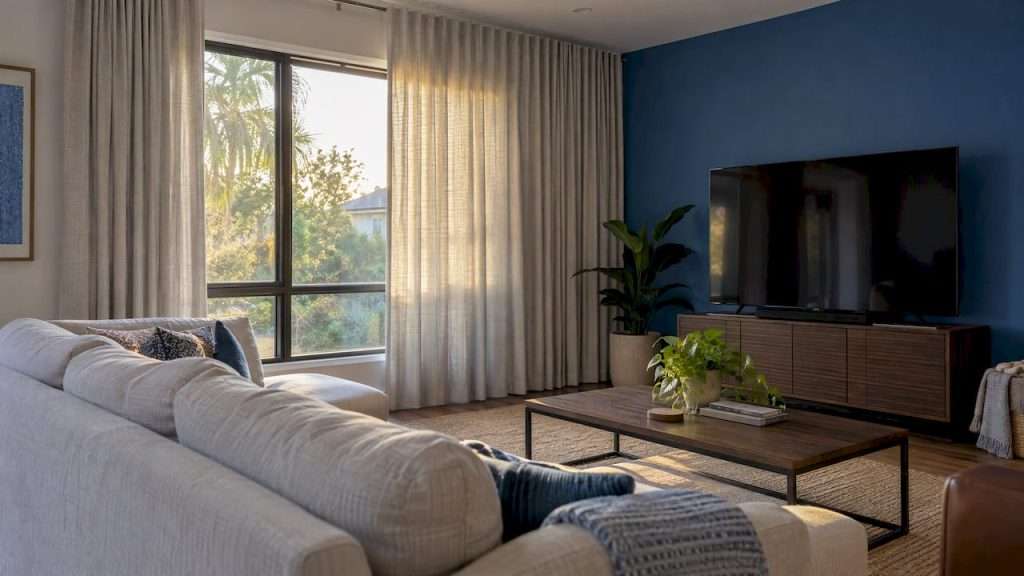
These are the hardest-working windows. Specify a fabric with documented lightfastness at or above the ACT drapery guideline, line it with a heat-reflective lining, and consider pairing drapery with a shade underneath. Solar or cellular shades take the harshest hours of sun so the drapery can carry the design. See our page on solar shades for sliding glass doors for large glass openings, where fading and heat both concentrate.
East windows
Morning sun is lower in intensity and shorter in duration, but it still adds up over years. Rated performance fabrics are a good idea. Natural fibers can work with proper lining.
North windows and shaded rooms
This is where linen, silk blends and delicate colors earn their place. Light exposure is gentle, so you can choose for hand and drape rather than lightfastness alone.
Bedrooms and media rooms
Here the goal is usually darkness, not sun protection. Use blackout or room-darkening lining, but still choose a face fabric you will not regret in five years, especially if the windows face west. Our guide to window treatments for privacy covers how layering works in rooms where you need both light control and discretion.
Lanais, porches and outdoor rooms
Indoor-rated fabrics do not belong outdoors. Outdoor drapery and shades need fabrics built for weather, mildew and sun, and we fabricate those too. See our outdoor drapery and custom shades page.
How to read a fabric sample like a specialist
When you hold a swatch, you are looking at its best day. Here is the checklist we use to see past that.
- Ask for the lightfastness rating. It should name the test (AATCC 16.2 or 16.3) and the hours reached at Grade 4 or better.
- Ask how the fabric is dyed. Solution dyed, piece dyed or yarn dyed gives you a different expectation for sun.
- Check the fiber content. Note the percentages. A blend of natural and synthetic fibers will behave as the weaker fiber does over time.
- Look for contract-grade documentation. ACT notes that recognized certification marks let designers and homeowners verify performance before specifying, rather than relying on initial shelf appeal.
- Hold it in the actual window. Tape the swatch to the glass for a day and see how it looks at 4 p.m.
- Ask what the lining is. Face fabric and lining should be specified together.
A useful rule: if a supplier cannot tell you how the fabric was tested, treat any fade claim as marketing.
Perspective: what 30 years in a Tampa Bay workroom has taught us
We think of custom drapery as architecture with fabric instead of drywall. It defines the room, and like any structure it should be built for the load it carries. In Tampa Bay, one of those loads is sun.
Here is what we tell clients who ask us to choose the most fade resistant option.
Test results beat adjectives. We would rather show you a rated fabric that is a little less dramatic than sell you a gorgeous one with no documentation on a western exposure.
Do not chase one perfect fabric for the whole house. The same sofa-facing window, the same color, in a shaded guest room and a sunroom, deserves two different specifications. Treating every window alike is the surest way to be disappointed.
Fabricate for fit. Because every product is made in our workroom, we can adjust width, fullness, lining and hems to your actual windows. Gaps and thin fullness are where fading and heat gain both get worse.
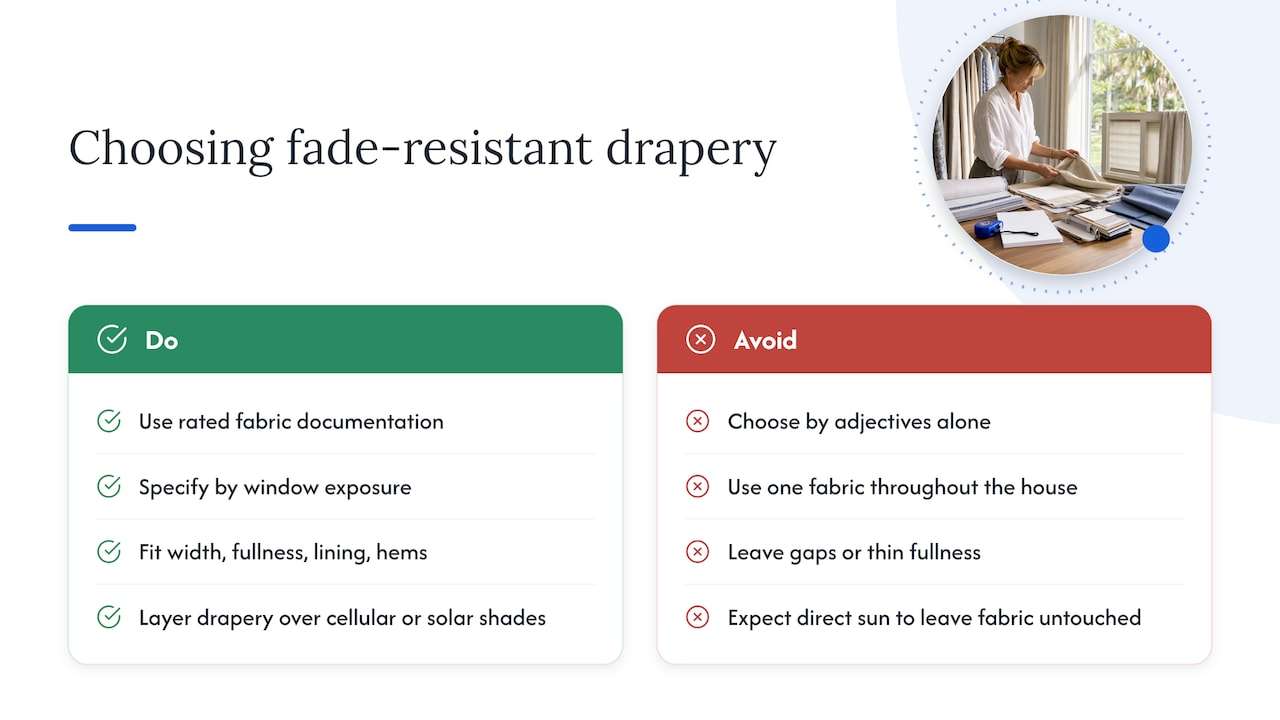
Layer when the window demands it. Sometimes the best answer is a rated drapery over a cellular or solar shade, so the shade takes the sun and the drapery stays beautiful. It costs more than one layer, and we will say so, but it often protects the larger investment.
We are also honest about limits. Nothing hung in direct Florida sun stays untouched forever. What you can do is choose well, line well, and place well, so that change is slow and even rather than sudden and blotchy.
— The Drapery Company
Care and habits that slow fading
Fabric selection does most of the work, but daily habits help.
- Rotate your sun exposure. Open and close treatments on a rhythm so one fold is not always the one facing the glass.
- Close treatments at peak hours. Drawing drapery or lowering a shade in the hottest part of the afternoon reduces both heat and exposure. Motorized options make that automatic, so it happens when you are at work. See our motorized blinds and shades.
- Vacuum gently and follow the care label. Dust and body oils can attach to fibers and speed deterioration.
- Keep fabric a little off the glass. Heat builds against a window pane, so a short stack back and proper rod projection help.
- Plan for refresh points. Linings and trims age before face fabrics do. We handle drapery repair, curtain repair and hemming if a panel needs attention rather than replacement.
Fade resistance and energy savings work together
Fabrics that hold their color are usually working in a home where sun has been managed well, and that overlaps with energy performance. The Department of Energy’s guidance suggests high-performance window coverings can trim household energy bills by an estimated 7 to 15 percent, depending on location and existing windows. Your own results will vary, and that range is a national estimate, not a promise for any one Tampa home.
For how cellular construction fits into that picture, the Department of Energy’s fact sheet on interior cellular shades explains how the honeycomb cells trap air, and our page on cellular shade R-value puts it in a Florida context. For a wider plan, see our guide to energy saving window treatments in Tampa Bay.
Commercial spaces: the same rules, bigger windows
Offices, restaurants and retail floors with large glass see heavy daily sun, and replacement is disruptive. Contract-rated fabrics are the baseline, and glare control often matters as much as fade control. Our article on commercial window coverings that reduce glare for Tampa offices covers that side. Property managers and designers who need fabrication at scale can also see our commercial window treatments.
Working with us on a fade resistant specification
If you would like a specific recommendation rather than general principles, we start with a consultation at your home or business. We look at which way each window faces, measure professionally, review rated fabric options and lining choices with you, then fabricate in our Tampa Bay workroom and install, including removal of old treatments as a courtesy. Start with our in-home consultation and installation services, or see the full range of custom window treatments.
FAQ
What fabric won’t fade in the sun?
No fabric is completely fade proof, but solution-dyed synthetics and contract-rated performance fabrics come closest. Look for a documented lightfastness result, such as Grade 4 or better at 60 hours in AATCC 16.2 or 16.3 testing. Linen, silk and naturally dyed fabrics are the most vulnerable.
Do blackout curtains stop fading?
Not by themselves. Blackout lining keeps light from passing through the drape, but the face fabric still takes the sun. The better approach is a lightfast face fabric with a heat-reflective lining, and a shade underneath on the harshest windows.
How long will fade resistant drapery last in a Florida home?
It depends mostly on exposure. Test hours are a quality benchmark, not a lifespan in years. A south or west window in Tampa will age a fabric much faster than a north window, so service life varies by room even within one house.
Is linen a bad choice for Tampa windows?
It is a poor choice for direct, all-day sun, but a good one for shaded or north-facing rooms. If you love linen for a bright room, we suggest lining it well and layering it over a solar or cellular shade so the shade takes the heaviest exposure.
Sources
- ACT: Colorfastness to Light, Woven Fabrics, Indoor Use
- Building America Solution Center: Window Attachments for Solar Control and Energy Efficiency
- University of Nebraska–Lincoln: Photodegradation of natural dyestuffs
- University of Nebraska–Lincoln: Ultraviolet Absorbers, a Treatment to Reduce Fading and Degradation of Textiles
- U.S. Department of Energy: Interior Cellular Shades Boost Home Energy Performance