Tampa Commercial Window Coverings Costs: Budget, Buy, Energy Payback
September 17, 2026
Homeowners: Demand 1–2 Years Labor on Window Treatment Warranties
September 19, 2026
Motorized roller and cellular shades solve the hard to reach window treatments problem better than any other option, because they put daily light and privacy control at your fingertips instead of at the top of a ladder. Cordless shades and extra-long drapery panels work as budget-friendly alternatives for shorter windows or specific design goals. Before buying anything, confirm your frame depth and treat professional installation as the safer default, not the exception.
TL;DR:
- Motorized shades are the best option for tall or hard-to-reach windows because they eliminate the need for manual operation and reduce safety risks during adjustment.
- Proper measurement, especially for height, depth, and hardware support, is crucial to prevent shade sagging, binding, or uneven stacking, with professional input reducing installation errors.
- Power sources for motorized shades include rechargeable batteries, hardwired systems, and plug-in options, while control methods range from remotes to app, voice, and scheduling automation.
- Installers recommend professional installation to ensure correct bracket placement, fabric tension, and hardware support, especially on uneven or complex window shapes.
- DIY operation with extension poles or retrofit kits works for some, but long-term reliability heavily depends on precise fitting and correct hardware choices.
What Window Treatment Options Work Best for Hard to Reach Windows?
The window covering aisle looks the same whether you’re shopping for a standard bedroom window or a 14-foot great room glass wall, but not every product on that shelf belongs on a window you can’t touch without a ladder. The category matters more than the color or fabric once height and access enter the equation.
Motorized roller and cellular shades top the list for a reason. They eliminate the need to physically reach the window at all, which restores something homeowners with tall windows often lose entirely: the ability to adjust light and privacy every day without a production. Motorized shades are widely recommended for windows out of safe reach precisely because manual operation on a stairwell or two-story window tends to get skipped, and the shade just stays in one position for weeks.
Cordless and continuous-loop shades fit a different scenario: windows that are awkward but not truly out of reach, where a cord poses a safety concern or a clean look matters more than remote control. They cost less than motorized versions and skip the wiring conversation entirely.
Extra-long drapery, ceiling tracks, and shutters solve style and insulation goals that shades alone can’t. Floor-to-ceiling drapery on a ceiling-mounted track draws by hand at a lower rod height even when the window itself soars overhead, and shutters handle irregular shapes like arches or transoms that roller shades can’t.
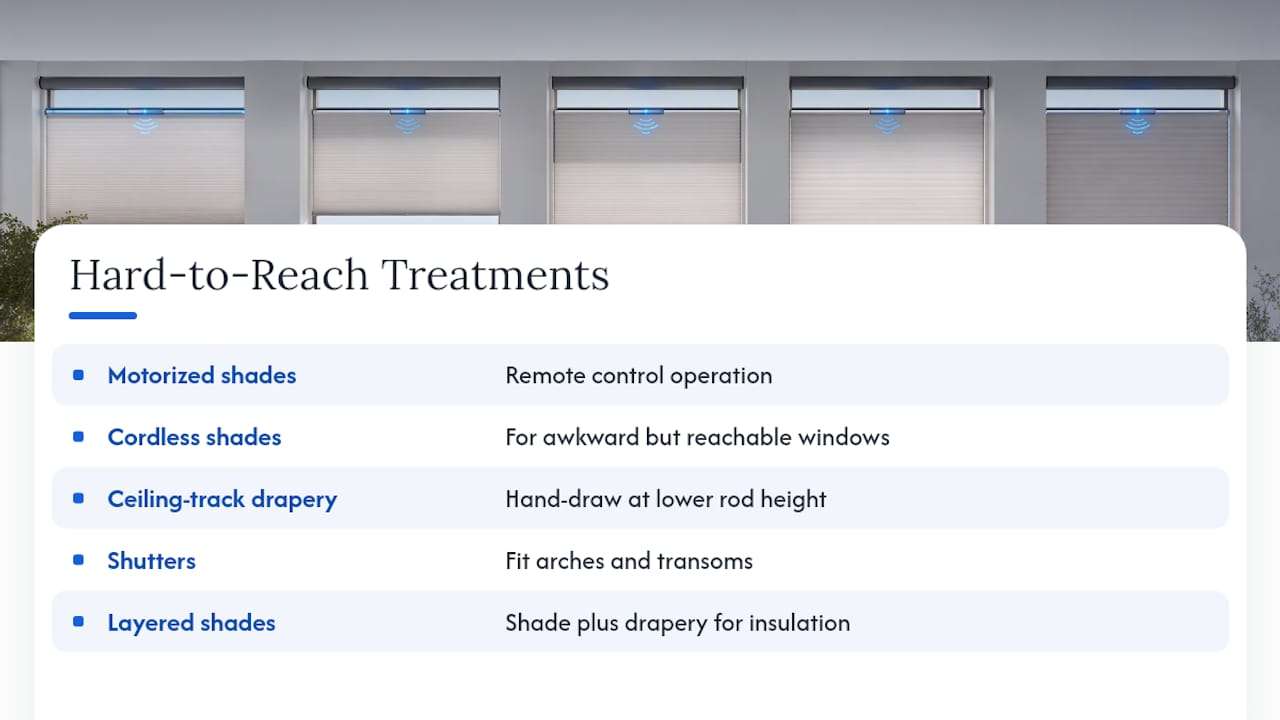
Layering a shade underneath drapery gives you the best of both: sunscreen or blackout roller fabric for daily light control, with drapery for texture, insulation, and a finished look. Homeowners weighing hard to reach window shades against full drapery setups often land here, using both rather than choosing one.
How Does Motorization Work, and What Should You Ask the Installer?
Motorization turns a hard-to-reach window from a maintenance headache into a set-and-forget fixture, but the power source and control method you choose will shape how it performs for years.
Power options break into three types. Rechargeable battery motors install without any electrical work, making them the fastest and least invasive option for retrofits, though they need periodic recharging depending on use frequency. Hardwired motors tie into your home’s electrical system and never need charging, but they require an electrician and are best planned during a renovation. Plug-in motors split the difference, offering wired reliability without opening up walls.
Control methods vary in convenience and cost:
- Handheld remotes are the simplest and cheapest, controlling one or several shades at once.
- Wall-mounted keypads give a fixed control point for shared spaces like living rooms.
- App-based control lets you group and schedule shades from a phone, including away-from-home access.
- Voice integration through smart-home systems adds hands-free operation for multi-shade rooms.
- Timers and light sensors automate the whole thing, closing shades at sunset without you lifting a finger.
Motor sizing matters more than most buyers expect. Correct tube and headrail sizing, paired with proper bracket spacing, prevents fabric drift and uneven stacking on long drops, a common complaint on oversized windows fitted with undersized hardware.
Pro Tip: Ask what fabric weight the motor is rated for before you fall in love with a heavier blackout or solar fabric. A motor sized for light-filtering material will strain and shorten its own service life under a heavier weave.
Most quality motors carry a multi-year warranty, and battery-powered units run quieter than older hardwired systems. Expect occasional recalibration if a shade starts stopping short of full open or closed.
How Do You Measure and Mount Treatments on Tall or Awkward Windows?
Getting the measurements right on a standard window is forgiving. Getting them right on a window you’ll need a ladder or lift to revisit is not, so it pays to slow down here.
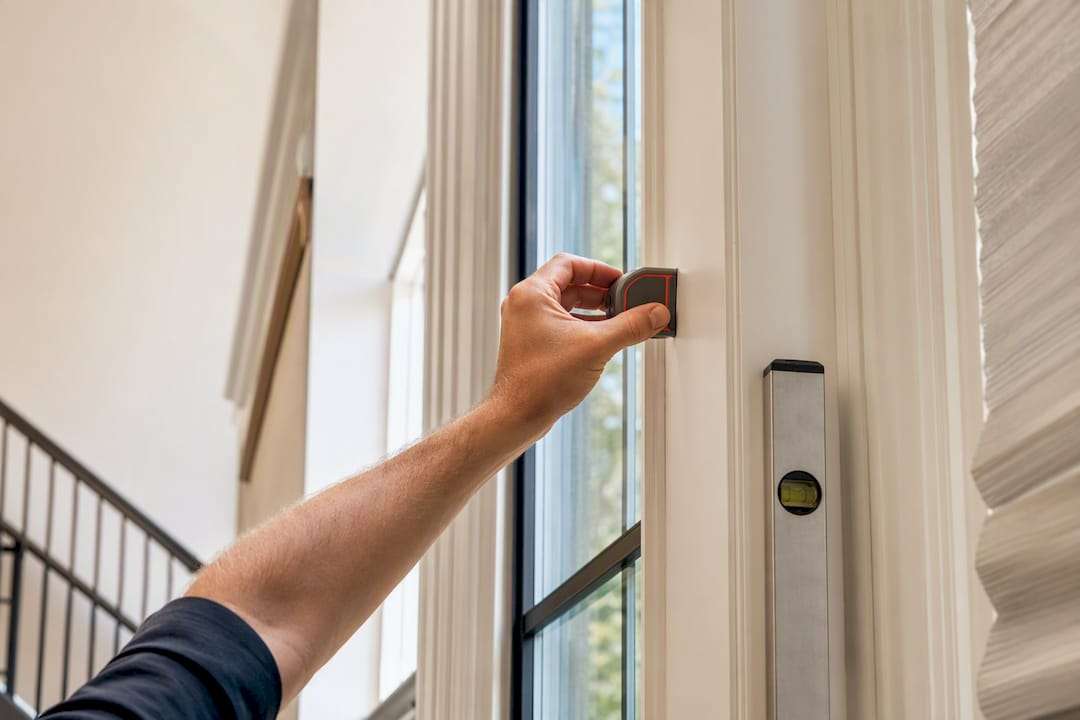
- Measure frame depth first. An inside mount needs enough depth to seat the headrail without hitting hardware; for guidance, see factory fit tilt and turn cabin windows matched to wall thickness to understand how window type influences mounting depth. When depth is limited, an outside mount often delivers cleaner coverage and closes light gaps that shallow inside mounts can’t avoid. This is also where a resource on how to measure for blinds pays for itself before you order anything.
- Match anchors to the wall type. Drywall needs toggle anchors rated for the shade’s weight, plaster often needs a different approach entirely, and masonry or concrete calls for concrete anchors and a hammer drill. Choosing the wrong anchor for the substrate is one of the most common causes of installation failure on heavier headrails.
- Add center supports on wide spans. Headrails wider than typical widths sag without a center bracket, and sag turns into fabric drift and motor strain over time.
- Plan for special shapes separately. Arched, angled, and transom windows typically need custom-fabricated shapes or shutters rather than a standard shade forced to fit, and stairwell windows demand access equipment as much as measurement precision.
If you’re pairing shades with drapery, a guide to measuring window curtains covers the rod height and fullness questions a shade measurement alone won’t answer.
Is It Safe to Install Hard to Reach Window Treatments Yourself?
Sometimes, but the margin for error shrinks fast once you’re working above eight or ten feet. Safe installation of tall window treatments depends on correct ladder use, accurate measurements, secure anchors, and a second person to help lift and hold larger shades or drapery panels.
Before you climb anything, run through this:
- Maintain three points of contact on a ladder at all times, and use a ladder rated for the height, never one you’re stretching to reach with.
- Switch to a platform, mini scaffold, or lift rental once a window sits above what a standard stepladder safely covers.
- Clear the drop zone below you and tether tools so nothing falls while your hands are full overhead.
- Scan the wall for wiring and plumbing before drilling anchors, especially near older construction where runs aren’t always where you’d expect.
A job hazard analysis approach to curtain and shade installation calls for eliminating ladder work where feasible and using proper access equipment instead, which is the same logic professional installers apply on every tall-window job. Heavy headrails on wide windows also genuinely need two people. That’s not a suggestion, it’s a physical limitation.
How Do You Choose Between DIY and a Professional Installer?
Start with what you’re actually solving for. Run through this checklist before you buy anything:
- Define the primary goal. Are you after access, blackout darkness, energy savings, or a design refresh? Each points toward a different product category.
- Check wiring access. If a hardwired motor is on the table, confirm an electrician can reach the window before you commit.
- Set a real budget range, including installation, since a motorized shade quote without labor isn’t a complete number.
- Decide if multiple windows need to sync, which affects whether you need app-based grouping now rather than adding it later.
When you do talk to a contractor or supplier, ask specifically: How do you measure, in person or from photos? What motor brand and warranty comes with the shade? What’s the battery life under normal use? What anchor type will you use for my walls, and does a wide headrail get a center support? What’s the lead time from order to install?
Vague answers on measurement method or anchor type are a red flag. So is a supplier who can’t speak to on-site fabrication or doesn’t offer any installation warranty at all.
Why Professional Measurement Changes the Outcome
Custom, professionally measured window treatments avoid the two most common failures on hard-to-reach windows: uneven hems and top gaps. Onsite fabrication means the finished piece gets built to your window’s actual dimensions rather than rounded to the nearest stock size, which matters more as drop length increases and small errors compound. The Drapery Company has fabricated products onsite for over 30 years, which keeps fit and quality control under one roof rather than split across a manufacturer and an installer.
Professional measurement also catches problems a DIY tape measure misses, like a frame that’s not quite square or a wall that isn’t perfectly plumb. An end-to-end service that handles design, fabrication, and installation typically backs the work with a warranty that a big-box purchase paired with a separate installer rarely matches.
What Cordless and Retrofit Options Exist for Existing Windows?
If motorizing every window in the house isn’t in the budget this year, cordless shades and retrofit kits close the gap without a full replacement.
Cordless shades operate with a simple push or pull on the bottom rail, using an internal spring mechanism instead of a dangling cord or chain. They work well on windows within arm’s reach from a step stool, which covers plenty of “difficult” windows that aren’t truly inaccessible, just tall enough to be annoying.
Retrofit motorization kits go a step further. Several manufacturers now sell battery-powered motor units designed to slide into existing roller or cellular shade tubes, converting a manual shade to remote or app control without replacing the whole unit. This works best when the existing shade is in good condition and properly sized. It’s a poor fix for a shade that was already misfitted or sagging.
Extension poles remain the low-tech answer for wands and cord loops just out of reach, letting you operate a manual shade from the floor. They’re inexpensive and immediate, but they don’t solve the underlying accessibility problem the way motorization does, and most homeowners outgrow them once they’ve tried a shade that just responds to a remote.
Our Take: The Real Problem Isn’t the Product, It’s the Fit
Most advice on hard to reach window treatments jumps straight to motorization as if buying a motorized shade automatically solves the problem. It doesn’t, not on its own. A motorized shade with the wrong tube size, a headrail without center support, or an inside mount forced into a frame that’s too shallow will drift, sag, or bind, motor or no motor. The technology is only as good as the measurement underneath it.
We’d argue the conventional wisdom underrates fit and overrates the remote control. Homeowners fixate on app features and voice compatibility, then get surprised when a beautifully specced shade stacks unevenly two years in because bracket spacing was an afterthought. Prioritize accurate measurement and correct anchoring first. Choose your control method second. That order rarely gets flipped in the marketing, but it’s the order that actually determines whether the shade still works the way it should five years from now.
— The Drapery Company
Get Professional Help With Your Hard to Reach Windows
Tall stairwell windows, two-story great rooms, and transoms above a bay window are exactly the situations where a DIY measurement mistake gets expensive fast, and where The Drapery Company’s approach pays off most. Every product is fabricated onsite in the Tampa Bay workroom, so fit, fabric, and motor specification are handled under one roof instead of split between a manufacturer and a separate installer. That means fewer surprises on drop length, bracket placement, and motor sizing for your exact window.
An in-home consultation includes a professional measurement of your hard-to-reach windows, a walkthrough of motorized shade options suited to your frame depth and wiring, and installation with removal of your old treatments included as a courtesy. Start with a consultation through The Drapery Company to get a fit and quote based on your actual windows, not a stock size.
Sources
- Living the high life: how to safely install tall window treatments — RealtyTimes
- Window Treatment Installation Safety: 10 Essential Tips — AAA Blind & Shutter Factory
- Control tall windows with motorized shades — Unique Blinds + Drapes Design
- Write a risk assessment for curtain installation — SALUS Safety
FAQ
What Are the Best Window Coverings for Hard-to-Reach Windows?
Motorized roller and cellular shades are the top choice because they remove the need to physically reach the window, with cordless shades and extra-long drapery as solid alternatives depending on budget and height.
What Is the New Trend for Window Coverings?
Motorized shades controlled by app, voice, or automated schedules have become the dominant trend, especially for tall or multi-window rooms where syncing several shades at once adds real convenience.
What Does Martha Stewart Use Instead of Curtains?
Coverage of Martha Stewart’s home style has highlighted shutters and structured shades as curtain alternatives, favored for their clean lines and lower-maintenance upkeep compared to fabric drapery.
What Are Four Outdated Window Treatments?
Heavy valances, vertical blinds, dated mini blinds, and floor-length sheer curtains with no layering are frequently named as outdated, largely because they limit light control and don’t suit taller modern windows.
Does The Drapery Company Install Motorized Shades?
Yes, motorized window coverings with onsite fabrication and professional installation are offered; current pricing is available by requesting a quote through the company’s site.
Recommended
- Motorized Shades for Arched Windows: A Luxury Guide
- Revolutionize Your Living Space with Motorized Drapery Tracks: Effortless Operation, Enhanced Convenience, Customization, Energy Efficiency, and Safety Features!
- Battery Operated Motorized Shades: Smart Home Luxury
- How Do Motorized Blinds Work A Guide To Smart Home Luxury