

2026 Staircase Window Treatments for Homeowners, Cordless, Motorized
September 30, 2026
Skip 304 Near the Sea: 316 Has 24.2 PREN for Durable Curtain Hardware
October 2, 2026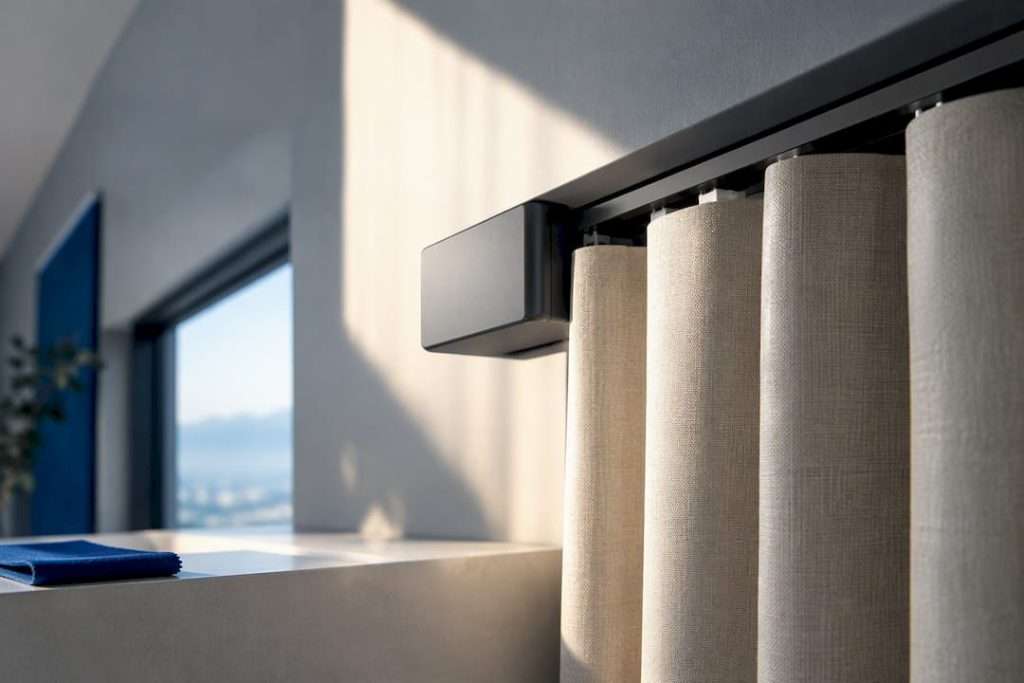
A motorized drapery system pairs a mechanized track with a motor, carriers, and a control interface so drapery panels open and close without a manual pull cord. Before choosing one, check three things: the track’s weight capacity against your fabric, whether your mounting surface can support the hardware, and how you want to power and control it. Get those right and the rest of the decision falls into place.
TL;DR:
- Choosing the correct motor-rated capacity is crucial, as residential motors typically support fabric panels up to 70 kilograms, but heavier fabrics require commercial-grade drives.
- Track length and splicing impact system performance, with longer spans needing precise brackets and potentially tandem drives to prevent carrier snagging.
- Power options include low-voltage wiring, plug-in transformers, or rechargeable batteries, with battery motors favored for retrofit projects to avoid wiring disruption.
- Confirming control compatibility with existing smart home systems and ensuring proper mounting and blocking can prevent installation failures and safety hazards.
- Proper installation involves accurate measurements, professional support for heavy or long spans, and testing fabric weight against motor capacity before assembly.
How motorized drapery systems work: components and system types
Every motorized drapery system shares the same basic anatomy: a track (the rail the panels ride on), a motor or drive unit that moves the carriers, the carriers themselves (small gliders attached to the drapery hooks), and a control interface that tells the motor what to do. End caps and stackback returns finish the track and determine how far the panels tuck away from the glass when open.
Two broad formats dominate residential and commercial projects. Exposed decorative tracks sit in view, often finished to match trim or ceiling color, and work well when the track itself is part of the room’s architecture. Recessed or pocket tracks hide inside a ceiling channel or valance, leaving only fabric visible, a detail-oriented choice for homeowners who want the mechanics to disappear entirely.
For windows wider than a single track length, installers use tandem or spliced systems, joining two track sections with a connector so one motor drives continuous fabric across a long span. Carrier spacing and fullness factor (the ratio of fabric width to track length) also affect how the drape stacks and moves. Tighter spacing and higher fullness create fuller folds but add weight the motor has to carry.
- Track: the rail that carries the carriers and defines the stackback.
- Motor or drive: the mechanized unit that moves fabric along the track.
- Carriers: gliders that attach drapery hooks to the track.
- Control interface: the switch, remote, or app that signals the motor.
Key technical features and specs buyers must compare
Weight capacity is the single most important spec, and it is often where installations fail. Motor and track systems are rated for a maximum fabric panel weight, and pairing a light-duty motor with heavy interlined drapery leads to slow operation, jamming, or early motor burnout.

Residential-grade drapery motors commonly support fabric panels in the 40 to 70 kilogram range, while heavy-duty commercial drives handle higher loads. That gap matters if you are hanging thick blackout linings or double-width panels, which push toward the top of that range quickly.
Track length is the second constraint. Single-run tracks have a maximum length before they need a splice, and splicing introduces a mid-span bracket and a connector that has to be positioned precisely so the carriers pass through smoothly. Beyond length, buyers should compare:
- Speed and precision: how smoothly the motor starts and stops, since abrupt movement stresses fabric and hardware over time.
- Noise level: quieter motors matter most in bedrooms and media rooms where operation happens during quiet hours.
- Finish and end treatments: track color, decorative end caps, and valance return options that affect the finished look.
- Draw configuration: center-open, one-way draw, or overlapping panels, which changes how many carriers and how much motor power the system needs.
Installation and mounting options: what installers evaluate
Where and how a track mounts changes both the visual result and the structural demands on your wall or ceiling. Wall-mounted tracks are straightforward to install and service but remain visible, while ceiling or recessed mounting hides the hardware and requires more precise blocking work above the drywall.
- Confirm blocking: installers check that the ceiling or wall framing behind the mounting point can carry the track and motor weight, adding solid blocking where standard framing will not hold screws securely.
- Space brackets correctly: brackets typically land every few feet along the track, with an extra mid-bracket required at any splice point to keep the connection rigid.
- Plan for corners and long spans: corner tracks and runs over roughly 12 feet without a splice need additional support and sometimes a tandem drive to share the load.
- Match the install to the retrofit: existing rooms with finished ceilings often favor surface-mounted tracks and plug-in or battery motors over new low-voltage wiring runs.
Heavy drapery on long or curved tracks is where professional installation earns its cost. For unusually large or arched openings, the mounting math changes further, which is why guidance on large window installations and arched window fittings treats them as their own category.
Power and control options: wiring, battery, and smart home integration
Motorized drapery needs power somewhere, and the choice shapes how invasive the installation is. Low-voltage systems run from a central distribution panel, which suits new construction or full renovations where wiring is easy to route. Individual plug-in transformers and junction boxes work for single rooms without opening walls, and rechargeable battery motors skip wiring entirely, a common choice for retrofit projects where running cable is impractical.
Control options range from a simple wall switch to a handheld remote, a smartphone app, or a voice assistant tied into a home automation hub. Compatibility depends on the system’s communication protocol: some motors use proprietary radio signals, others use Zigbee or Z-Wave to join a broader smart home network, and some connect over Wi-Fi directly. Confirm protocol compatibility before assuming a new drapery motor will talk to an existing hub.
- Low-voltage panels: best for new builds with accessible wiring paths.
- Plug-in transformers: simple single-room installs with no wall access needed.
- Rechargeable battery motors: retrofit-friendly, no wiring, periodic charging required.
- Smart hub integration: adds voice and scheduling control through Zigbee, Z-Wave, or Wi-Fi.
Pro Tip: If you are retrofitting an older home, ask about battery motors first: they avoid the cost and disruption of running low-voltage wiring through finished walls.
Safety and regulation: why motorized systems reduce risk
Cordless and motorized window coverings exist largely because of child safety concerns tied to exposed operating cords. The federal safety standard for operating cords on custom window coverings references ANSI/WCMA guidance and identifies making cords inaccessible, along with cordless or motorized operation, as accepted ways to meet the standard. Motorization removes the operating cord from the equation entirely, which eliminates the strangulation hazard cords present around young children.
Before hiring anyone, confirm a few things:
- The system operates cordless, with no exposed pull cord or bead chain.
- The installer secures brackets and blocking to a standard that will not loosen under repeated motor cycling.
- The product line has been tested to the applicable ANSI/WCMA reference.
Meeting these standards can add modestly to project cost, largely because compliant hardware and proper structural mounting take more labor and better components than a basic manual track.
How to choose: checklist and questions to ask an installer
Work through the decision in order rather than shopping by price alone.
- Measure the window and confirm total track length, noting whether a splice will be needed.
- Estimate fabric weight, factoring in lining, fullness, and panel width, since this determines which motor tier you need.
- Confirm power routing: decide between low-voltage wiring, a plug-in transformer, or a rechargeable motor based on your walls and timeline.
- Confirm control compatibility with any existing smart home hub before committing to a specific motor brand.
When you talk to an installer, ask directly about mounting blocking, warranty length and what it covers, expected installation timeline, motor noise and operating speed, and available finish or end-treatment options. Custom motorized drapery costs more than off-the-shelf manual tracks because custom window coverings generally run higher than stock products, and motorized hardware, in-home measurement, and precise fabrication add to that baseline.
Pro Tip: Ask an installer to quote fabric weight against their motor’s rated capacity before you order, not after the track is already on the wall.
What we have learned installing motorized drapery
Over many years fabricating window treatments onsite and completing numerous projects, most motorized drapery problems trace back to two things: insufficient blocking behind the mounting point and a motor sized for the wrong fabric weight. Splices planned without a mid-bracket are the third repeat offender, causing carriers to snag right where the track joins.
Custom fabrication and professional installation earn their cost by catching these issues before the track goes up, particularly on heavy interlined panels or long spans where a manual retrofit kit was never designed to perform.
— The Drapery Company
Get a motorized drapery consultation and measurement
Choosing the right motor and track means knowing your exact fabric weight, window span, and mounting conditions, which is hard to judge from measurements alone. The vendor fabricates custom drapery and motorized window coverings onsite in their workroom, so the track, fabric, and motor are matched to your windows before installation day, not adjusted afterward.
Our in-home consultation and measurement service covers everything from checking blocking and bracket spacing to confirming power and smart home compatibility, and we remove your old window treatments as part of the visit. For commercial spaces or larger motorized projects, our motorized window coverings page outlines what we install and support. Reach out to schedule a measurement and get a project quote based on your actual windows and fabric choice.
Where to verify specs and regulations
For weight and splice limits, check manufacturer documentation like Lutron’s drapery track specifications. For safety rules on operating cords, consult the federal operating cord safety standard directly.
FAQ
How much does a motorized curtain system cost?
Published spec sheets do not list a universal price, since cost depends on track length, motor type, and fabric. Custom window coverings, including motorized systems, generally cost more than stock products and installers typically recommend an in-home measurement to price a specific project.
What is the best motorized curtain system?
There is no single best system: the right choice depends on your fabric weight, track length, and whether you need wired or battery power. A system rated for your specific panel weight and compatible with your preferred control method, whether a remote, wall switch, or smart home hub, will outperform a system chosen on brand name alone.
Are motorized curtains expensive?
Motorized curtains cost more than manual tracks because of the added motor, control hardware, and typically custom fabrication. Custom window coverings as a category run higher than mass-market stock products, and pricing varies enough that an in-home consultation is the most reliable way to get an accurate figure.
What is the best motorized curtain track?
The best track for your project is the one whose length, splice capability, and weight rating match your window and fabric, whether that is an exposed decorative track or a recessed pocket track. Checking manufacturer capacity charts against your fabric weight matters more than choosing a specific track brand.
How do motorized drapes work?
Motorized drapes use a small motor built into or attached to the track to pull carriers along the rail, opening or closing the fabric panels without a manual cord. The motor responds to a wall switch, remote, app, or voice command, depending on the control interface the system uses.
Recommended
- Revolutionize Your Living Space with Motorized Drapery Tracks: Effortless Operation, Enhanced Convenience, Customization, Energy Efficiency, and Safety Features!
- Electric Curtain Track: A Luxury Buyer’s Guide
- Drapery Hardware Types: 3 Installation Mistakes Homeowners Must Avoid
- Curtain Rods And Rings: A Luxury Buyer’s Guide


