Homeowners: Roman Shades Cost Per Window and When to DIY
September 8, 2026
Order the Right Yardage: Drapery Fullness for Homeowners & Makers
September 10, 2026
Go with 1% to 3% for south or west windows with heavy glare, and 3% to 5% for living areas where you want a softer balance between visibility and protection. At those openness levels, fabric shades block a very high percentage of UV rays, and this range solves many glare and fading complaints effectively.
TL;DR:
- Use 1% to 3% openness fabrics for south and west windows with intense glare, and 3% to 5% for living areas where a softer balance of view and protection is desired.
- Tight weave density, measured by openness factor, directly predicts UV blocking, with lower percentages offering higher protection at the expense of view clarity.
- Orientation influences ideal openness: 1% to 3% for south and west-facing windows, 3% to 5% for east-facing, and 5% to 10% for north-facing windows.
- Darker fabrics improve perceived glare control and contrast without changing actual UV protection, which remains primarily determined by openness.
- For nighttime privacy, layer solar shades with drapery or blackout shades, especially for bedrooms, since solar shades become reflective after dark.
What Are UV Blocking Shades and How Do They Work?
UV blocking shades work like a fine screen door for sunlight. The fabric is a tight weave, usually vinyl coated polyester yarns or a fiberglass blend, and the size of the gaps between those yarns determines how much light, heat, and ultraviolet radiation gets through. Manufacturers call this weave density the openness factor, and it is the single most important spec on the product tag, more telling than color, brand, or price.
The mechanism is simple physics rather than a coating or chemical treatment. Every solar shade fabric is woven with intentional gaps, and the ratio of open space to solid yarn determines how much UV, visible light, and heat passes through versus how much gets absorbed or reflected. A tighter weave leaves less open space, so less UV gets through and less of the outdoor view survives on the other side. It’s the same principle behind a screened porch. The tighter the mesh, the dimmer the space but the better the bug and sun protection.
Solar shades are built specifically to filter both UV and visible light while still letting you see outside during the day. That’s the trait that separates them from other UV-blocking window treatments, and it’s worth understanding the full lineup before you commit to one:
- Solar (screen) roller shades: A single flat fabric on a roller tube, woven for openness ranging from under 1% to over 14%. Best for anyone who wants daytime UV protection without sacrificing the view entirely.
- Cellular (honeycomb) shades: Pleated fabric cells that trap air for insulation. Some fabrics carry UV-blocking treatments, but the honeycomb structure is opaque by design, so you lose the see-through quality solar shades preserve.
- Blackout shades: Fully opaque fabric or vinyl backing that blocks essentially all light and UV, ideal for bedrooms and media rooms, but you sacrifice any daytime view.
- Exterior solar screens: Mounted outside the glass rather than inside, these intercept solar energy before it ever reaches the window. Field research from the Department of Energy and Pacific Northwest National Laboratory shows this location advantage delivers measurable reductions in solar heat gain compared to interior-only treatments.
Cellular and blackout shades earn their place in bedrooms and screening rooms, but they’re not really UV-blocking shades in the view-preserving sense most homeowners are shopping for. If you want to look outside during the day and still protect your floors, art, and furniture, solar roller shades are the category built for that specific job. UV exposure doesn’t take a season off, either. Interior fading continues year-round, even on overcast days, which is why solar shades work as a permanent fixture rather than a seasonal swap.
How Does Openness Factor Affect UV Protection?
Openness factor is expressed as a percentage, and it tells you exactly what portion of the fabric is open weave versus solid yarn. A 1% openness fabric is nearly completely solid; a 14% openness fabric has much more open space, with just enough yarn to hold its shape. This one number predicts UV blocking, glare control, and view clarity more reliably than any marketing description of “light filtering” or “sheer.”
The relationship between openness and UV blocking is close to inverse and fairly consistent across manufacturers. Lower openness numbers concentrate more solid fabric between you and the sun, so less UV gets through.
| Openness factor | Approximate UV block | Best use case |
|---|---|---|
| 1% | very high | Home theaters, south/west windows with intense glare, art or wine storage rooms |
| 3% | very high | Home offices, living rooms, kitchens facing strong sun |
| 5% | very high | Living rooms and dining rooms balancing view with protection |
| 10% | moderately high | North or east windows, rooms prioritizing outdoor view |
| 14% | moderate | Covered porches, low-glare rooms, decorative applications |
These figures line up with the ranges cited in industry buyer guides on solar shade openness, and they hold true across most vinyl-coated polyester and fiberglass fabrics on the market. The tradeoff runs in both directions: a 1% fabric gives you excellent protection but a noticeably hazier view, almost like looking through a fine curtain. A 14% fabric gives you a nearly unobstructed view but lets in enough UV and glare that it stops functioning as real sun protection on a bright Florida afternoon.
Pro Tip: *If you’re torn between two openness percentages, order both as fabric swatches and hold them up against your actual window at the time of day you use the room most.

Color interacts with openness in a way the percentage alone doesn’t capture.
What Openness Level Works Best for Each Room?
Sun exposure is not the same on every wall of your house, and treating every window with the same fabric is one of the most common mistakes we see homeowners make before they call a professional. Orientation changes everything about which openness percentage actually performs the way you expect.
- South-facing windows: These get the most consistent, high-angle sun exposure throughout the day. Stick to 1% to 3% openness fabrics to control both UV and heat buildup.
- West-facing windows: Afternoon sun hits these windows at a low, blinding angle. This is the toughest exposure in most homes, and 1% to 3% openness is usually non-negotiable if glare is a complaint.
- East-facing windows: Morning sun is intense but short-lived. A 3% to 5% fabric usually balances protection with a brighter start to the day.
- North-facing windows: These see the least direct sun. You can comfortably go to 5% to 10% openness here and prioritize the outdoor view without much UV tradeoff.
Room function matters just as much as compass direction. Sliding glass patio doors deserve special attention, since their sheer glass area multiplies both the UV load and the heat gain; a dedicated look at solar shades for sliding glass doors covers sizing and motorization options specific to that application.
Bedrooms are the one category where we generally steer clients away from solar shades as the sole treatment. That’s a job for a blackout shade or a layered system, which we cover in the privacy section below. The general zoning logic tracks closely with DOE and PNNL guidance on shading strategy, which recommends matching shading intensity to actual solar exposure rather than applying one blanket solution across a home.
Does Fabric Color Change UV Protection or Glare?
Color is a secondary lever, but it’s a real one, and it often makes the difference between a shade that feels comfortable and one that still causes squinting. At the same openness percentage, a darker fabric typically improves perceived glare control and delivers a sharper, higher-contrast view through the weave than a lighter fabric of identical openness.
Here’s why: lighter colored screens reflect more incoming light back toward your eye at the fabric surface itself, which washes out the contrast between the shade and whatever’s happening outside it. Darker screens absorb more of that surface glare, so what you perceive through the fabric reads more like tinted glass. This is a widely cited pattern among fabricators, though it’s worth noting the effect is about perceived comfort and view clarity rather than a change in the actual UV-blocking percentage, which is still primarily set by the weave itself.
Material choice affects durability as much as looks. Vinyl-coated polyester tends to resist stretching and holds its shape well over years of daily use, while fiberglass-core blends often deliver a slightly crisper view-through and better dimensional stability in humidity, a real consideration in a Gulf Coast climate.
A short checklist for balancing looks and performance:
- Choose darker neutrals (charcoal, espresso, graphite) for any screen shade in a high-glare, view-priority room.
- Reserve pale or white screen fabrics for lower-glare, north-facing rooms where softness matters more than contrast.
- Ask about fiberglass-blend fabrics if you live somewhere with high humidity and want extra resistance to sagging.
- Confirm the fabric carries UV stabilizers in its manufacturing, since raw vinyl coatings can degrade faster under constant direct sun exposure.
Pro Tip: When two clients want the same openness percentage for the same room, we often steer one toward a darker tone if their main complaint is glare, and the other toward a lighter tone if their priority is keeping the room feeling bright. The percentage sets the ceiling on protection; color shapes how that protection actually feels day to day.
Do Solar Shades Give You Privacy at Night?
Solar shades excel at daytime privacy and view, and then flip completely once the sun goes down. During daylight, the brighter conditions outside compared to inside let you see out while anyone outside sees mostly a reflective surface. After dark, with interior lights on, that relationship reverses.
This isn’t a defect. It’s simply how a screen fabric behaves, and it means most homes need a second layer for evening privacy or bedroom-level darkness. A few layering patterns solve this cleanly:
- Solar shade plus drapery: Keep the solar shade down for daytime UV and glare control, then draw a lined drapery panel closed in the evening for privacy and a softer look.
- Solar shade plus secondary blackout roller: A dual-roller or dual-bracket system lets you lower a blackout shade behind the solar screen for full nighttime coverage, common in bedrooms that still want a daytime view.
- Dual-roller systems: One headrail holding both fabrics side by side gives you the flexibility to run either shade independently, which works well for home offices that flip between video calls and quiet focus time.
Layering adds a real side benefit beyond privacy. A drapery panel or secondary shade behind a solar screen improves insulation against both heat transfer and outside noise, since you’re adding a second barrier of fabric mass rather than relying on one thin layer to do every job at once.
How Should You Measure, Mount, and Control UV Blocking Shades?
Mount choice changes how well any UV-blocking shade actually performs, not just how it looks. An inside mount, where the shade sits within the window frame, gives a clean architectural look but tends to leave small light gaps along the edges where UV and glare can sneak past the fabric. An outside mount, where the shade hangs on the wall beyond the frame, covers those edge gaps and typically delivers more complete light control, which matters more on high-glare south and west exposures than it does on a shaded north window.
Hardware choice matters just as much on larger openings. Side channels or guide wires keep wide fabric panels, like those on sliding glass doors, from billowing or gapping at the edges in a breeze from an open door nearby. A cassette headrail conceals the roller tube and adds a slightly more finished look while also blocking a small amount of light leak at the top of the shade.
A short list of what to confirm before ordering:
- Decide inside versus outside mount based on how much edge light leakage your room can tolerate.
- Ask about side channels or guide wires for any opening wider than a standard window, especially sliding glass doors.
- Consider a cassette headrail for a cleaner look and slightly tighter light seal at the top.
- Look into motorized controls for hard-to-reach windows, skylights, or any room where you want scheduled operation.
Motorization has become one of the more practical upgrades for solar shades specifically because these shades are meant to move throughout the day as the sun angle shifts. Scheduled operation means a west-facing shade can lower automatically before the worst afternoon glare hits, without anyone needing to remember. Wind sensors on exterior-mounted screens add a layer of protection for the hardware itself, retracting the shade automatically before gusts cause damage. Because performance depends so heavily on a tight, gap-free fit, professional measurement and installation is where the numbers on a fabric spec sheet actually translate into real-world protection; our Window Solutions team handles that measurement and fitting work directly.
How Do UV Blocking Shades Compare to Other Window Treatments?
Solar shades occupy a specific niche: strong, tunable UV protection while preserving a view. Compared against other common window treatments, the differences come down to what each product is actually built to do.
Standard aluminum blinds offer adjustable slats, but the gaps between and around slats let more UV and glare through than a woven screen fabric at almost any openness setting, and dust collects on horizontal slats faster than on a flat roller fabric. Cellular shades trap air for strong insulation value and some UV reduction, but they’re opaque, so you’re trading the view entirely for that insulation benefit. Plain glass with no treatment at all blocks only a portion of UVB and very little UVA, which is why furniture and flooring fade steadily in untreated rooms regardless of season.
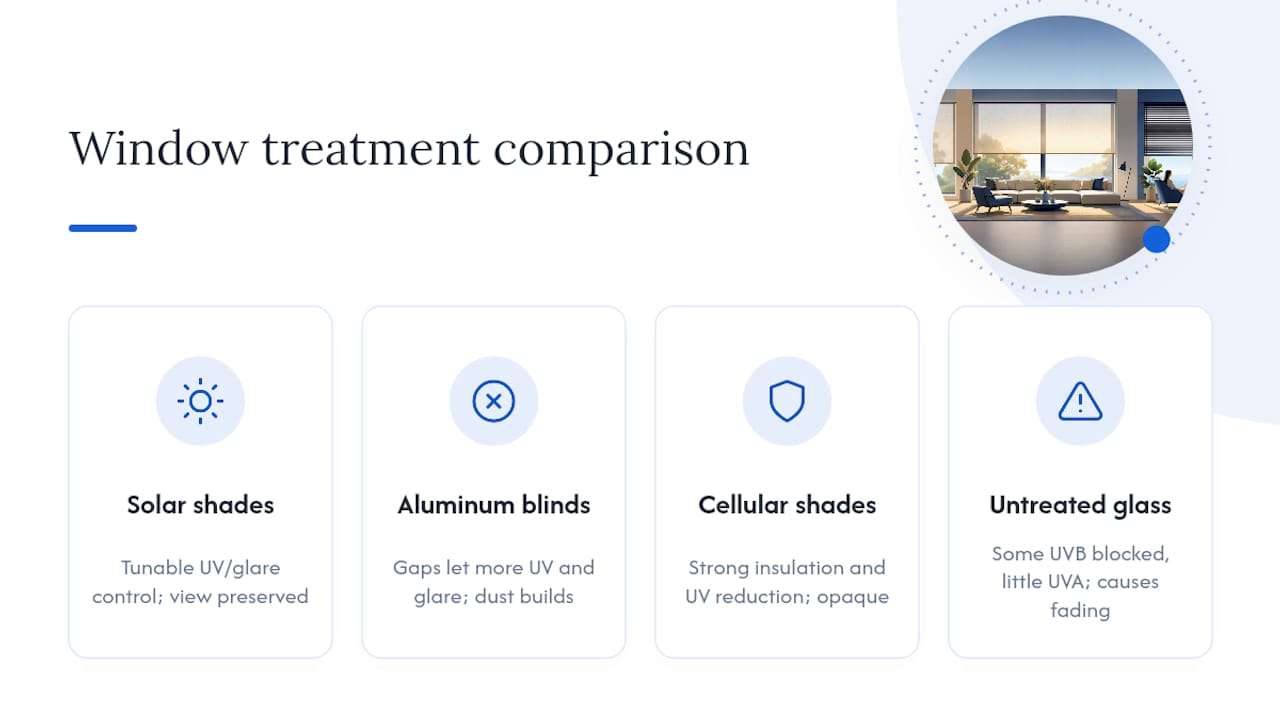
Solar shades are the only category built around a tunable percentage, letting you dial in exactly how much protection you need on a room-by-room basis rather than accepting a fixed opaque-or-nothing tradeoff.
What Certification Standards Apply to UV Blocking Shades?
Unlike sunglasses or apparel fabrics, window shade UV protection doesn’t operate under one universal government certification standard in the way, say, sunscreen SPF ratings do. Instead, manufacturers typically publish openness factor percentages alongside independent lab testing of UV transmittance for each fabric line, and reputable brands make that data available on request.
When shopping, ask specifically for the fabric’s tested UV block percentage at its stated openness factor, not just a general marketing claim of “UV protective.” The numbers in the openness factor table earlier in this guide reflect the kind of testing data serious fabric manufacturers publish, and those figures are what you should expect a fabricator to be able to show you before you commit to a specific product line.
How Long Do UV Blocking Shades Last, and What Maintenance Do They Need?
A well-made solar shade fabric, properly installed, typically holds its performance and appearance for many years of daily use, though exact service life varies by fabric grade, sun exposure intensity, and how often the shade cycles up and down. Vinyl-coated polyester tends to be the more forgiving option for stretching and warping over time, while fiberglass blends often hold their flatness and view clarity a bit longer in humid climates.
Maintenance is refreshingly simple. Most solar screen fabrics only need occasional vacuuming with a soft brush attachment or a wipe-down with a damp cloth to remove dust and pollen buildup, since the openweave structure doesn’t trap debris the way pleated cellular fabric can. Avoid harsh chemical cleaners, which can degrade UV-stabilizing treatments in the fabric coating over time. Motorized components need essentially no regular upkeep beyond occasional battery checks or, on hardwired systems, none at all.
The one thing that shortens service life fastest is a mount that doesn’t fit the window properly, since misaligned hardware puts uneven stress on the fabric and roller mechanism every time it operates.
What Does It Cost to Get UV Blocking Shades?
Pricing for UV-blocking shades spans a wide range depending on fabric grade, window size, and whether you choose manual or motorized operation. Basic off-the-shelf solar shades in standard sizes sit at the lower end of the market, while custom-fabricated fabric, larger openings like sliding glass doors, and motorized control all add cost.
Motorization typically carries the largest single price increase over manual operation, followed by premium fabric grades like fiberglass blends over standard vinyl-coated polyester. Larger openings, sliding glass doors especially, cost more simply due to the additional fabric and stronger hardware needed to support wider spans without sagging.
The most useful way to think about budget isn’t the sticker price on a single shade, but the cost of getting it wrong. A cheap, ill-fitting shade that leaks light at the edges or a fabric openness mismatched to the room’s actual sun exposure means you’re paying for a product that doesn’t deliver the UV protection you bought it for. Custom measurement and fabrication costs more upfront than a big-box off-the-shelf option, but it closes the gaps, literally and figuratively, that undercut performance.
What 30 Years of Installations Taught Us About Getting This Right
The single most common mistake we see is a homeowner buying one openness percentage for the whole house because it looked good in a showroom.
Zoning by exposure, treating each window as its own decision rather than a uniform order, solves most of the regret we hear about after the fact. We also push clients to test actual fabric swatches against their own glass at the time of day the room gets used most, because a fabric sample under showroom lighting tells you almost nothing about how it performs against 4 p.m. sun on a Tampa summer afternoon.
Motorization planning is the other place people get caught off guard, usually because they didn’t think about power access or scheduling needs until after installation. Sorting that out during the measurement visit, rather than as an afterthought, is far cheaper than retrofitting later. If you’re weighing custom fabrication against ready-made options, our guide to custom window shades walks through what that process actually looks like room by room.
— The Drapery Company
Ready to Get Your Windows Measured for UV Protection?
Choosing the right openness percentage on paper is only half the job. The other half is a precise fit, since even a well-chosen fabric underperforms if it’s mounted with gaps at the edges or sized wrong for the opening. That’s where The Drapery Company’s onsite fabrication process pays off directly: every shade we build is cut and assembled locally under the same roof where we schedule your measurement, so what you order is what actually gets installed, with no guesswork lost in translation between a factory order form and your specific window.
If you’re ready to move from research to results, request fabric swatches to test against your own glass, schedule an in-home measurement, and ask about motorized options for sliding glass doors or hard-to-reach windows. Old window treatments are also removed and hauled away as part of the installation visit, so there’s nothing left for you to handle. Start by visiting Window Solutions to request your consultation and get a measurement scheduled.
Sources
- Shading and solar control for windows and skylights | Building America Solution Center
- Do solar roller shades block UV rays? — SenseBlinds (industry buyer guide)
FAQ
Do UV Blocking Shades Actually Work?
Yes.
Are UV-Blocking Window Treatments Worth the Investment?
For rooms with strong sun exposure, yes, since cumulative UV damage fades furniture and flooring year-round regardless of season, and a properly fitted solar shade addresses that continuously rather than as a onetime fix.
Can You See Outside Through UV Blocking Shades at Night?
Not comfortably. Once interior lights are on after dark, solar shades tend to reverse their daytime privacy advantage, so pairing them with drapery or a secondary blackout shade solves nighttime visibility concerns.