How To Measure For Valances: A Guide To Achieving A Perfect Fit
February 25, 2026
The Ultimate Guide To Custom Window Treatments
February 27, 2026
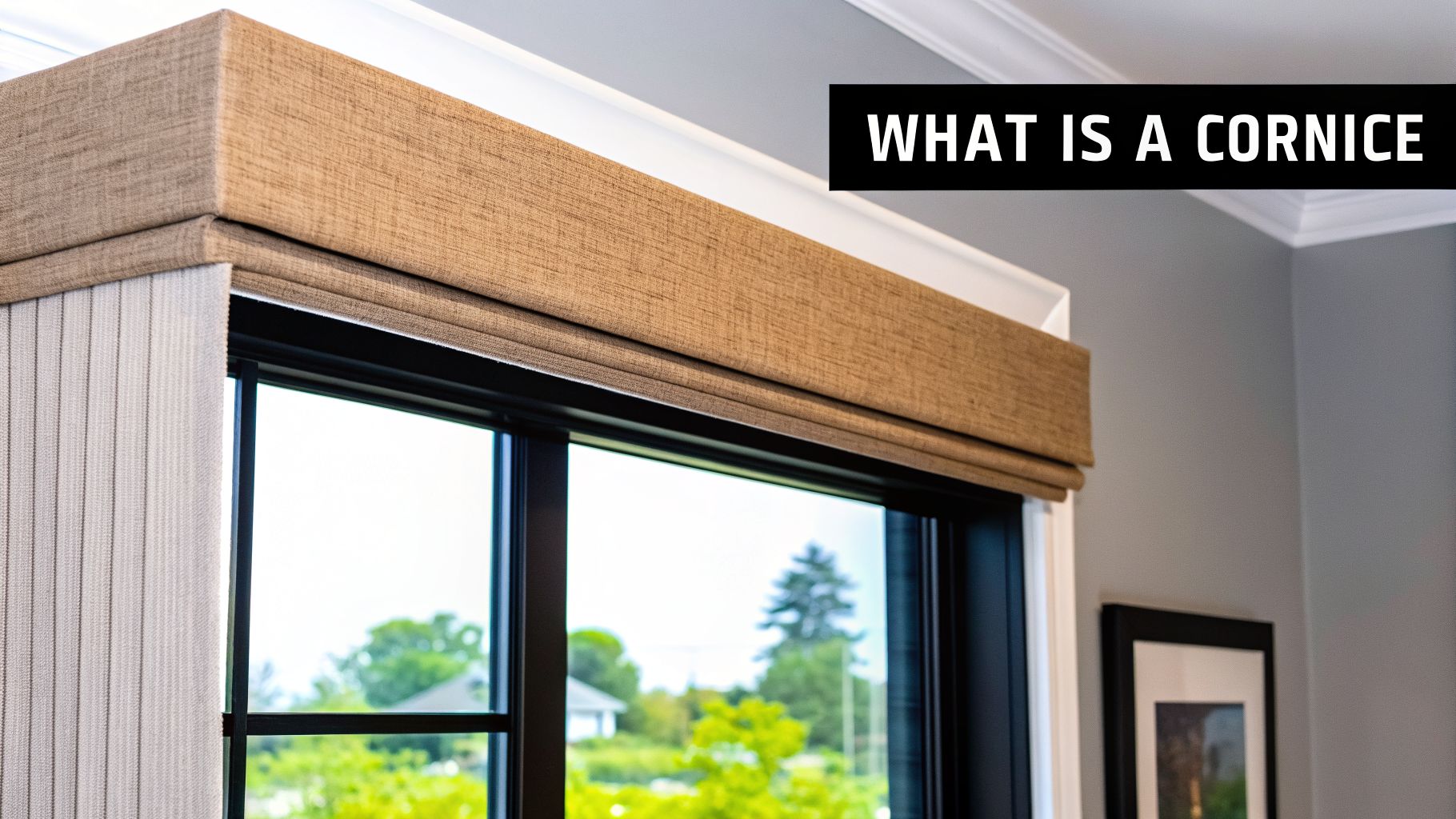
If you’ve ever admired a window that looks perfectly finished—almost like a piece of custom furniture—you were likely looking at a cornice board. It's a hard, box-like top treatment, usually built from wood and then upholstered in fabric, that gives your windows a structured, architectural look.
Think of it as a custom frame for the top of your window, hiding all the drapery hardware and creating a clean, built-in appearance.
What Exactly Is A Cornice Board?
Unlike a soft, flowing valance, a cornice has sharp, clean lines and a tailored feel. This makes it a sophisticated choice that works just as well in luxury homes as it does in upscale commercial spaces. It’s one of those versatile design elements that bridges the gap between a simple window dressing and a truly intentional interior design.
It's the perfect solution for hiding hardware, framing a beautiful view, and tying your entire room's decor together.
Merging Form With Function
Imagine the difference between a casual scarf and a perfectly tailored suit jacket. A cornice board is the jacket—it's structured, purposeful, and sharp. It’s built on a sturdy wood frame, which is then padded and meticulously upholstered in the fabric of your choice. That solid construction gives it a substantial presence that soft treatments just can't match.
This architectural quality is what allows a cornice board to play its dual role so well. It’s not just for looks; it’s a functional workhorse in high-end design.
The main job of a cornice board is to create a clean, uninterrupted line at the top of a window. It hides the less-than-pretty rods, rings, and brackets, letting the drapery fabric be the star while adding a sense of height and grandeur to the room.
Elevating Indoor And Outdoor Spaces
The beauty of a cornice board is its adaptability. In a formal dining room, a cornice wrapped in elegant silk can add a layer of classic refinement. In a modern office, a minimalist design with a solid linen fabric provides a clean, professional finish. If you're curious about how different window treatments compare, you can learn more about the difference between drapes and curtains in our detailed guide.
Plus, the robust structure of a cornice makes it a fantastic choice for more demanding environments. For outdoor living areas, a cornice board upholstered in performance fabric can beautifully frame outdoor drapery, concealing the heavy-duty hardware needed to withstand the elements. This creates a cohesive, resort-like feel for patios and lanais, proving that a cornice is a true statement piece that perfectly merges form and function.
The Architectural History Of Cornice Design
The cornice board, a staple of sophisticated interior design, has a surprisingly grand history that started not inside the home, but on the exteriors of ancient temples. Long before they framed our windows, cornices were critical architectural features, crowning buildings to shield them from rain while lending a sense of power and completion. This journey from outdoor necessity to indoor luxury is what gives today’s cornice boards such a timeless feel.
The story really begins with classical architecture. In ancient Greece and Rome, the cornice was the top, projecting layer of an entablature—that decorative band sitting right above the columns. Its carefully designed overhang was both practical and beautiful, casting strong shadow lines that defined the building’s shape and gave it a commanding presence. This classical foundation cemented the cornice as a symbol of both structural purpose and aesthetic grandeur.
From Ancient Temples To Opulent Interiors
As architectural tastes shifted, so did the cornice. Interior cornice boards, often just called cornices, are custom-built wooden boxes that elegantly frame window treatments, hiding all the hardware while adding a touch of architectural structure to a room. Unlike the exterior cornices that have crowned buildings for millennia—a practice going all the way back to ancient Egypt with the iconic papyrus-leaf-inspired cavetto style—these indoor versions really took off in the 18th-century Georgian era.
During this period, grand English and American homes widely embraced dentil cornices, known for their evenly spaced rectangular blocks that create a beautiful, rhythmic pattern. In fact, you can still see them in countless surviving colonial mansions across the U.S. today. You can discover more insights about the evolution of cornice design over the ages.
A cornice board is more than just a window treatment; it is a piece of architectural history brought indoors. Its clean, structural lines echo the classical principles of order and elegance, lending a sense of permanence and prestige to a room.
The Cornice Board In Modern Luxury Design
This rich history is exactly why the cornice board feels so perfectly at home in today’s luxury homes and commercial spaces. Its historical DNA gives it a sense of sophistication that softer treatments often can't match. When you install a custom cornice board, you’re not just adding an accessory; you’re weaving a time-honored architectural feature right into your decor.
This connection to the past turns a simple window into a deliberate design statement. Whether it's upholstered in a sleek, modern solid or a classic print, the cornice board’s strong, defined shape brings a sense of structure and intention to the room. It honors its architectural roots by framing the view, concealing hardware, and adding a finishing touch that feels both classic and current, elevating the entire space with a bit of historical prestige.
Understanding Cornices And Valances
When you're trying to find that perfect finishing touch for a window, it often comes down to two choices: a cornice or a valance. They both sit at the top of the window and hide the hardware, but they bring completely different energy to a room. Getting the distinction right is the key to nailing the look you want, whether it’s for a formal living room or a relaxed coastal retreat.
Think of a cornice board as a beautifully tailored jacket for your window. It’s a hard, structured frame—usually built from wood and then upholstered—that provides crisp, clean architectural lines. Its solid form gives it a commanding presence that feels intentional and built-in, adding a real sense of substance to the room.
A valance, on the other hand, is all about the fabric. It’s more like a soft, flowing scarf draped elegantly over the window. With its gentle folds, swags, and pleats, a valance creates a much softer feel. Depending on the fabric you choose, it can be romantic, traditional, or even casual.
The Decisive Difference In Structure
The real fork in the road is in how they’re made. A cornice is a hard treatment because it has a rigid, box-like structure underneath the fabric. A valance is a soft treatment; it's nothing but fabric, skillfully cut and sewn to drape beautifully. This isn't just a minor detail—it completely changes what they look and feel like in a space.
A cornice's solid construction gives it that clean, architectural finish. It's fantastic at hiding bulky hardware, especially the motorized systems we see more and more for both indoor and outdoor drapery. A soft valance will drape around the hardware, but it won’t conceal it with the same sharp, seamless precision.
The infographic below shows just how far back the idea of a cornice goes, from its roots in classical architecture to its role in modern homes today.
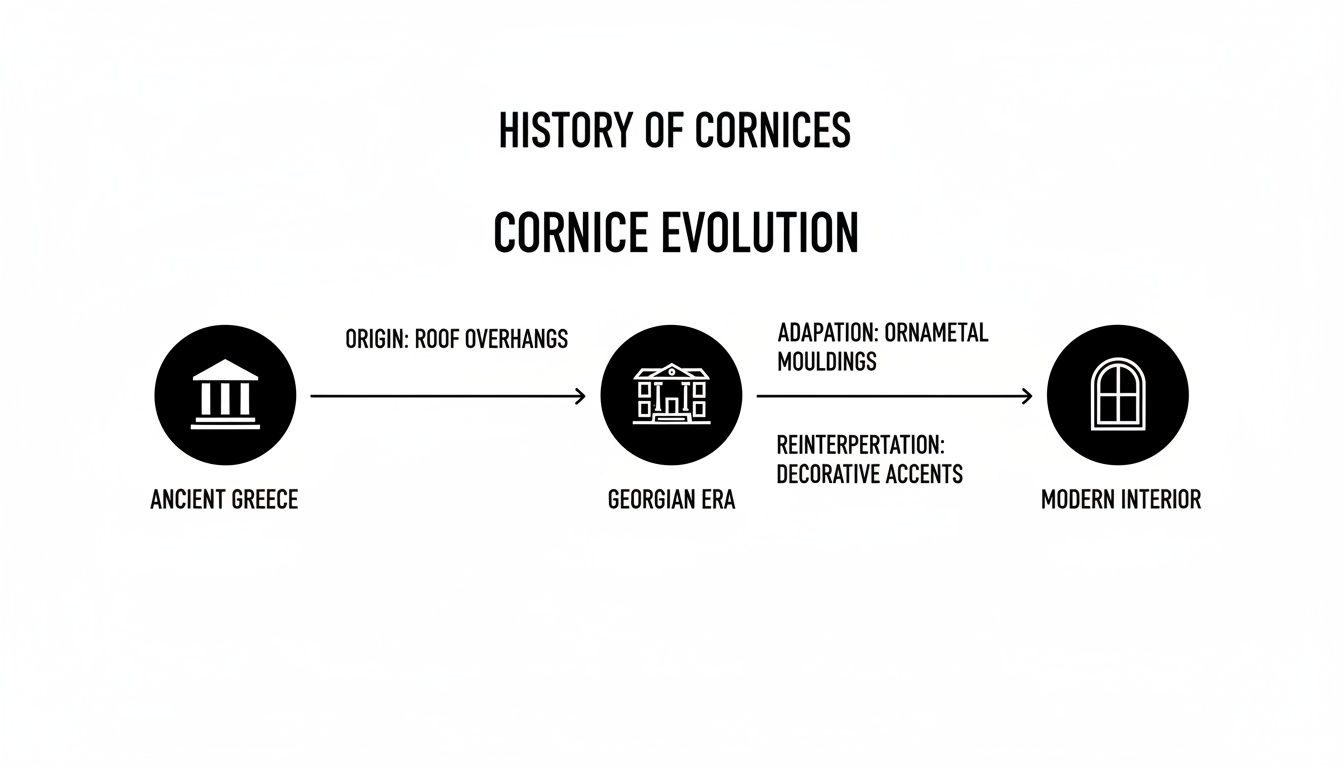
You can see how those strong, classic lines have been brought indoors to create a sense of elegance and permanence. Of course, if you're leaning toward that softer look, it's just as important to learn how to measure for valances correctly to make sure the fabric hangs perfectly.
Ultimately, it all comes down to your goal. If you want a bold, architectural statement that gives you superior coverage and a high-end, custom-built feel, the cornice is the way to go. If you're looking for a softer, more decorative touch where the fabric can be the star, a valance offers endless possibilities.
Customizing Your Cornice Materials And Styles
Think of a custom cornice board as a blank canvas for your window. It’s an opportunity to transform a simple opening into a true architectural feature. We always start with a high-quality wood foundation, which gives the cornice its clean, sharp structure. From there, the fun really begins—the possibilities for making it uniquely yours are practically endless.
The real personality comes from the upholstery. We work with an extensive selection of premier fabric lines, so you can dial in the perfect texture, color, and pattern for your space. Whether you’re drawn to the relaxed elegance of Belgian linen, the rich sheen of silk, or need the durability of performance fabrics for outdoor drapery, the material you choose sets the entire mood.
Shaping Your Cornice Style
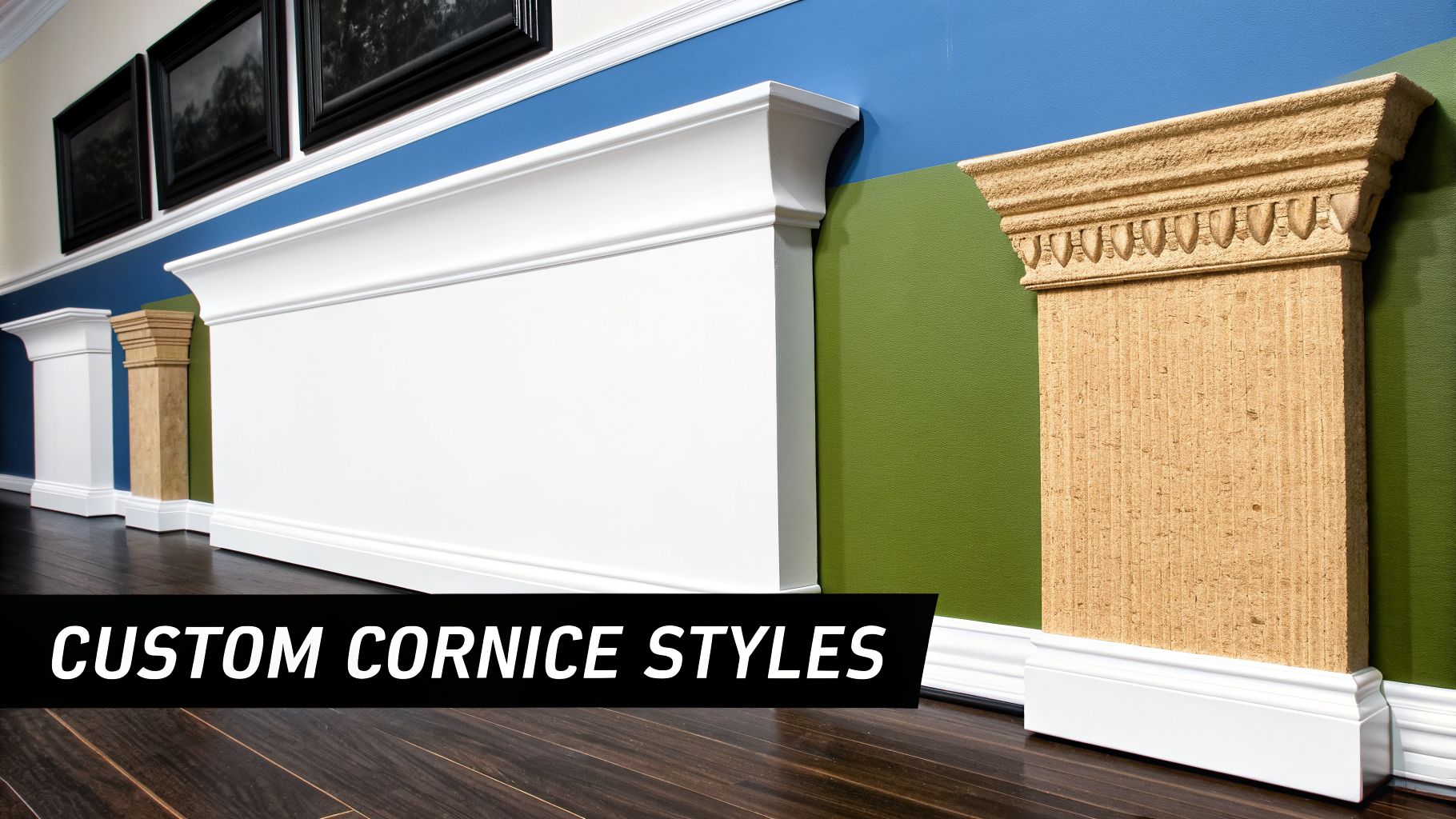
The silhouette of your cornice board makes a powerful statement. The shape is what steers your room’s aesthetic, taking it from sleek and contemporary to traditionally opulent. Every style profile has its own distinct personality.
The shape of a cornice board is where its architectural heritage truly shines. Modern styles often favor clean, straight lines that complement a minimalist aesthetic, while more traditional designs can feature intricate curves, arches, or stepped edges for a dramatic effect.
You can actually trace these shapes back to ancient architecture. In classical Greece, cornices were the crowning jewels of buildings. The Doric style was all about plain, geometric lines, while the Ionic order incorporated scrolls and the elaborate Corinthian style used lavish leaf designs in the most opulent buildings. You can discover more insights about these classical architectural styles and see how those ancient forms still influence design today.
Adding Exquisite Finishing Touches
It’s the final details that elevate a cornice from a simple window covering to a true work of art. These are the little embellishments that add layers of texture and character, turning a standard piece into something completely custom.
Here are a few popular ways to add that finishing touch:
- Decorative Trims: A touch of sophisticated gimp, classic cording, or even a playful tassel fringe along the bottom edge can add so much elegance.
- Nailhead Accents: For a hint of industrial chic or traditional charm, precisely applied nailheads are a great choice. They come in finishes like brushed nickel, antique brass, or polished chrome.
- Contrast Welting: This is a fantastic way to define the cornice’s shape. Using welting in a contrasting fabric outlines the top and bottom edges for a crisp, tailored look.
By carefully selecting these final elements, you’re creating a personalized statement piece. If you'd like to dive deeper, check out our guide on understanding different window treatment materials and styles.
More Than Just Good Looks: The Practical Side Of Cornice Boards
A custom cornice board is undeniably a showstopper, but its true genius lies in what it does behind the scenes. Think of it less as just a pretty accessory and more as a hardworking upgrade for your windows. Beyond the elegant silhouette, a cornice delivers real, tangible benefits that boost comfort, save energy, and even make modern smart-home features possible. It’s where high style meets everyday practicality.
One of its most celebrated jobs is light control. You know that frustrating sliver of light that always seems to peek out from the top of even the best blackout curtains? A cornice board puts a stop to that. It creates a solid cap over the top of the window treatment, completely blocking that "light halo" and giving you a true room-darkening effect. This is a game-changer for bedrooms, media rooms, or any space where you need total darkness.
Better Efficiency, Smarter Homes
A cornice board is also a quiet hero when it comes to energy efficiency. By enclosing the top of the window, it traps a pocket of air between your drapery and the glass. This trapped air acts as an extra layer of insulation, helping keep your air-conditioned cool air inside during summer and preventing heat from escaping on chilly days. It’s a simple addition that helps your home maintain a more consistent, comfortable temperature.
This same functional design is also exactly what makes a cornice board perfect for modern home automation.
A key advantage in luxury design is the cornice board's ability to completely hide the hardware. Its solid, boxy structure is the perfect housing for the tracks, motors, and wiring of automated drapery systems, keeping all the tech neatly out of sight.
This is a huge plus for those massive, show-stopping windows or hard-to-reach spots where motorized treatments are a must. It also creates a clean, polished look for outdoor drapery on lanais and patios, hiding the heavy-duty hardware from view and giving it a bit of extra protection from the elements.
At the end of the day, a cornice board is proof that the most beautiful design choices are often the smartest. It takes a simple window and turns it into a high-performing feature of your home.
Our Process For Custom Cornice Fabrication And Installation
Bringing a custom cornice board to life is a mix of artistry and precision. It’s a journey we take with you, starting with your initial idea and ending with a flawless, white-glove installation in your home. It’s this hands-on, detailed approach that truly sets a custom-built piece apart from anything you can buy off the shelf.
It all starts with a simple conversation. We sit down to understand what you're looking for—your style, your functional needs, and the unique feel of your space, whether it’s a modern waterfront home or a classic commercial property. This first step ensures the final cornice is a perfect match for your vision.
Meticulous On-Site Fabrication
One of the biggest advantages of working with us is our on-site workroom. We control every single part of the fabrication process under our own roof, which means no unexpected delays or inconsistencies from outside suppliers. This direct oversight is our guarantee that every cut, every seam, and every final touch meets our incredibly high standards.
Having an integrated workroom means we can maintain unparalleled quality control. Your custom cornice board is not just assembled; it is meticulously crafted by our experienced artisans who take immense pride in their work, from building the wood frame to hand-upholstering the final piece.
Our team brings decades of dedicated expertise to every project. We build each cornice to the exact specifications of your windows, ensuring a perfect, bespoke fit. This in-house method not only allows for true customization but also keeps your project on track and on time.
White-Glove Installation Service
The final step is just as important as the first: a perfect installation. Our professional installers treat your home with the utmost respect. They make sure your new cornice is mounted securely, leveled perfectly, and seamlessly integrated with your existing decor. They handle everything, leaving your space clean and the job done right.
This commitment to an end-to-end, in-house process results in a cornice board that doesn't just fit your window—it elevates the entire room's architecture. To learn more about our commitment to excellence, read about our professional drapery installation services near you. We manage the entire journey, delivering a final product that exceeds every expectation.
Common Questions About Cornice Boards
When you start thinking about adding a cornice board to a room, a few practical questions always pop up. It's completely natural. Whether we're talking with homeowners or our commercial clients, the same thoughtful inquiries tend to surface. Getting good answers is the first step toward feeling confident about your design choice.
We've pulled together the most common questions we hear day in and day out. Our answers are based on decades of hands-on experience fabricating and installing these beautiful pieces right here in our own workroom.
How Much Does A Custom Cornice Board Cost?
There's no one-size-fits-all answer here, because every single cornice board we create is built from scratch for a specific window. The final investment really depends on a few key things: the overall size, the fabric you choose, how complex the shape is, and any extra details like nailhead trim or a contrasting welt.
Because we build everything in our local workroom, we can give you a clear, detailed quote during our design consultation. This way, the final piece is a perfect match for both your design vision and your budget. Think of it as a lasting architectural detail that adds a ton of polish and value to your home.
Can I Use A Cornice Board With Blinds Or Shades?
Absolutely! This is one of their biggest strengths. Cornice boards are incredibly versatile and look fantastic when layered over other window treatments. We often install them over blinds, shutters, or Roman shades to create a complete, fully finished look.
In this setup, the cornice board's main job is to hide the headrails, brackets, and all the functional hardware of the treatment underneath. It creates a seamless, high-end appearance that really pulls the whole window together. Getting that perfect fit is critical, and you can learn why professional measurements for window treatments are so important.
How Do I Care For My Upholstered Cornice Board?
Keeping your cornice board looking beautiful is actually pretty simple. For day-to-day upkeep, a light dusting or a gentle pass with the soft brush attachment on your vacuum is all it takes. This just keeps dust from settling into the fabric fibers over time.
If you ever have a small spot or spill, it's always best to check the specific cleaning instructions for your particular fabric. As part of our service, we make sure all our clients have expert guidance on caring for their custom pieces so they stay stunning for years.
Ready to give your windows that timeless, architectural finish they deserve? The experts at The Drapery Company are here to bring your vision to life with a custom cornice board, fabricated right here in our on-site workroom. https://draperycompany.com