How to Choose the Right Size of Curtain Panels
August 6, 2026
Relaxed Roman Shades: Custom vs Ready-Made Guide
August 8, 2026
You're standing in a Tampa Bay living room with the afternoon light pouring across the glass, and the drapes looked perfect an hour ago. Then the humidity settles in, the folds soften, the hem starts to relax, and that gorgeous pure linen begins to show every crease like it's trying to prove a point. That's usually the moment homeowners, designers, and property managers start asking what linen blend fabric is, and whether it can survive the rooms we live in, not just the rooms we photograph.
For custom window treatments, linen blends have become the fabric that solves the everyday complaints pure linen can't always avoid. They're built to improve wrinkle recovery, reduce unpredictable shrinkage, and hang more cleanly on everything from pinch pleats to motorized tracks. In a climate like Tampa Bay, that difference isn't theoretical, it's the difference between panels that stay composed and panels that need constant attention.

If you're trying to reduce heat and glare in a bright room, this practical overview of window shades for heat reduction helps frame the fabric choice in the right context. Fabric is only one part of the equation, but it's the part you see and touch every day.
Why Linen Blends Matter for Tampa Bay Window Treatments
Pure linen can look sharp on installation day. It has the crisp texture that suits coastal homes, formal dining rooms, and commercial spaces that need a softer, polished finish. Tampa Bay gives fabric a harder job. Humidity, harsh sun, and frequent handling expose weakness quickly, especially when panels need to stay neat on a track or fold cleanly into a Roman shade.
Linen blend fabric earns its place because it gives you more control over how the treatment performs after it leaves the workroom. Mixing linen with another fiber can make the cloth easier to live with while keeping the character people want from linen in the first place. The practical payoff shows up in better wrinkle behavior, more predictable sizing after fabrication, and hems that stay cleaner over time. For custom drapery, that matters because a panel that hangs well on install day but sags, twists, or looks uneven later is not doing its job.
What blend fabric changes in real rooms
A blend is not just a cosmetic compromise. In practice, linen is often combined with cotton, viscose, polyester, or another fiber to improve stability, softness, or cost control while linen still provides texture and breathability. Linen's long textile history also explains why blending is not a modern trick, it has been part of the fabric's evolution for a long time, as noted in linen history.
In a Tampa living room, that usually means a better shot at panels that still look finished after repeated use. On motorized tracks, it can mean fewer complaints about creasing where the fabric stacks. On lined drapery, it can mean the hem and side seams are less likely to fight you during finishing. A blend does not erase linen's personality, it makes that personality workable.
If the treatment has to look composed every day, not only on installation day, a blend usually earns its keep.
For homeowners comparing fabrics against heat and glare, this guide to window shades for heat reduction helps put the fabric choice in the right context.
What Linen Blend Fabric Is

A linen blend starts with flax, the fiber behind linen, and then changes the cloth's behavior by adding another fiber. In the workroom, that matters more than the label on the bolt. A pure linen panel may have a beautiful dry hand and strong texture, but once humidity, sun exposure, and daily use enter the room, a blend can give you a fabric that hangs with more control.
Flax has a long textile history, and that history explains why linen still matters in window work. The fiber has been valued for body, texture, and breathability for a very long time, then adapted as production and use changed over time. That background is useful, but the practical question is what the cloth does on a rod, on a motorized track, and after it has spent time in a bright Tampa Bay room.
The working definition
A linen blend fabric is linen combined with another fiber to change how the cloth behaves. That partner might be cotton for a softer hand, viscose for more fluid drape, polyester for durability and crease control, or another fiber chosen for a narrow purpose. The blend is not trying to pass as pure linen. It is built to perform a specific way.
That kind of fiber engineering matters because flax linen holds moisture differently from polyester and stretches differently too. Linen keeps the cool, natural hand people want, while polyester helps the fabric dry faster, recover shape, and hang more consistently. In a humid room, a linen-polyester drapery panel usually behaves more predictably than 100% linen, especially when the fabric has to cycle open and closed on a motorized track (fiber engineering reference).
For homeowners comparing sample books, the decision is practical. Pure linen gives more character. Linen blend fabric gives more control. If a room needs both, the blend is usually the place to start.
Products marketed as faux linen curtains show the same buyer preference in a different form, since they borrow linen's look while pushing harder toward easy-care performance. That is not the same thing as a linen blend, but it makes the point clear. People want the texture, and they also want a fabric that holds up when the room is hot, bright, and used every day.
Common Fiber Partners and What Each One Contributes

A spec sheet can tell you a lot if you know what to look for. The fiber partner changes how the fabric stacks, how it catches light, how often it needs steaming, and whether it still looks refined after the first season in a sunny room.
Cotton, viscose, polyester, and smaller blends
Cotton softens linen without erasing its structure. In window treatments, that usually means a smoother hand, a more approachable feel, and a drape that reads a little less rigid than pure linen. It's a smart pairing for living rooms and bedrooms where you want the fabric to feel relaxed but still put together. That's why cotton-linen is often the easiest blend for homeowners to recognize as “comforting” rather than formal.
Viscose changes the visual language. It deepens drape, adds fluidity, and can make the cloth hang with more graceful movement. For curtains that need a softer fall, viscose can be useful, especially when the room needs a more luxe, fluid finish. The trade-off is that the fabric may feel less crisp than a cotton-linen version.
Polyester is the workhorse partner. It improves wrinkle resistance, dimensional stability, and price control. It also helps the fabric recover after stacking and repeated use, which is one reason linen-polyester shows up so often in contemporary drapery and Roman shade applications. For many homes, it's the most practical answer to daily handling.
Smaller blends, including combinations with wool or silk, tend to be used for more specialized hand and finish goals. They're less about everyday utility and more about fine-tuning opacity, luster, or softness.
A good fabric card doesn't just say “linen blend.” It tells you what the other fiber is doing, and what it's costing you in feel.
Industry references commonly formulate these blends at about 30% to 70% linen with the balance in cotton, viscose, or polyester, because the partner fiber offsets linen's limits while preserving enough of its character. That range gives workrooms room to choose between softness, structure, and easier care, depending on the room.
For a broader fabric context, it also helps to compare the blend against cotton curtains for living room, because many homeowners are deciding between cotton's easy familiarity and linen's more refined texture.
Reading the Blend Ratio for Real-World Performance
Blend ratio is the number that tells you how the fabric is likely to behave once it's sewn, hung, and lived with. A bolt may say linen blend, but 55/45, 70/30, 50/50, and 90/10 all perform differently in drapery, and the differences show up fast in humidity and sunlight.
What the common ratios usually signal
A 60/40 linen-cotton cloth tends to land in the middle, enough linen to keep texture and breathability, enough cotton to soften the hand and make the panel feel a little easier to live with. It works well when the room needs polish without stiffness.
A 55/45 or 70/30 linen-polyester blend usually feels more controlled. The higher the polyester share, the more the fabric resists wrinkling and holds its shape after installation. That makes a difference on west-facing windows, where repeated sun exposure and temperature shifts can make pure linen look tired sooner.
A 50/50 linen-polyester balance is often the safest practical middle ground for homeowners who want structure without giving up too much natural texture. Typical shrinkage for 50/50 linen-polyester blends is about 1% to 3% on first wash, compared with 4% to 10% for unsanforized 100% linen (shrinkage reference). For hemmed treatments, that stability matters.
Ratio to use case
| Blend Ratio | Typical Feel and Drape | Wrinkle Recovery | Best Window-Treatment Use |
|---|---|---|---|
| 55/45 linen-polyester | Tailored, slightly firmer, cleaner stack | Stronger than pure linen | Lined drapery in busy rooms |
| 70/30 linen-polyester | More natural feel, still controlled | Good balance | Sunny living rooms and dining rooms |
| 50/50 linen-polyester | Middle-ground hand, predictable finish | Reliable stability | General-purpose custom panels |
| 90/10 linen-polyester | Closest to pure linen, with some help | Modest improvement | Decorative panels where texture matters |
| 60/40 linen-cotton | Softer, approachable, less crisp | Moderate recovery | Bedrooms and family rooms |
For comparison shopping, I tell clients to read the ratio before they fall in love with the label. The word “linen” on the bolt is less useful than the actual blend. A panel's future is mostly written in that percentage line.
If you're comparing drapery styles at the same time, types of drapery is a useful reference point because the treatment style changes how much the fabric's ratio matters.
Care, Cleaning, and Drapery Repair Considerations
Tampa Bay is rough on fabric. Humidity makes natural fibers relax, salt air can leave a finish looking dull, and harsh sun fades both color and confidence if the fabric choice wasn't right from the start. Linen blends handle that reality better than pure linen, but they still need a maintenance plan.

What a workroom watches after installation
Start with dust control. Gentle vacuuming with a brush attachment keeps grit from working into the weave. Spot clean small marks before they set, and keep the room ventilated so trapped moisture doesn't linger in folds or hems. For homeowners who want a broader maintenance checklist, the fabric care guide for homeowners from AMPM Restoration Services is a useful outside resource to keep on hand.
Outdoor drapery deserves a separate conversation. A buying guide classifies 40% to 59% linen blends as suitable for drapery, while 15% to 39% linen blends are commonly recommended for outdoor cushions and other high-durability uses, with polyester variants resisting stains but sometimes trapping heat (outdoor and drapery guide). For outdoor drapery in Tampa, that means the blend choice has to be paired with drainage, airflow, and a realistic expectation about sun exposure.
Repair matters too. If a linen blend panel relaxes over time, drapery hemming or minor curtain repair can bring the treatment back into line without replacing the whole job. A small correction is often smarter than living with a panel that has sagged at the floor or pulled unevenly at the stack-back. For Roman treatments, how to clean Roman shades is relevant because clean folds are easier to preserve when the treatment is maintained on a schedule instead of left to build up grime.
In humid climates, maintenance isn't cosmetic. It's part of the installation's lifespan.
Matching Blends to Draperies, Roman Shades, and Motorized Solutions
The right blend depends on what the fabric has to do once it leaves the workroom. A drapery panel, a Roman shade, and a motorized track all stress fabric differently, so the same cloth can be perfect in one application and frustrating in another.
Where each treatment needs help
For drapery, you usually want a blend that keeps enough linen character to look elegant, but enough stability to hang cleanly and stack well. That's why moderate-linen blends are often the easiest choice in formal rooms and large openings. They give you body without the brittle, overly crisp look that can happen when the fabric is too linen-heavy.
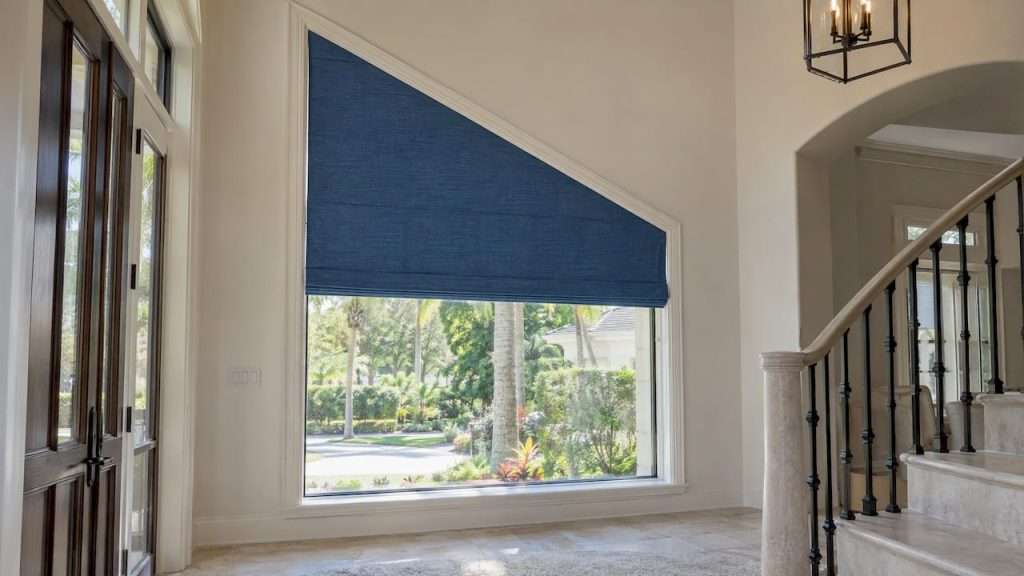
For Roman shades, predictable fold memory matters more than the romance of the fiber content. The fabric has to crease where it's meant to crease, and resist looking sloppy where it shouldn't. A blend with better shear control and a stable hand usually performs better than a fabric that looks beautiful on the roll but fights the shade mechanism after installation.
Motorized tracks are less forgiving. Repeated movement punishes weak yarn structure, and the fabric has to behave consistently every time the system cycles. In that context, a linen-polyester blend often gives a cleaner result than a purer linen cloth because it helps the panel recover after motion.
Research on bedding fabrics found that linen blends with man-made cellulosics produced higher air permeability, bending, and shear ability without significantly changing thermal absorptivity, which points to better drape and handling while keeping linen's cool-touch behavior (fabric performance study). That same logic shows up in window treatments, especially when a room needs elegance without stiffness.
For motorized shades, the fabric has to be kind to the mechanism, not just pretty in a sample book.
A workroom can also layer a linen-blend face fabric over a performance lining when room darkening or sun control matters. That's often the cleanest way to keep the front face luxurious while giving the system the support it needs behind the scenes. I've seen that approach work well in polished homes and commercial spaces where the treatment has to look expensive and behave predictably.
Buying Considerations for Homeowners and Trade Professionals
The smartest buying decision starts with three questions, where is the fabric going, what is it hanging on, and how much punishment will it take? Once those answers are clear, the blend choice usually gets easier.
What to ask before you approve a sample
- Sun exposure: A west-facing room needs a different blend mindset than a shaded guest room.
- Movement: Motorized systems and frequently used panels need better recovery and stability.
- Finish requirement: If the room demands sharp hems and controlled stacking, pure linen is often too temperamental.
- Indoor or outdoor use: Outdoor drapery needs a different durability conversation than a formal dining room.
- Fabrication quality: Onsite workroom finishing matters because blend behavior shows up in seams, hems, and returns.
The right spec sheet also helps you decide whether a fabric is a statement piece or a maintenance item. Linen-heavy blends keep more texture and natural irregularity. Polyester-heavier blends are easier to manage and usually more forgiving for busy households, hospitality spaces, or homes with lots of glass and sun.
I do use The Drapery Company as one practical option when a client needs consultation, fabrication, and installation in one place, because onsite workroom control makes blend-specific hemming and fit easier to manage. That matters when the fabric is chosen for performance as much as appearance.
The final decision should be made on swatches in the actual room, not under showroom lighting. Hold the sample against the window, let it fold in your hand, and ask whether you want the treatment to read crisp, relaxed, or engineered. That's the buying test.
Common Questions About Linen Blend Fabric
Can linen blend fabric be motorized? Yes, and in many rooms it's a better choice than pure linen because the blend usually tracks more predictably and recovers better after repeated motion. The key is choosing a ratio that supports the system instead of fighting it.
Is linen blend fabric good for sunny rooms? It can be, but the blend has to match the room's exposure. Higher-stability blends handle daily use better, while lighter, lower-linen blends are usually more practical where the sun is harsh and constant.
Can linen blend fabric be used outdoors? Some blends are better suited than others, but outdoor use needs the right construction, the right lining or backing, and a realistic care plan. Don't assume every linen blend is outdoor-ready just because it includes polyester.
Does linen blend fabric need curtain repair or hemming over time? Sometimes, yes. Humidity and use can relax a panel, and a good drapery repair or hemming adjustment can restore the finished length without replacing the fabric.
What's the simplest way to choose between two linen blends? Compare the ratio, the fiber partner, and the room conditions. If one sample feels more controlled in your hand and hangs with less fuss, that one usually wins in a Tampa Bay installation.
If you're planning custom drapery, Roman shades, outdoor drapery, or motorized window treatments in Tampa Bay, The Drapery Company can help you sort out the fabric ratio, fabrication details, and installation before you buy. Visit The Drapery Company to start with a consultation and choose a linen blend that fits the room, the light, and the way you live.