Fade Resistant Drapery Fabrics for Tampa Bay Homes
October 23, 2026
West-Facing Window Glare: How to Control It in Tampa Bay
October 26, 2026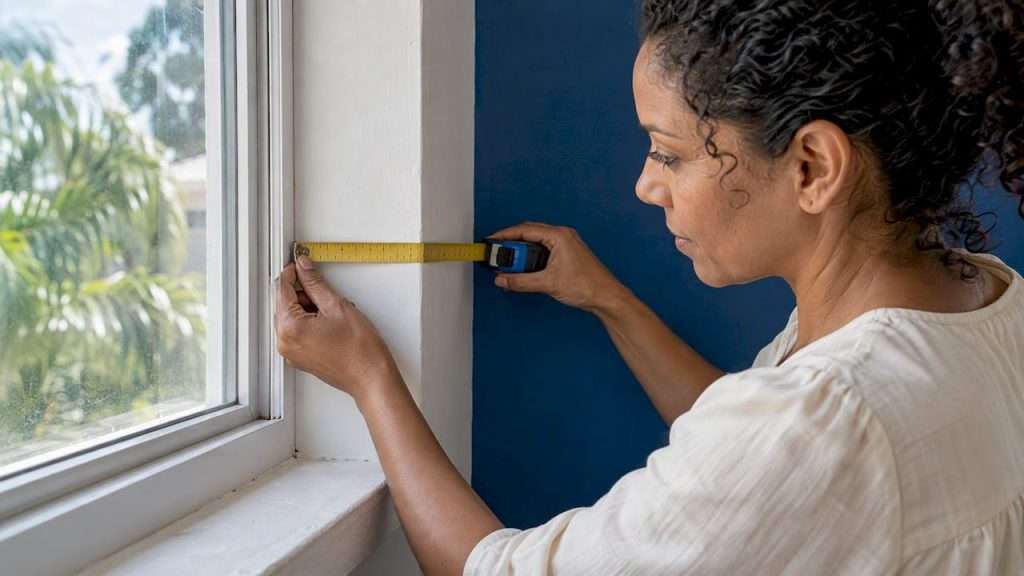
Inside mount depth is the distance from the face of your window glass to the front edge of the frame or trim. It decides whether a blind, shade or shutter can sit inside the window opening, and whether it will sit flush with the trim or stick out into the room. The right number depends on the product and its lift system, so measure your depth first, then compare it to the headrail or cassette size listed for the exact treatment you want.
We fabricate custom window treatments in our Tampa Bay workroom, and depth is the measurement that surprises homeowners most. Width and height get all the attention. Depth quietly decides whether an inside mount is possible at all.
TL;DR
- Depth is measured from the window glass to the front edge of the frame, at the top of the opening, where the headrail will mount.
- There is no universal minimum. Each product and lift type (cordless, motorized, continuous loop) has its own headrail size, so the spec for your exact product is the number that counts.
- A shade can fit inside the frame without sitting flush. Flush needs more depth than a bare minimum mount.
- If depth falls short, or you need near-total darkness, an outside mount is usually the better answer.
- Give your fabricator your exact opening sizes. Do not deduct for clearance yourself.
What Inside Mount Depth Actually Measures
Think of the window opening as a shallow box. The glass is the back of the box, the trim or wall edge is the front, and the depth is how far apart they are. An inside mount places the treatment in that box. An outside mount places it on the wall or trim around the box.
The Building America Solution Center describes the choice in the same terms: both options are inside the home, and the difference is whether the blind mounts inside or outside the window well. Depth is the deciding dimension for the first option.
A published manufacturer’s measuring worksheet calls depth critical for inside mounts and tells you to measure the window frame from front to back. That is the whole principle. The part people miss is where to measure and what to compare it against.
Where to Take the Measurement
Place the tape against the glass at the top of the opening, near where the brackets will go, and read to the front edge of the trim. Check a second spot lower down. Older Tampa Bay homes, especially mid-century block construction and homes with replacement windows, often have frames that are not consistent from one side to the other. Record the smallest depth you find, because that is the one that limits you.
Also look for obstructions inside the opening: window cranks, lock handles, tilt latches, muntins and the raised lip some vinyl replacement windows have. A frame that is deep on paper can be shallow where it matters.
Flush Mount Versus Simply Fitting Inside
These are two different goals, and mixing them up causes most inside mount disappointments.
Fits inside the frame. The brackets and headrail mount in the opening, but the front of the headrail may stand slightly proud of the trim. The treatment is inside the window, but you can see it from the side.
Fully flush. The whole headrail, cassette or fascia sits behind the plane of the trim. The window looks built in, with the trim framing the shade. This is the look most people picture when they say inside mount, and it asks for more depth.
When you review a product spec, you will usually see two figures: a minimum depth to mount, and a greater depth for a flush look. Use the second figure if appearance matters to you.
A Worked Example
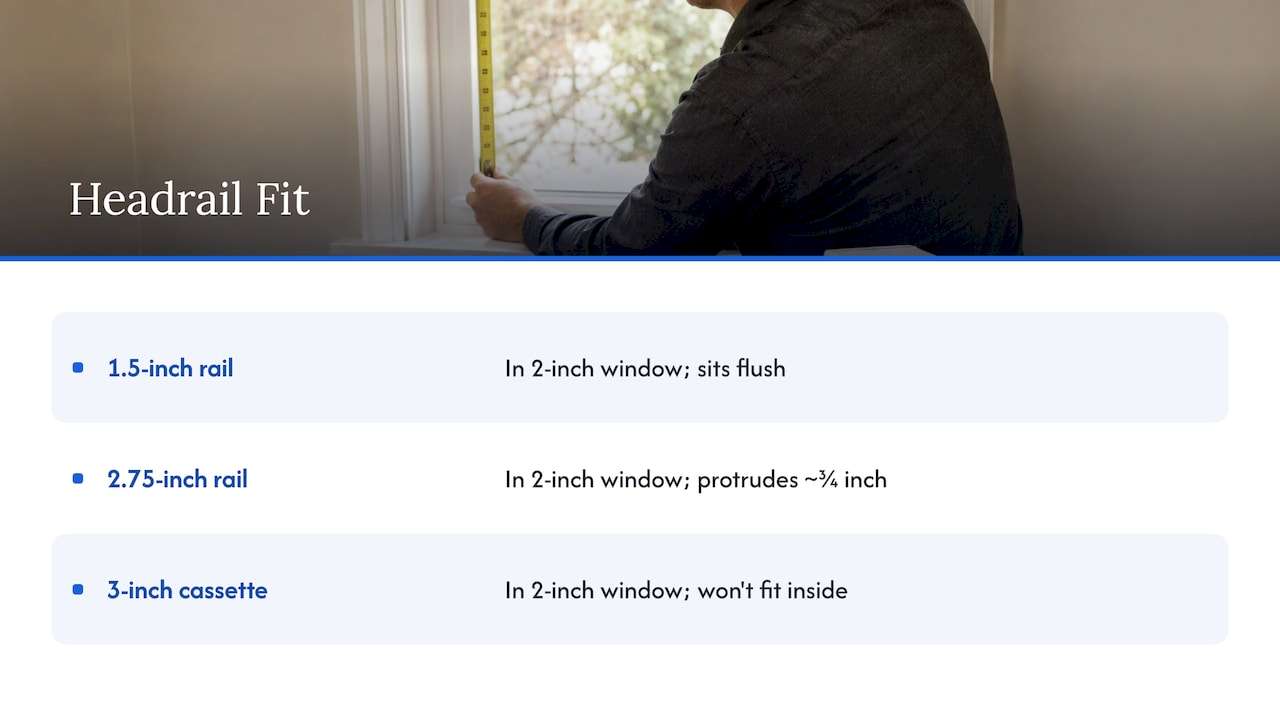
Suppose your window has a depth of 2 inches at its tightest point. A shade with a 1.5-inch headrail clears the glass and sits flush with room to spare. A shade whose spec calls for 2.75 inches to sit flush will mount, but the headrail will protrude about three-quarters of an inch. A shade with a 3-inch cassette will not fit inside at all, and you would shift to an outside mount or choose a slimmer product. The numbers here are illustrations of the arithmetic, not specs for any particular product. Always read your own spec sheet.
Why There Is No Standard Depth
Homeowners often ask for the standard depth for an inside mount. There isn’t one, because the mechanism that raises and lowers the treatment is a design constraint of its own.
Reviewers and practitioners of high-end shades make the same point: the lift system (cordless, motorized wand or continuous-loop cord) directly sets the physical size of the headrail, and motorized options can require a deeper casing to house the motor or battery. In our experience that is exactly why a window that accepts one shade can reject another that looks identical from the front.
Product type matters too:
| Treatment | What drives the depth it needs |
|---|---|
| Roller shades | Roller tube and bracket, or a cassette if you choose one. See our guide to inside mount roller shades. |
| Cellular shades | Headrail height, which changes with lift type and with single or double cell construction |
| Roman shades | Fabric stack when raised, plus the headboard or mounting board. Our guide on how to measure for Roman shades covers this. |
| Horizontal blinds | Headrail plus the stack of slats when the blind is raised |
| Shutters | Frame and louver thickness, and clearance for the louvers to tilt. See how to measure windows for shutters. |
| Motorized shades | Motor housing or battery tube in addition to the headrail |
Cordless and Motorized Lifts
Safety rules are pushing the market toward cordless and motorized products. The ANSI/WCMA A100.1-2022 standard addresses operating cord hazards on window coverings, and the Consumer Product Safety Commission’s safety standard for operating cords on custom window coverings was published in the Federal Register on January 7, 2022. Cordless and motorized mechanisms can change headrail dimensions compared with an older corded design, so do not assume the depth you remember from your old blinds carries over. If you have small children at home, treat cord safety as part of the depth conversation, not a separate one.
If you are weighing motorization, our page on motorized blinds and shades explains the options. Bring your depth numbers when you talk to us.
How to Measure for an Inside Mount
- Measure depth first. Record the smallest depth at the top of the opening and note any obstructions.
- Measure width in three places. Take top, middle and bottom. The Building America guidance says to record the most restrictive reading so the treatment fits the tightest part of the frame.
- Measure height in three places. Take left, middle and right. For blinds, instructions for vertical blind installation say to use the narrowest width and the longest height. Follow the fabricator’s instructions for your product.
- Write down exact numbers. Do not round, and do not subtract anything.
- Note the window type. Casement cranks, sliders and French doors all change what can mount where.
Our guides on how to measure for blinds and using a tape measure accurately go deeper on technique.
Do Not Deduct for Clearance Yourself
This is a rule we hold firmly. A shade built for an inside mount has to be slightly narrower than the opening so it can operate without rubbing. The fabricator makes those deductions. The Building America guide advises against making your own, because providing pre-deducted measurements can produce a product that does not fit. Send us the exact opening, and the shade comes back sized correctly.
What to Do When Depth Falls Short
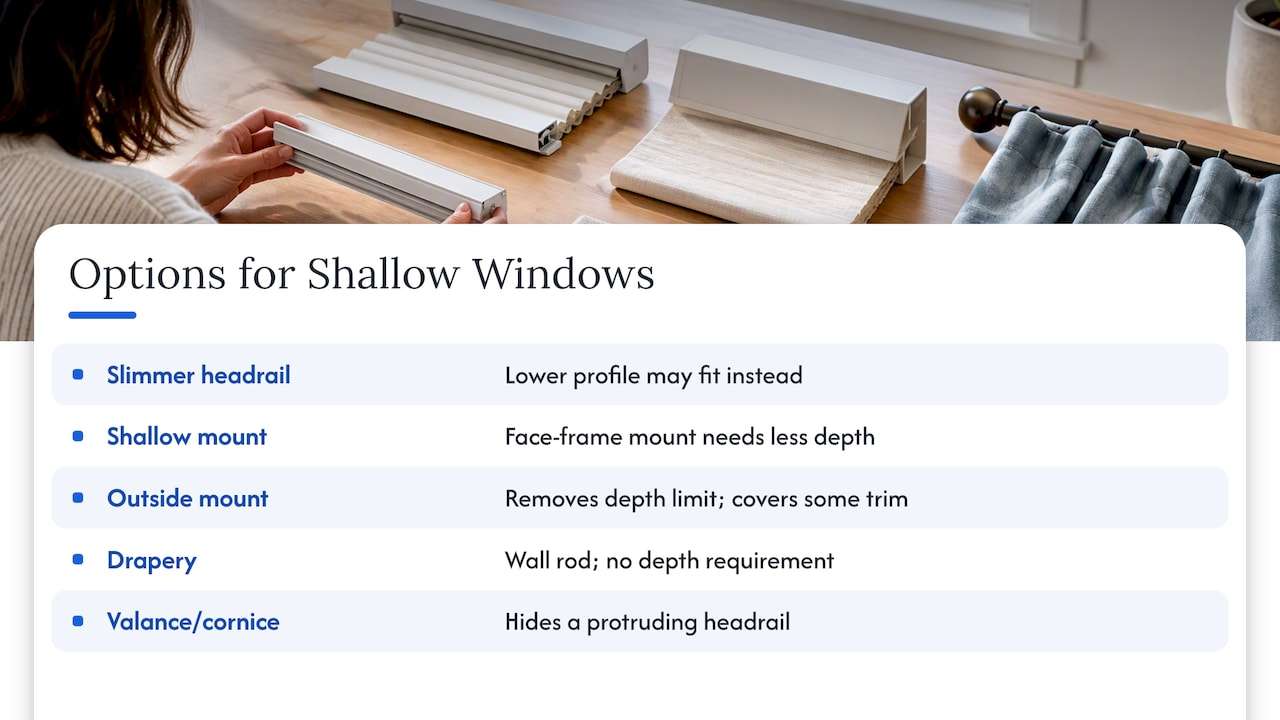
A shallow window does not mean a bad window treatment. You have several good paths.
Choose a slimmer headrail. Some products have a lower profile than others. A cordless, low-profile option may fit where a motorized one with a larger tube would not.
Use a shallow-depth or surface-friendly mount. Certain shades can be mounted to the face of the frame, giving an inside look without full depth. Ask whether your product offers this.
Go with an outside mount. Mounting above and beyond the frame removes the depth limit entirely. It can make a window look taller and wider, and it hides unattractive frames or uneven gaps. Its drawback is that it covers some of your trim.
Switch to drapery. Drapery hangs from a rod on the wall and has no depth requirement at all. For a shallow window in a living room or bedroom, panels on a ceiling-mounted or wall-mounted track can be the more elegant answer.
Add a valance or cornice. If your depth is just short, a valance can hide a protruding headrail.
Light Control and Energy: What Depth Cannot Fix
A deeper frame does not make an inside mount seal the window. Even a perfectly installed inside mount leaves a thin gap around the edges so the shade can move. A TechHive reviewer who installed premium shades inside the window frame noted some light leakage around the edges in every room, though the shades darkened the rooms well.
That matters for a few rooms in particular:
- Bedrooms and media rooms. If you want near-total darkness, an outside mount that overlaps the frame is the stronger functional choice, or add side channels or a layered drapery panel.
- West-facing windows. Our Florida afternoons are hard on rooms. UMass Amherst’s building science team notes that air leakage around windows drives much of the energy loss, so how well a treatment seals the opening matters. For heat and glare control, we often layer a cellular or roller shade with drapery.
- Rooms where the trim is a feature. Inside mounts show off crown-style casing and deep sills. That is the best argument for them.
So the choice is partly aesthetic and partly functional. Decide which matters more in each room, then let depth tell you what is possible.
Our Perspective: Treat Depth as a Design Decision
We have fabricated window treatments in our Tampa Bay workroom for more than 30 years, and the pattern is consistent. Homeowners fall in love with an inside mount from a photo, then discover their windows are 1.5 inches deep. That is rarely a reason to give up the look. It is a reason to pick the right product.
Because we make every treatment onsite, we can adjust more than a mass-produced catalog allows. We measure your windows ourselves, check depth and obstructions at the top of the opening, and tell you plainly whether an inside mount will sit flush, sit proud or not work. If it will not, we show you the options above, tailored to your budget and how you use the room.
Our rule of thumb: measure depth before you fall for a product, and never let a depth number overrule how the room needs to perform. A bedroom that has to be dark is a different decision from a dining room that has to look beautiful.
— The Drapery Company
Let Us Measure Your Windows
If you are in Tampa Bay and unsure whether your windows can take an inside mount, we will check during an in-home consultation. We handle measurement, fabrication, installation and removal of your old treatments. Start with our in-home consultation and installation service, or browse our blinds, shades and shutters. Our guide to the window treatment installation process explains what happens after you measure.
FAQ
What is the minimum depth for an inside mount?
It depends on the product. Some low-profile blinds mount in a shallow opening, while motorized shades and shades with a cassette need more. Look at the spec sheet for your exact product and compare it to the smallest depth you measured.
How deep must a window be for blinds to sit flush?
Flush means the entire headrail sits behind the trim, so you need a depth equal to or greater than the full headrail or cassette. That figure is larger than the bare minimum to mount. Ask for the flush depth specifically.
Can I do an inside mount on a window that is too shallow?
Not with a standard inside mount if the headrail will not clear the glass. You can pick a slimmer product, use a face-mount option where the product offers one, go outside mount, or choose drapery, which has no depth requirement.
Should I subtract from my measurements for an inside mount?
No. Give your fabricator the exact opening sizes, measured in three places, and use the smallest width and the longest height as your fabricator instructs. The deductions for clearance are made when the shade is built.
Sources
- Install Cellular Blinds, Building America Solution Center
- TechHive: lift system and headrail size
- ANSI/WCMA A100.1-2022 Standard for Safety of Window Covering Products
- Federal Register: Safety Standard for Operating Cords on Custom Window Coverings
- UMass Amherst: Windows, Understanding Energy Efficient Performance