
Mildew Resistant Drapery Fabrics for Humid Climates
October 26, 2026
Shades That Preserve Your View: How to Choose
October 28, 2026
Motorized shades need very little maintenance, but they are not maintenance-free. Dust the fabric regularly, vacuum gently with a soft brush, keep moisture away from the motor and electronics, and treat batteries as a scheduled item rather than a surprise. Do that, and a well-installed system should run quietly for years. This guide covers what to do, how often, and the point where a call to your installer saves you money.
TL;DR
- Dust the fabric with a microfiber cloth or feather duster, and vacuum with low suction and a soft brush attachment. Never spray or wet the motor, headrail or wiring.
- Properly installed shades generally need no lubrication. Only lubricate parts the manufacturer’s instructions name.
- Battery life depends on the system, shade size and how often it moves. Use fresh batteries from one package and never mix types.
- If a shade stalls or moves unevenly, check for obstructions, then batteries, then power and connections, then follow the manual’s reset. If it persists, call your installer.
- Cellular and commercial fabrics often forbid water, steam and harsh chemicals, so read the care sheet before you clean.
What motorized shades actually need
A motorized shade is a fabric, a tube or headrail, a motor, and a control. Most owners think about the fabric because they can see it. The motor is sealed and quiet, and it is the part you can least afford to damage.
Maintenance therefore splits into four jobs:
- Keeping the fabric clean without distorting it.
- Keeping the motor and electronics dry and unobstructed.
- Managing power, whether batteries, a rechargeable pack or hardwired.
- Noticing small changes in how the shade moves before they become failures.
Hunter Douglas Architectural’s care instructions say properly installed products generally require no operational maintenance or lubrication. The same document notes that motorized-shade idlers may occasionally need lubrication, but only when the product instructions call for it. That is a useful rule: do not oil anything on a hunch. A spray lubricant on the wrong part can attract dust or stain fabric.
If you want a broader view of how long-term upkeep works for anything mounted in your windows, this preventive window maintenance guide is a good companion to the shade-specific advice here.
How to clean motorized shades safely
Start with dry methods
Dry cleaning does 90 percent of the work. Manufacturer guidance for motorized fabrics is consistent: dust regularly with a feather duster or microfiber cloth, and vacuum with low suction and a brush attachment. The same instructions say never to spray electrical components directly and to keep them dry.
A simple routine:
- Lower the shade fully so the fabric hangs flat.
- Work top to bottom with a dry microfiber cloth or feather duster, using light strokes.
- For deeper dust, use a handheld vacuum on its lowest suction with a soft brush. The manufacturer recommends this setting to avoid distorting or damaging delicate fabrics.
- Wipe the headrail or fascia with a barely damp cloth only if the care sheet allows it, and keep any moisture away from the motor end and wiring.
Steady the fabric with your free hand as you clean. The Hunter Douglas Architectural roller shade guidance specifically cautions against jerking the fabric or placing weight on it. On a motorized shade, a tug can throw off the limit settings or stress the tube.
Spot cleaning and what to avoid
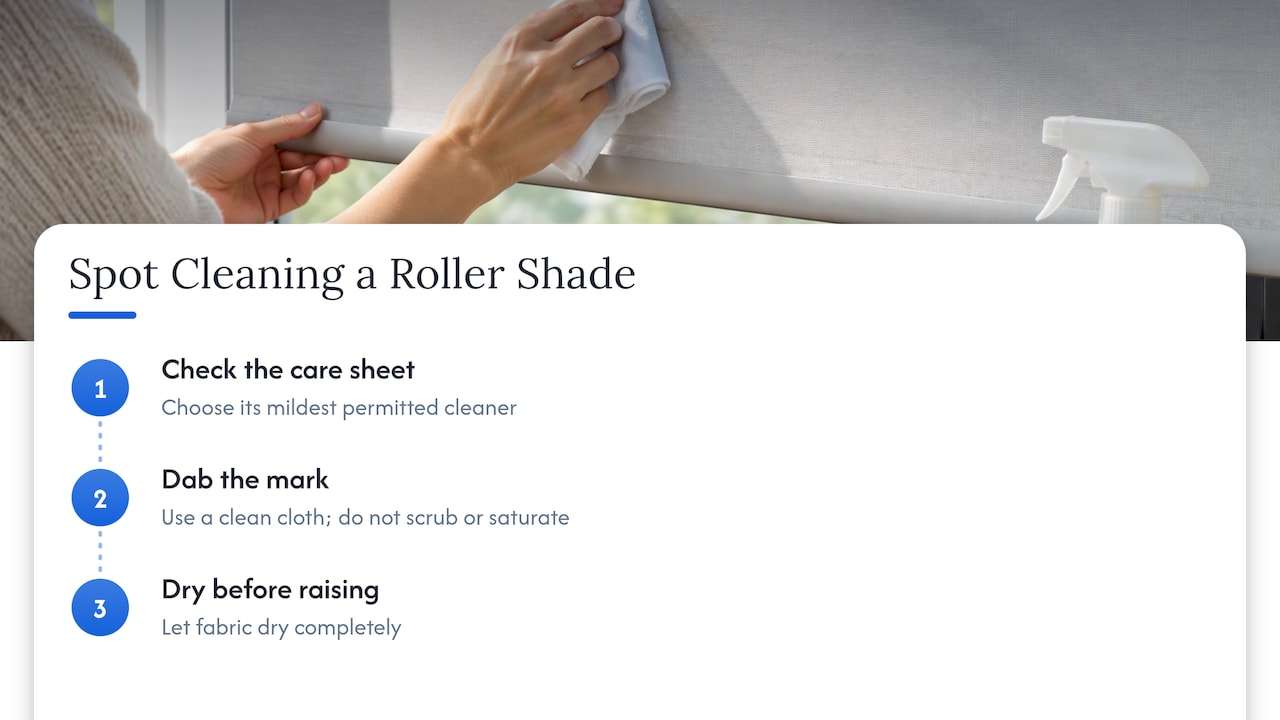
For a mark on a roller shade, dab with a clean cloth and the mildest option your fabric’s care sheet permits. Do not scrub. Do not saturate. If you do use any moisture, let the fabric dry completely before you raise the shade, so it does not roll up damp and leave a water line or mildew.
Tampa Bay adds a wrinkle. Humidity is high most of the year, and shades near sliding doors, lanais and kitchens collect more airborne grime and, occasionally, mildew spotting. Those are the windows we suggest you look at first.
Different fabrics, different rules
Not every motorized shade tolerates the same treatment. Commercial fabrics and specialty coverings such as cellular (honeycomb) shades often prohibit water immersion, steam cleaning and harsh chemical agents to protect their structure. Treating a motorized shade like a manual one is where many owners cause damage.
| Shade type | Safe routine | Avoid |
|---|---|---|
| Roller shade | Dust, soft-brush vacuum, careful spot cleaning per care sheet | Soaking, pulling the fabric, wetting the tube end |
| Cellular | Dust and low-suction vacuum, gentle blotting | Immersion, steam, harsh chemicals |
| Roman | Dust and light vacuuming; follow the fabric’s care label | Wet cleaning that can shrink or distort the folds |
| Drapery on a motorized track | Light vacuuming, professional cleaning for heavy fabrics | Pulling the drapery by hand against the motor |
For fabric-specific detail, we have written separately on how to clean Roman shades and how to clean vertical blinds. Add the motorized part of this guide on top: power off where the manual says to, and keep the motor dry.
How often to clean and inspect
Manufacturers give method more than they give a calendar, so this schedule is our own working rule from years of servicing local homes and businesses, not a manufacturer requirement. Adjust it to your fabric and your windows.
| Task | Suggested frequency |
|---|---|
| Quick dusting of fabric and headrail | Every two to four weeks, more often near doors that open often |
| Low-suction vacuum with brush attachment | Every one to three months |
| Visual check of fabric edges, brackets and the head rail | Every three months |
| Run every shade through a full open and close cycle, listening for changes | Every three months |
| Battery check or recharge (battery-powered systems) | Per your system’s schedule, see below |
| Professional inspection | Once a year for large or commercial systems, or whenever behavior changes |
The quarterly full-cycle test is the habit that pays off most. Shades fail gradually: a slightly slower raise, a faint new noise, one edge that stops a quarter inch short. If you catch it in the quarter it begins, the fix is usually a recalibration or a bracket adjustment, not a motor.
Batteries: how long they last and how to manage them
The most common question we hear is how long batteries last. The honest answer is that it depends. Lutron states that battery life varies with the batteries, the shade application and the environment, particularly the size of the system and how often the shades move. A large shade that moves several times a day drains faster than a small one that moves once.
One manufacturer’s published figure gives a sense of scale. Somfy lists a rechargeable lithium-ion shade with a once-a-year recharge, and a reference autonomy of 10 months at one cycle a day with low RF traffic. Treat that as a benchmark under controlled conditions, not a promise for your home. Smart-home automations that move shades several times daily will shorten it.
Sensible battery habits:
- Use new batteries from one package. Lutron advises not mixing manufacturers or battery types.
- Check orientation when you replace them. A battery in backward is a classic cause of a shade that will not respond.
- Write the replacement or recharge date on the inside of your control closet door or in your phone calendar.
- If you are planning around power, our guides to motorized shades battery life and battery operated motorized shades go deeper on the trade-offs between battery, rechargeable and hardwired options.
Troubleshooting: when a shade stalls or moves unevenly
Work through the problem in order. Most issues resolve in the first two steps.
- Look for obstructions. A curtain panel, a plant, a window latch or a stray cord can stop a shade. Clear it and try again.
- Check the batteries. Make sure they are fresh and installed in the right direction.
- Check power and connections. For hardwired systems, look at power cords, transformers and plugs for a loose connection.
- Check the control group. Manufacturer guidance asks you to verify the shade is correctly joined to its control group. A shade that responds to the remote but not the app, or the reverse, often points here.
- Run a calibration reset as the manual describes. If the problem persists after the previous checks, follow the product manual’s calibration reset.
A note on resets
Resets are brand-specific, and the steps differ between systems. As one example, for a stuck or not fully opening Legacy PowerView shade, Hunter Douglas says to hold the headrail programming button for six seconds, then check batteries, power cords and connections, and contact the installer or dealer if the issue continues. Do not apply that sequence to a different brand. Use the instructions for your own motor, and write down the existing limit settings first if the system lets you.
When to call a professional
Call your installer, rather than trying another reset, when:
- A shade runs crooked or telescopes (the fabric walks to one side of the roller).
- The motor hums, grinds or stops mid-travel after you have cleared obstructions and replaced batteries.
- Several shades fail at once, which points to a hub, transformer or wiring issue rather than individual motors.
- A shade has gotten wet near the motor or wiring.
- A heavy drapery or oversized shade is straining the motor.
Timing matters. A shade that continues to strain against a misaligned bracket can wear the motor and fabric alike. Large openings in particular need correct hardware from the start, which we cover in our guide to motorized shades for large windows.
Getting the installation right so maintenance stays light
Most maintenance headaches trace back to installation: a bracket not quite level, a shade cut or rolled slightly off square, a power run not planned. A well-measured, well-hung shade tracks straight and puts less load on the motor. Our walkthrough on motorized blinds installation explains what to expect from a professional install, and our motorized blinds and shades page shows the systems we work with. If you are weighing a budget, see what to plan for motorized shade costs.
Our perspective: treat shades like architecture with fabric
We think of custom window treatments as architecture with fabric instead of drywall. They shape light, privacy and comfort, and they have moving parts that deserve the same attention as any other fixture in the house.
Here is what 30 years in this trade has taught us about upkeep:
- Fit prevents most problems. Because we fabricate every product in our Tampa Bay workroom, we control the dimensions, the fullness and the fabric choice. A shade built square to the window is easier on its motor.
- Fabric choice is a maintenance decision. A tight-weave roller fabric wipes down and vacuums easily. A delicate textile may look beautiful and need more careful handling. Choose with your household and your windows in mind.
- Humidity and sun are the local factors. Gulf-coast light and moisture are hard on materials. Think about it when you pick fabrics for sunny exposures and bathrooms.
- Small repairs beat replacement. We repair and hem drapery and curtains, and we would rather help you keep a good treatment working than sell you a new one.
We have installed thousands of projects, and the owners who are happiest years later are not the ones who did the most. They are the ones who dusted regularly, kept water away from the motor, and called early.
— The Drapery Company
Work with us on your motorized shades
If you want motorized shades designed, fabricated and installed with maintenance in mind, we start with an in-home consultation, measure professionally, build the shades in our own workroom, install them, and remove your old treatments as a courtesy. See our motorized window coverings for homes and businesses, or request an in-home consultation. If you already own treatments that need hemming or repair, our repair services cover drapery and curtains.
FAQ
Do motorized shades need lubrication?
Generally no. Manufacturer instructions say properly installed products require no operational maintenance or lubrication, with the exception that idlers on some motorized shades may occasionally need it, and only when the product instructions say so. Do not spray anything on the motor or headrail unless your manual names that part.
How long do batteries last on motorized shades?
It varies with the battery type, shade size and how often the shade moves. One manufacturer lists a rechargeable model with a yearly recharge and a reference autonomy of 10 months at one cycle per day. Your own results will differ, so track the first replacement and plan from there.
Can I use water or cleaning spray on motorized shades?
Not near the motor, headrail or wiring. Manufacturer guidance says to keep electrical components dry, and some fabrics, such as cellular and commercial types, often prohibit water immersion, steam and harsh chemicals. Dry dusting and low-suction vacuuming are the safe default.
What should I do if my motorized shade stops working?
Clear any obstruction, check that batteries are fresh and correctly oriented, and check power cords and connections. Then confirm the shade is joined to the right control group and follow your manual’s calibration reset. If it still fails, contact your installer.
Sources
- Hunter Douglas Architectural: Installation, Operation and Care (Skyline PowerView Gen 3)
- Hunter Douglas Architectural: Cleaning, Maintenance and Operating Instructions
- Lutron: Optimizing Battery Life in Lutron Shades
- Somfy: Sonesse ULTRA 30 WireFree Zigbee (Li-ion)
- Hunter Douglas: What to do if a motorized shade is stuck or not opening fully