Shades That Preserve Your View: How to Choose
October 28, 2026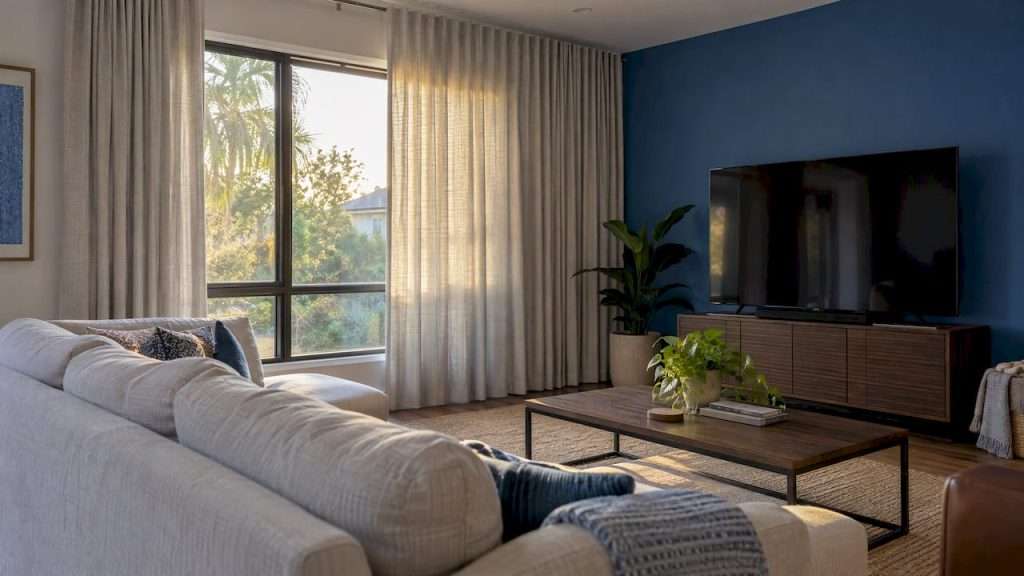
The best fix for TV glare is a window treatment that cuts or diffuses the sun at the exact hours you watch, without turning the whole room into a cave. For most Tampa Bay living rooms that means a layered setup: a low-openness solar or light-filtering shade for daytime, plus drapery panels or a blackout layer for the hours the sun hits the screen head-on. The right choice depends on where your window sits in relation to the TV, how glossy the screen is, and how much view you want to keep.
We fabricate custom window treatments in our Tampa Bay workroom, and TV glare is one of the most common problems we are asked to solve. Below is how glare actually happens, which treatments handle it best, and how to measure and mount them so the fix holds up.
TL;DR
- Glare is a placement problem as much as a product problem: a window behind you reflects in the screen, and a window beside or behind the TV causes washed-out contrast.
- Solar shades and light-filtering cellular shades are the best all-day answer when you want daylight and some view.
- Blackout drapery or blackout-lined shades are the strongest choice for a dedicated media room or a screen that takes direct sun.
- Layering a shade under drapery panels gives you control at every hour, and mounting panels high and wide stops light leaking around the edges.
- Custom fabrication matters here: gaps at the sides and top are where glare sneaks back in.
Why your TV looks washed out near a window
A TV screen is a reflective surface. Light from outside or overhead can hit it and reduce contrast until details are hard to make out. Whether you see a hazy wash or a sharp mirror image depends partly on the panel: a matte screen tends to scatter reflections into haze, while a glossy one shows clearer reflections of whatever is bright behind you.
There are two separate problems, and they call for different solutions:
- Reflected glare. A window behind or beside your seating reflects in the screen. The window itself is the bright object, so the fix is to reduce how bright that window appears.
- Washout. Sunlight lands on the screen surface or floods the wall around it, so the whole picture looks faded. The fix is to reduce the total light in the viewing area, or to redirect it.
There is also a comfort angle. Display specialists point out that when your eye keeps shifting between a clear reflection of something distant and the close-up image on the screen, that refocusing is a major source of eye fatigue. If you have ever felt tired after an afternoon game with the blinds half open, that is likely part of the reason.
Start with the room, not the product
Before you choose a fabric, look at three things.
Where the window sits relative to the TV
- Window directly opposite the TV. This is the classic reflection problem. The window is the bright object being mirrored in the screen. You need strong control over that window, which usually means a darker shade or blackout layer for viewing hours.
- Window beside the TV (on the same wall or the adjoining wall). You get a mix of washout and side glare. Light-filtering shades with full-width coverage do well here.
- Window behind the TV. The bright background makes the screen look dim by comparison, and your eyes struggle with the contrast. Diffusing the light is usually better than blacking it out.
If you can move furniture, do. Display experts recommend orienting the screen perpendicular to windows so direct light does not bounce straight back to your eyes, and using window treatments to control the intensity and distribution of incoming sunlight. Even a small angle change can shrink the problem before you spend anything.
What time you actually watch
A room that is fine at 8 p.m. may be unwatchable at 3 p.m. In Tampa, low western sun in the afternoon is the usual culprit for rooms with a west-facing view of a lanai, pool or backyard. If you watch mostly at night, you may only need to control reflections from lamps and bright evening light. If you watch games in the afternoon, you need real solar control.
How much daylight you want to keep
Most people do not want a dark room all day. Many want natural light when the TV is off and a dimmer room when it is on. That is the case for treatments you can adjust, or for two layers working together.
The treatments that work, and when to choose each
Solar shades
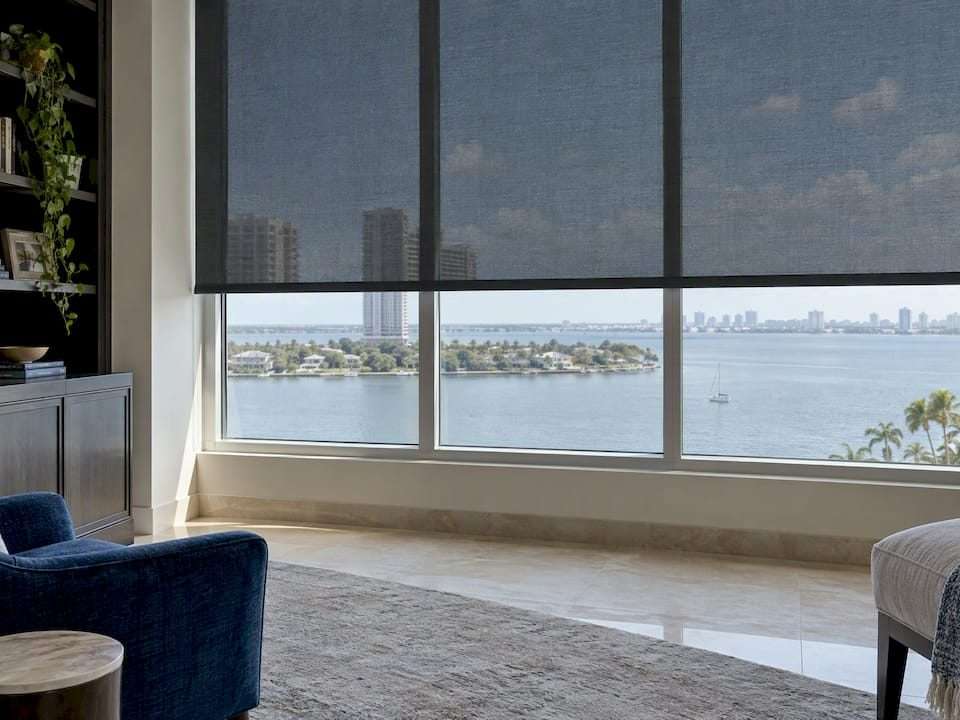
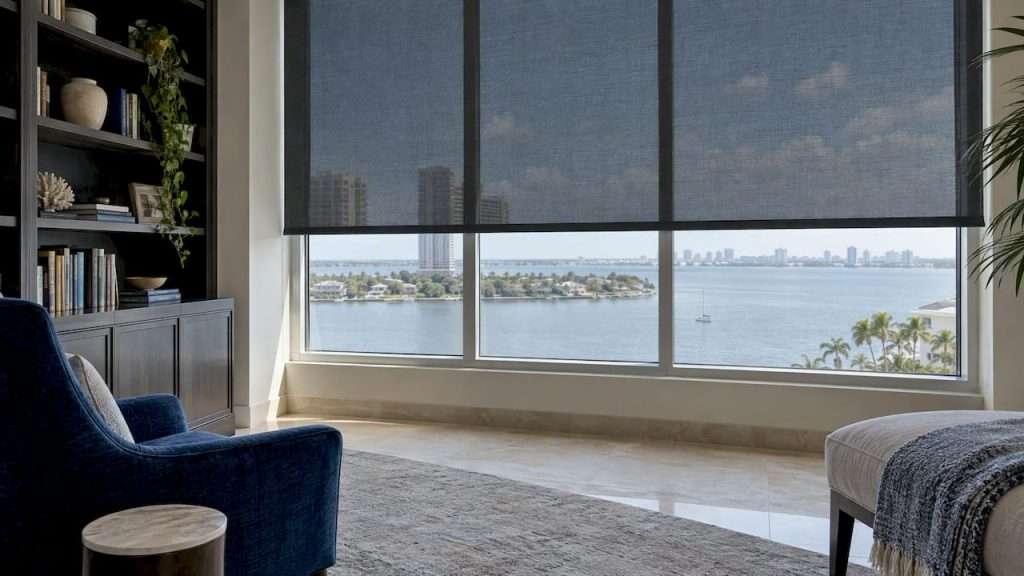
Solar shades are woven screens that cut a measured percentage of light and heat while keeping some view to the outside. The key spec is openness: the lower the percentage, the tighter the weave and the more glare it stops. A low-openness fabric will tame a bright lanai view without making the room feel closed in. We cover how the weave and openness work in our guide to sheer shades and their 1% to 5% openness, and our page on solar shades for sliding glass doors applies the same logic to the large glass walls common in Florida homes.
Choose solar shades when you want to keep the view, you watch TV during the day, and the glare comes from general brightness rather than one hard beam.
The tradeoff: at lower openness, you see out less at night with lights on, and very dark fabrics can look heavy in a small room. A fabric around the middle of the range is often a better fit for a living room than the tightest weave.
Light-filtering cellular shades
Cellular (honeycomb) shades diffuse light through the fabric and trap air in their pockets. Light-filtering versions glow softly rather than showing the view. In a Department of Energy lab study of a real commercial building, single-cell light-filtering cellular shades increased useful daylight by up to 95% and reduced glare by up to 91%. That was an office setting, so treat it as evidence of what diffusion can do, not a promise for your living room.
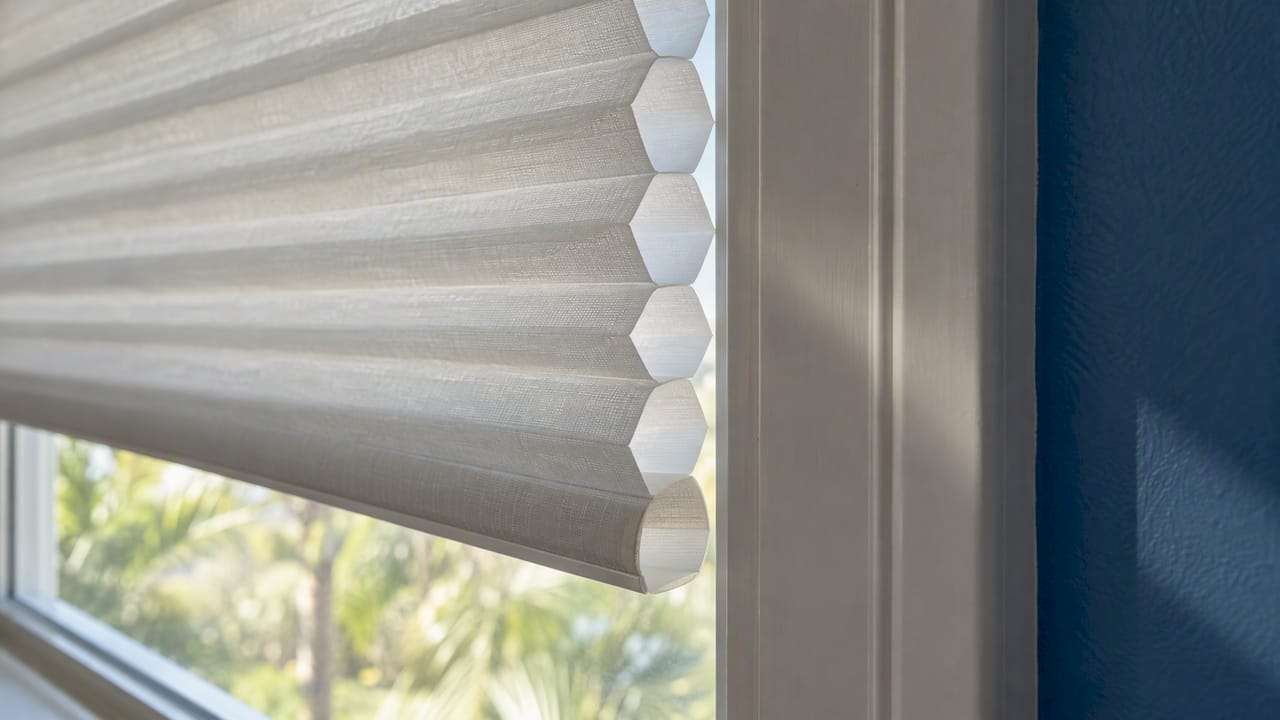
Choose cellular shades when you want even, soft daylight with no hot spots on the screen, and you do not need to see out through them. They also help with heat, which we explain in our piece on window shades for heat reduction.
Roller shades
Roller shades are the cleanest, most minimal option, and they come in solar, light-filtering and blackout fabrics. That flexibility is the point: you can pick the fabric to match your viewing habits. In a media room, a blackout roller on the main window with a light-filtering roller on a side window is a common pairing. Browse the styles on our custom window shades page.
Blackout drapery
When the sun hits the screen directly, nothing beats a lined, full panel. Blackout curtains are the most effective option for maximum glare control in a room that gets direct sun, because they block most incoming daylight. Custom blackout drapery does this better than ready-made panels because we control the lining, the width and the fullness. Ready-made panels often leave gaps and fall short of the floor.
Choose blackout drapery for a dedicated media room, a bonus room, or any space where movie-night darkness matters more than daytime light.
Sheer curtains
Sheers soften harsh light and break up the glare, which makes them useful for daytime viewing when the sun is not directly on the screen. They will not stop a hard reflection on their own, but they work well as the first layer in a layered treatment. Our guide to a double curtain rod with sheers shows how the sheer layer and a heavier layer sit together.
Blinds and shutters
Adjustable slats are valuable because the sun moves. Tilting blinds or shutters can redirect light toward the ceiling while still letting daylight in, which helps when the glare comes from a specific angle. Some smart blinds even adjust their louvers through the day to maximize natural light while stopping glare, according to a Wirecutter review. Fitted shutters and wood or faux-wood blinds also sit close to the frame, which limits light around the edges. Our blinds, shades and shutters page shows the options we build and install.
The tradeoff: slatted products leave small gaps between the slats, so they cannot match a blackout shade for total darkness.
Window film
Window film is often suggested for TV glare, and it can reduce glare and UV without closing anything. It will not solve glare from lamps, mirrors, glossy furniture or a bright window directly opposite the TV, and it cannot be adjusted by the hour. We treat it as a partial answer. If your problem changes throughout the day, a treatment you can open and close gives you more control.
Quick comparison
| Treatment | Glare control | Keeps view | Best for | Watch out for |
|---|---|---|---|---|
| Solar shade (low openness) | Good | Yes, softened | Daytime viewing in bright rooms | Less view at night with lights on |
| Light-filtering cellular shade | Very good | No | Even, soft daylight and heat control | Not for rooms where you want the view |
| Blackout roller shade | Excellent | No | Media rooms, direct sun on screen | Closes the room when down |
| Blackout drapery | Excellent | No | Movie nights, layered rooms | Needs proper width and mounting |
| Sheer curtains | Moderate | Yes, hazy | First layer, soft daytime light | Will not stop a hard reflection alone |
| Blinds or shutters | Good, adjustable | Partly | Shifting sun angles | Slat gaps let in some light |
Layering: the answer for most living rooms
If your TV is in a room you also live in, one product rarely covers every hour. Layering solves that. A common arrangement is a solar or light-filtering shade on the window, with drapery panels outside it. During the day the shade does the work and you keep your light. When the sun swings onto the screen, you close the drapery, or lower a blackout layer behind it.
It also makes decorating easier. When the functional shade underneath is a neutral color, the outer panels can be swapped to change the color or pattern of the room without replacing the glare solution. Our two guides to layered window treatments and layered design and function go deeper, and double curtain tracks are the hardware that makes two layers glide independently.
Fit and mounting decide whether it works
The difference between a treatment that fixes glare and one that only mostly fixes it is usually fit.
- Mount drapery high and wide. Hanging panels near the ceiling and extending several inches past each side of the window frame limits light leaking around the edges. A narrow rod right at the frame creates bright slivers that show up as streaks across a screen.
- Choose fullness on purpose. Drapery that is too flat gaps when closed. Proper fullness means the folds still cover the glass when the panel is drawn.
- Consider inside versus outside mount for shades. An inside mount looks tailored but leaves small side gaps. An outside mount that overlaps the frame blocks more light. For glare control, outside mounts or side channels often win.
- Do not forget the top. A valance, a cornice or a headrail cover stops light from leaking over the top of a shade.
- Measure for the actual window. Florida homes often have large picture windows, sliders and transoms. Odd sizes are exactly where custom beats stock. Our in-home consultations and professional measurement cover this so the fit is right the first time.
Tampa-specific points
Heat and glare travel together. The same sun that washes out your TV also heats the room. The U.S. Department of Energy found that in cooling-dominated climates, all window attachments save energy, which describes Florida. The same research notes that actual use of operable attachments can have a large effect on performance, so a treatment you will really close at 3 p.m. is worth more than a better one you leave open. If efficiency is part of your decision, our guide to the best blinds for energy efficiency covers the tradeoffs.
Large glass is common. Sliding doors, lanai doors and picture windows put a lot of glass in one room. Wide spans favor motorized options, since a heavy shade or long drapery run is easy to forget if you have to cross the room. See our motorized blinds and shades. You can lower them from the sofa, or schedule them to close when the sun hits.
Humidity matters for material. Choose fabrics and hardware for a humid climate, and ask about fade resistance. Strong sun also fades fabric over time, which is another reason a good solar layer protects what is in the room.
If you are replacing or choosing windows, the window type also shapes how much glare reaches the screen. Help with choosing the right windows for sunlight and energy performance starts with understanding how operable attachments work with them.
Beyond the windows: other glare sources
If you fix the window and still see reflections, check these:
- Lamps and overhead lights. Move them off to the side or behind you, or use dimmable bulbs. A soft light behind the TV can reduce the contrast between the screen and the wall.
- Wall color. A glossy or very light wall behind you throws more light back into the screen. Our clients with dark walls often find a matte finish helps.
- Screen finish. A glossy panel reflects more than a matte one. If you are shopping for a TV for a bright room, that is worth knowing.
- Screen angle. Tilting the TV slightly or changing the seating angle can put the reflection somewhere you will not see it.
These small changes complement the window treatment. They do not replace it.
How to decide: a short checklist
When homeowners ask us where to begin, we walk through this list:
- When do you watch, and when does the sun hit the screen?
- Is the window opposite, beside, or behind the TV?
- Do you want the view, or just the light?
- Do you need total darkness, or just less glare?
- Do you also need privacy, heat control or fade protection?
- Will you adjust it by hand, or would you prefer motorized control?
The things worth weighing are natural-light needs, sun glare on the TV, privacy, style, cleaning and budget, as extension guidance on buying blinds and shades puts it. Blinds can let in natural light while keeping privacy, and blackout shades keep out the glare.
Our perspective
We think of custom window treatments as architecture with fabric instead of drywall. They shape how a room works at 10 a.m. and at 8 p.m., and TV glare is a good test of whether they were designed properly or just hung.
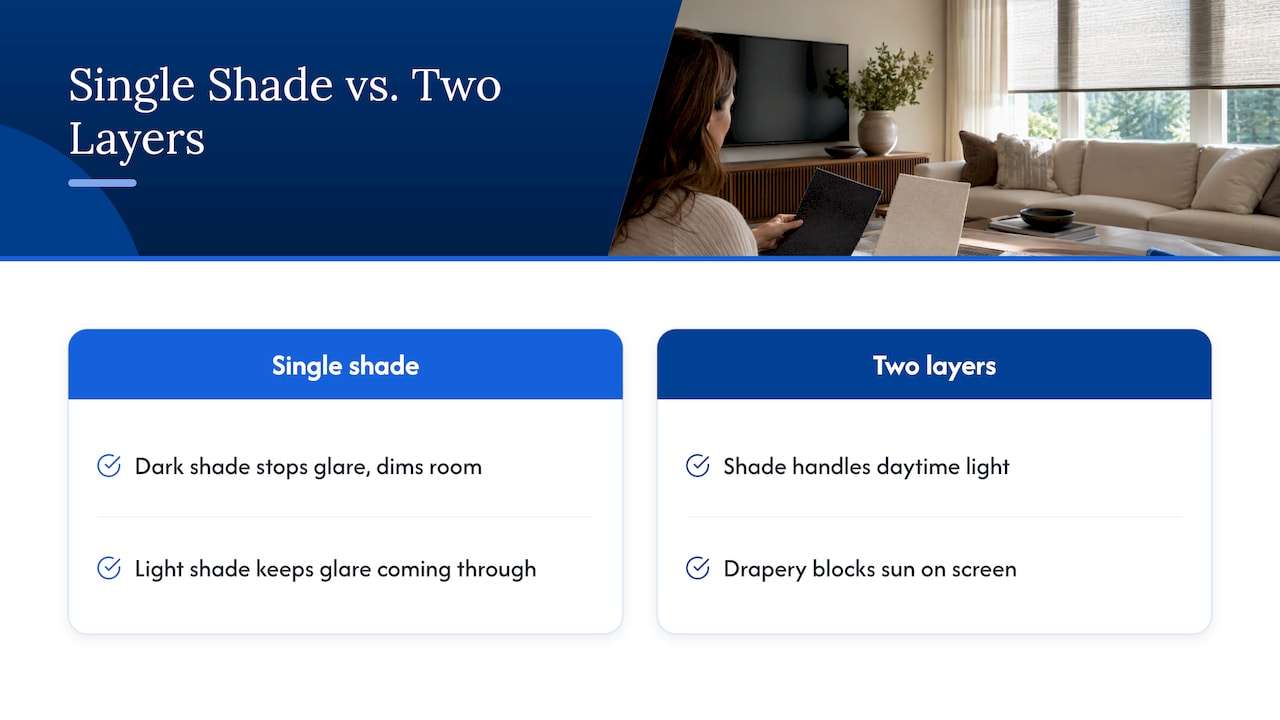
The most common mistake we see is buying one product to do two jobs. A single shade that is dark enough to stop afternoon glare makes the room gloomy the rest of the day, and a shade light enough for daily life lets the glare through. Two layers, each doing one job well, solve both. We also see standard-size products fall short because the window, the rod and the ceiling height do not match the stock dimensions, and light leaks at the edges.
Because we fabricate every product in our Tampa Bay workroom, we can control the width, the lining, the fullness and the fabric opacity to suit your window and your screen. Our approach is to start with how you use the room, then choose the treatment, not the other way around. After more than 30 years of doing this, that sequence is the thing we trust most.
— The Drapery Company
Get a glare solution measured for your room
If you want a treatment sized and built for your windows, we offer design consultation, onsite fabrication, professional measurement and installation, and removal of your old treatments as a courtesy. We work with homeowners, designers, businesses and property managers across the Tampa Bay Area. Request an in-home consultation and we will look at your TV wall, your window exposure and the hours you watch, then recommend a layered setup that fits your budget. You can also start from our main site.
FAQ
How can I reduce glare from my window on my TV?
Start by changing where the light lands: turn the TV so it is not facing the window head-on, then add a window treatment that matches how you watch. Solar or light-filtering shades diffuse daytime light, and blackout drapery or blackout shades handle direct sun. Layering two of them gives you control at every hour.
What is the best window treatment for TV glare during the day?
For most living rooms, a low-openness solar shade or a light-filtering cellular shade is the best daytime choice, because it cuts glare and still lets daylight in. If sun hits the screen directly, add blackout drapery or choose a blackout shade. Rooms used only for movies are best served by blackout fabrics.
How do I make a TV in front of a window look good?
Use a shade for function and drapery panels for style. Mount the panels high and wide so the window looks larger and the light does not leak around the sides. Keep the shade a neutral color so you can change the panels later. A soft sheer layer on a double track gives you a finished look when the drapery is open.
Will blinds or curtains completely remove TV glare?
Not always. Ordinary blinds and curtains can block sunlight but may leave reflections if they leave gaps or let in light around the edges. Custom-fitted treatments that cover the full window and overlap the frame do much better. Pairing them with sensible TV placement and lamp positioning handles what is left.
Is window film better than shades for TV glare?
Film can reduce glare and UV without closing anything, but it is permanent and cannot adjust as the sun moves. Shades and drapery let you change the light by the hour, which is why we usually recommend them for rooms where the TV and the daylight both matter.
Sources
- What is TV glare and how do you get rid of it? (Tom’s Guide)
- DisplayMate Manual: Minimizing Glare
- Cellular Shades in Commercial Buildings (U.S. Department of Energy)
- Energy Savings from Window Attachments (U.S. Department of Energy)
- Buying Blinds or Shades (NC State Extension, Granville County)
- The Best Window Treatments for Every Room in Your Home (Bob Vila)
- Smart window blinds review (Wirecutter)
- How to Reduce TV Screen Glare From Windows (Nordic Design Blog)