What Is the Ideal Valance Height for Your Windows?
August 26, 2026
The Best Restaurant Window Shades for Comfort and Revenue
August 28, 2026
Sheer curtains give you solid daytime privacy but usually turn transparent at night once your interior lights click on. That reversal catches most homeowners off guard the first time a neighbor waves at them through a lit window they thought was covered. The fix isn’t complicated, but it does take more than hanging a pretty panel and hoping.
If nighttime privacy matters in your space, here’s where to start:
- Add an opaque layer, like a roller shade or blackout curtain, that you draw once the sun goes down.
- Choose a denser privacy-weave sheer instead of a thin voile or net if you want a single layer to do more work.
- Shift lamps away from the window plane and use dimmers to soften the silhouette effect.
We’ll walk through the fabric science, the installation details that actually move the needle, and how a custom double-track setup solves this permanently.
Key Takeaways
Reliable nighttime privacy with sheer curtains comes down to pairing a dense privacy-weave fabric with a properly installed opaque layer, not fabric choice alone.
| Point | Details |
|---|---|
| Day and night are different problems | Sheers diffuse daylight for privacy but transmit interior light outward once lamps are on. |
| Fabric density helps, but has limits | Privacy-weave sheers outperform voile or net, though none fully block a silhouette under bright light. |
| Layering is the reliable fix | A double track with a sheer front and opaque back gives daytime softness and nighttime coverage. |
| Installation details matter as much as fabric | Fullness of 2.5 times the width, high-and-wide mounting, and returns close the gaps that leak light. |
| Draperycompany solves the install gap | Onsite fabrication and double-track installation across 30-plus years of Tampa Bay projects close the sightlines DIY setups often miss. |
Table of Contents
- Why Sheer Curtains Protect Privacy by Day but Not by Night
- Which Sheer Fabrics Actually Reduce Nighttime Visibility?
- What’s the Best Way to Get Full Privacy Without Losing the Sheer Look?
- Does Lamp Placement Really Change What Neighbors Can See?
- How Should You Hang Sheers for Better Coverage?
- How Long Do Sheer Curtains Keep Their Privacy Performance?
- When Does a Privacy Problem Need a Professional Measure?
- What Actually Determines Privacy: The Product Label or the Install?
- Get a Custom Privacy Solution Fitted to Your Windows
- Sources
- FAQ
Why Sheer Curtains Protect Privacy by Day but Not by Night
The mechanics come down to one rule: light travels toward the dimmer side. During the day, outdoor light is far brighter than your living room, so a sheer curtain reads from outside as a soft, glowing veil. Anyone looking in sees fabric texture, not furniture. Sheers work as a daylight tool first, and that’s exactly the effect people love them for.
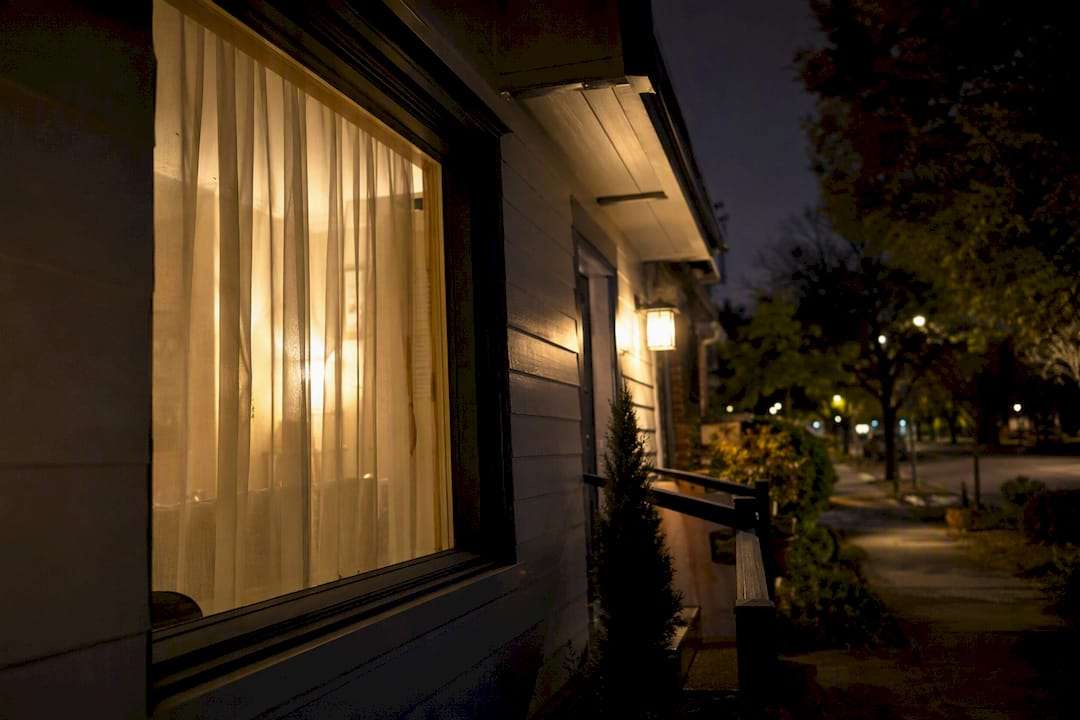
At night, that balance flips. Once your lamps are on, your room becomes the brighter side of the glass, and the sheer fabric stops diffusing outside light. Instead, it transmits your interior light outward, and anyone standing in your dim yard sees shapes and movement clearly. The fabric hasn’t changed. The light source driving visibility has moved from outside to inside.
You can test this yourself in about five minutes, and for understanding how glass features in your windows affect this, consider insights from how glass interior doors make a big impact.
- Turn on your usual evening lighting, including any lamp near the window.
- Walk outside once it’s dark and stand at normal sidewalk or driveway distance.
- Look back at your window and note what you can make out. Furniture outlines? A person walking past? Nothing at all?
- Repeat with just one lamp turned off, then with a lamp repositioned farther from the glass.
Pro Tip: Run this test with a single floor lamp moved to three different spots in the room. You’ll usually find that pulling a lamp even three or four feet back from the window cuts the silhouette effect noticeably, without changing a single thing about the curtain.
Which Sheer Fabrics Actually Reduce Nighttime Visibility?
Not all sheers behave the same way once the sun sets. The weave, the fiber, and the color all change how much light passes through, and picking the right one can mean the difference between needing a second layer and getting by without one in a low-traffic room.
- Net and voile: the lightest, airiest options, and the least private after dark. Great for diffusing harsh sun, poor at hiding movement at night.
- Linen-sheer: slightly heavier drape with a natural texture, offering marginally better evening coverage than voile but still far from opaque.
- Privacy-weave sheers: built with a tighter, denser construction that meaningfully improves evening privacy compared to standard net, though it still won’t fully block a silhouette under bright interior light.
- Color matters too: darker, denser sheers scatter more light than pale ones, but color alone won’t compensate for a loose weave.
A dense privacy-weave sheer paired with soft lamp light can be a reasonable standalone choice in a formal living room or dining area where extra privacy is not critical after dark. For bedrooms and any street-facing window, plan on an opaque companion. Retailers selling “semi-sheer privacy” panels market real improvements over basic voile, but treat those claims as one input, not a guarantee.
What’s the Best Way to Get Full Privacy Without Losing the Sheer Look?
You don’t have to choose between the soft, layered look of sheers and actual nighttime privacy. The two most common professional approaches solve this differently, and picking the right one depends on the room.
- Double track, two fabrics. A sheer hangs on the front track for daytime softness; an opaque or blackout panel rides a second track behind it, ready to draw at dusk. This is the setup most designers plan around when privacy is non-negotiable, and it lets you keep both looks without swapping panels.
- Roller shade behind the sheer. A blackout or light-filtering roller mounts inside the window frame, hidden by the sheer during the day, and drops down at night. This works well in tighter reveals where a second full curtain track isn’t practical.
- Paired curtains on a double rod. Two rods at slightly different depths let you hang a sheer panel and a heavier drapery panel side by side, drawing whichever one suits the hour.
Non-textile fixes have their place too. Frosted or privacy window film works well on bathroom or side-lot windows where you still want daylight but never want a clear view in either direction. Cellular shades and motorized rollers make sense on tall or hard-to-reach windows, especially over sliding glass doors, where pulling a cord twice a day gets old fast.
So which approach fits your room? A bedroom or any window facing a sidewalk or neighbor’s porch needs the blackout layer, full stop. A living room with a TV benefits from a solar or roller shade under the sheer, since it also cuts glare during the day, a combination Nicetown specifically recommends for screen glare. A formal front room used mainly in daylight hours can often get by with a dense privacy-weave sheer alone.
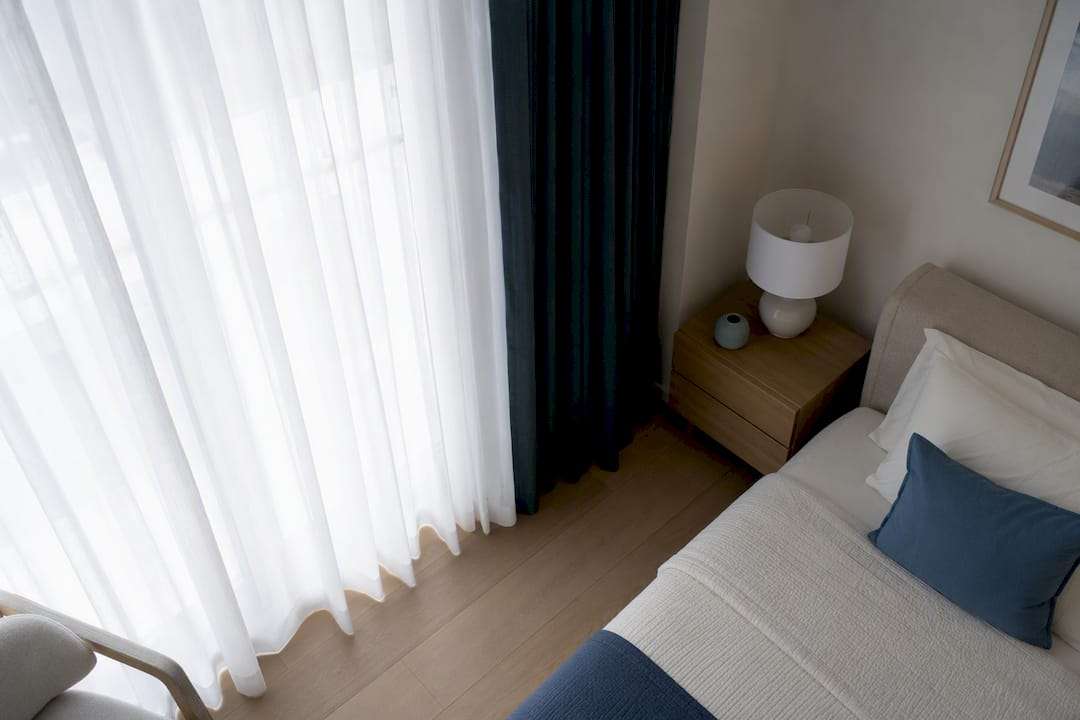
Pro Tip: Use a true blockout fabric for bedrooms where you want zero light and zero sightline. For living spaces, choose a dim-out fabric instead. It still blocks the view but lets a little glow through, which keeps the room from feeling like a cave the moment you draw the curtain.
Does Lamp Placement Really Change What Neighbors Can See?
It changes more than most homeowners expect. A ceiling downlight positioned close to a window throws light directly at the glass, lighting up the sheer fabric like a movie screen and putting every shadow that crosses the room in sharp relief.
Move the light source, and you change the picture entirely:
- Swap overhead downlights near windows for lamps set farther into the room.
- Use dimmers so you can drop brightness during the hours privacy matters most, typically evening and pre-bedtime.
- Favor indirect, side-angled lighting over anything pointed straight at the glass.
- Consider a porch or landscape light outside; brightening the exterior narrows the contrast between inside and outside, which is the same brighter-side rule working in your favor from the other direction.
Pro Tip: If you only make one change tonight, move your closest floor lamp at least three feet back from the window. It costs nothing and it’s often the single biggest visibility fix in the room.
Exterior lighting has limits, though. A porch light helps on a suburban lot, but it won’t compensate for a bedroom window twelve feet from a sidewalk. At that distance, you still need fabric or hardware doing the real work.
How Should You Hang Sheers for Better Coverage?
Even the right fabric underperforms if it’s mounted wrong. Fullness is the first place people cut corners, and it shows immediately at night. A sheer panel needs roughly 2.5 times the window’s width in fabric to gather into folds dense enough to block gaps; anything skimpier leaves vertical strips of clear sightline between the pleats.
Mounting height and width matter just as much:
- Hang the track high above the frame and wide past the sides so the panel has no gap to leak light or view through at the edges.
- Use returns, the small side wraps that turn a flat panel back to the wall, to close off the sliver of exposure that a straight-hung edge always leaves.
- Choose a double track installation over a simple double rod if you want the sheer and blockout layers to stack cleanly without one dragging on the other.
- Plan your stack-back, the space the fabric occupies when fully open, so the opaque layer doesn’t block window light during the day.
Ceiling-mounted tracks with proper returns consistently outperform face-fixed rods on side light bleed, a detail that matters more on wide or floor-to-ceiling windows than most people expect.
How Long Do Sheer Curtains Keep Their Privacy Performance?
Fabric that’s thinned out from years of sun exposure loses whatever opacity it had, so maintenance is really a privacy question, not just a housekeeping one.
- Polyester and UV-stable synthetic blends resist yellowing and hold their weave density far longer than natural fibers under direct sun.
- Cotton voile and linen-sheer look beautiful but degrade faster on south- or west-facing windows, thinning and yellowing within a few seasons of strong exposure.
- Wash or dry-clean according to the fabric’s care label. Rough handling accelerates the fiber breakdown that makes sheers see-through even in daylight.
- Replace panels once you notice visible thinning, yellowing, or small holes; those spots are the first to fail as privacy barriers.
- Budget for earlier replacement on bright, south-facing exposures, where UV damage moves faster than on shaded or north-facing rooms.
When Does a Privacy Problem Need a Professional Measure?
Some privacy issues are simple lamp and layering fixes. Others, like a bank of five windows across a great room or a wide sliding glass door, need hardware planned by someone who’s fabricated hundreds of these systems. Draperycompany has spent more than 30 years building custom drapery, curtains, blinds, shades, and shutters onsite for homes and businesses across the Tampa Bay area, and that onsite fabrication is what makes matched drops and double-track planning possible in the first place.
A staircase run of windows, a wall of sliders, or mismatched drop heights across a room are exactly the jobs where a DIY sheer purchase falls apart. Getting every panel to match in length and fullness, and getting a double track to sit flush without binding, is a measurement problem before it’s a fabric problem.
A professional measure typically covers matched drop heights across multiple windows, double-track spacing and returns, stack-back planning so open panels don’t block the glass, and motorization options for windows too tall to reach comfortably by hand. Draperycompany also removes your old treatments as part of the visit, so you’re not left staring at mismatched brackets from the last owner.
What Actually Determines Privacy: The Product Label or the Install?
Most advice about sheer curtains focuses on the wrong variable. Shoppers hunt for a fabric labeled “privacy sheer” as if the tag alone will solve the problem, when the research consistently points somewhere else: weave density, lamp placement, and how the panel is actually hung matter more than what the packaging promises.
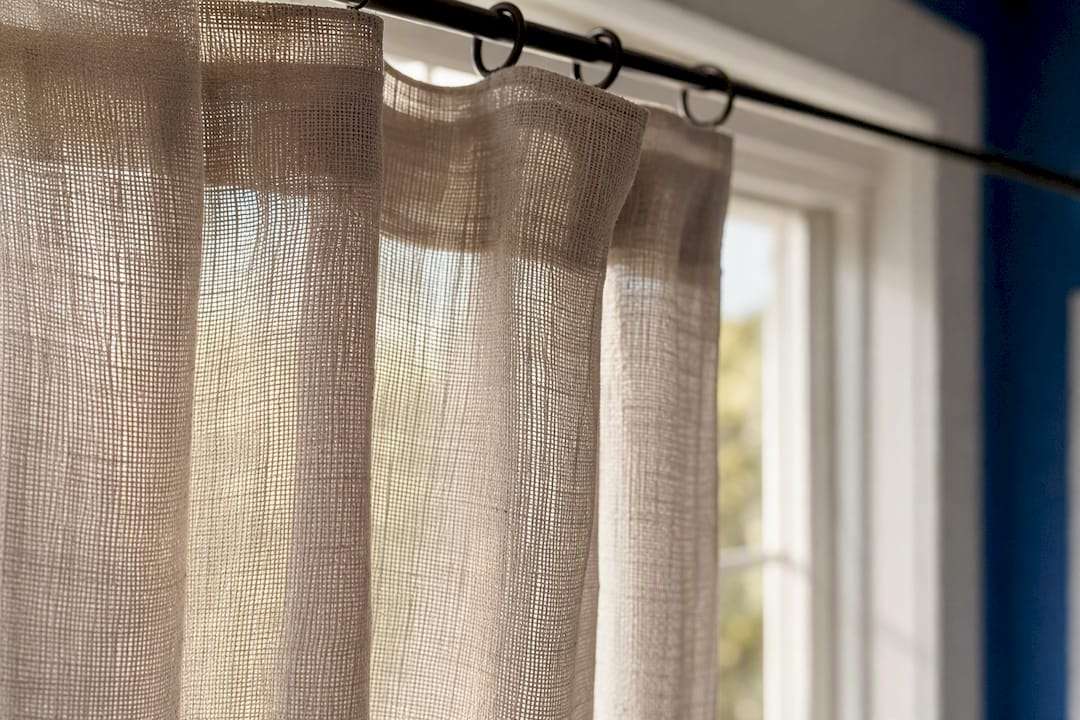
I’d go further than most guides do here. A cheap privacy-weave sheer hung with proper fullness, returns, and a lamp moved off the window plane will often outperform an expensive “premium privacy” panel installed with gaps at every seam. Hardware and measurement aren’t a footnote to fabric choice; they’re at least half the equation, and usually the half people skip because it’s less fun to shop for.
The conventional wisdom oversimplifies the fix into “buy denser fabric.” That’s a start, not an answer. If you actually want a room that looks soft during the day and disappears from the sidewalk at night, prioritize the double-track plan and the mounting details before you fall in love with a swatch. Fabric sets the ceiling on privacy performance; installation determines whether you ever reach it.
— Muna
Get a Custom Privacy Solution Fitted to Your Windows
Draperycompany builds the fix this article just walked through, not as separate parts you have to piece together, but as one measured, fabricated, and installed system. Where a DIY double-track attempt often means guessing at fullness and fighting mismatched hardware, an in-home measure gets your drop heights, returns, and stack-back planned before a single panel is cut.

The service includes an in-home measure, onsite fabrication of both your sheer and opaque layers, professional double-track installation, and removal of your old curtains or blinds at no extra step for you. That combination is what closes the gaps that DIY installs almost always leave at the edges and top of the frame, which are exactly the gaps that let evening light and silhouettes through. If you’re dealing with a wide window, a sliding glass door, or a room with mismatched panels from a previous owner, browse big window curtain ideas for layout inspiration, then request a measure to get your exact windows fitted with a system built to hold up night and day.
Sources
- Sheer Curtains Explained: Light, Privacy & Layering (Studio Matrx)
- Can People See Through Sheer Curtains at Night? | Adek Blinds & Curtains
- Curtainie
FAQ
Can Sheer Curtains Provide Privacy?
Yes, during the day. Sheers diffuse bright outdoor light into a soft veil that hides your room’s interior, but that protection reverses at night once your lamps are on.
Are There Sheer Curtains You Can’t See Through?
No sheer fabric fully blocks visibility once your interior light is brighter than the light outside. Privacy-weave sheers with a tighter, denser construction reduce visibility more than standard voile or net, but none eliminate the silhouette effect entirely.
How Do You Make Sheer Curtains More Private at Night?
Pair the sheer with an opaque layer, such as a roller shade or blackout curtain on a second track, and move lamps away from the window plane. A double-track installation lets you keep the sheer look by day and draw full coverage after dark.
Can You See Through Sheer Curtains During the Daytime?
Rarely, under normal conditions. Outdoor daylight is typically much brighter than your interior, so the sheer reads as an opaque-looking veil from outside, which is the core reason sheers work so well by day.