
New Construction Window Treatments: Wire Early, Measure Before Paint
October 13, 2026
Custom Drapery Lead Time: Why Complex Orders Can Pass Eight Weeks
October 15, 2026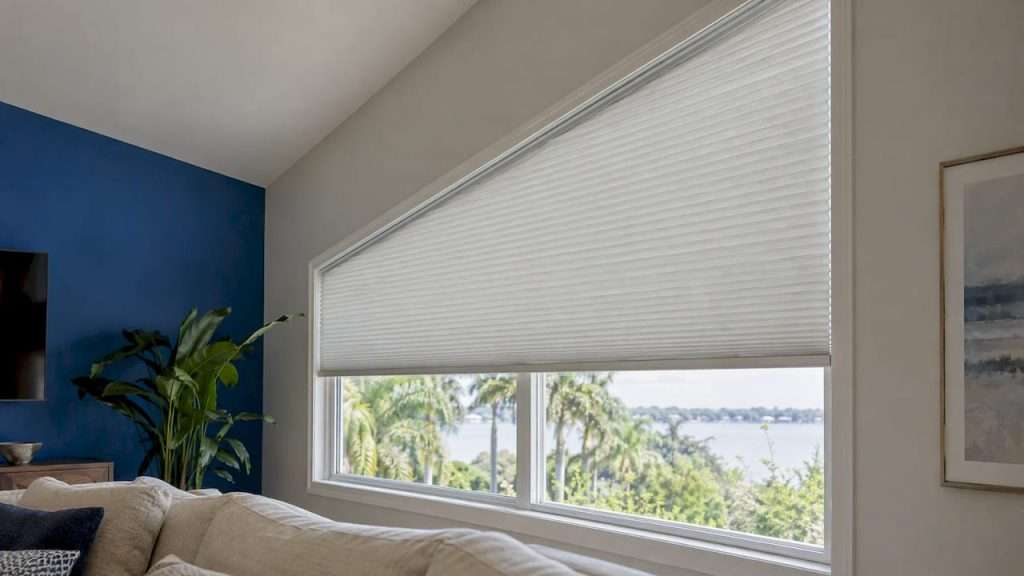
For trapezoid windows, custom cellular shades are usually the strongest practical choice because their pleats can be templated to follow a sloped top edge while trimming heat gain and loss. Custom-shaped roller or Roman shades and tailored drapery work well too, depending on the sightline and style you want. Whatever the family, we recommend cordless or motorized lifts for safety and day-to-day ease, and a tight, custom fit to keep the geometry looking intentional.
TL;DR:
- One cellular shade test found heating load reductions up to 24% on north and west exposures, versus 57% on south and east exposures.
- Measure the opening at both top and bottom, both sides, and along the slope; also record frame depth, angle, trim, and obstructions.
- Choose an inside mount only when the frame has enough depth; an outside mount can cover a shallow or uneven recess and reduce edge gaps.
- Use cordless lifts where young children live or visit; CPSC recommends cordless coverings, while motorization also helps operate high or awkward windows.
- Custom roller shades offer a clean line and broad opacity choices, while Roman shades add texture but leave a taller stack when raised.
Types of shades and treatments that work for trapezoid windows
Trapezoid windows, with their angled top or bottom edge, rule out most off-the-shelf shades. The fix is a treatment built around a template of the actual opening rather than a standard rectangle.
Cellular, or honeycomb, shades are often the first recommendation. Their folded cell structure can be cut and reinforced along a custom slope, so the shade still stacks cleanly at the top even when that top edge is angled. Beyond the fit, the trapped-air pockets in each cell add a layer of insulation that a flat fabric panel simply can’t match.
Custom-shaped roller and Roman shades are a strong alternative when you want a cleaner, more tailored look. Roller shades need a headrail cut to match the slope, and the fabric itself has to be sturdy enough to hang straight without a bottom bar fighting against gravity at an angle. Roman shades bring in soft folds and texture, though the irregular top edge limits how evenly they stack when raised.
For wide or asymmetrical trapezoid openings, segmented panels or a custom track system let you divide the window into manageable sections instead of forcing one oversized shade to span the whole opening.
When you’d rather downplay the angle altogether, full-height drapery or soft side panels can frame the window without drawing attention to its shape.
Each option changes the light and privacy you get:
- Cellular shades filter light evenly and come in blackout versions for bedrooms or media rooms.
- Roller shades offer the cleanest line and the widest range of opacities, from sheer to full blackout.
- Roman shades soften the light and add texture but leave more stack height at the top when raised.
- Drapery provides the most flexible light control but needs floor-to-ceiling space to work with the angle visually.
Motorization and cordless operation: making trapezoid shades usable and safe
Trapezoid windows are often set high, above a stairwell, or tucked into a cathedral ceiling where a pole or wand simply can’t reach. In those spots, motorized operation turns an awkward daily chore into a one-button task, and it’s frequently the only realistic way to operate a shade mounted at an odd angle or height.
A few ways to power the lift:
- Battery-powered motors retrofit easily onto most cellular, roller, or Roman shades without new wiring.
- Hardwired motors suit new construction or a renovation where an electrician is already running lines.
- Solar-assisted motors work well for skylights or trapezoid windows that get consistent sun exposure, trimming battery swaps.
Control options range from a simple handheld remote to a wall switch, and many motors now pair with smart-home systems for scheduling shades to open at sunrise or close during the hottest part of the afternoon. A manual cordless lift still makes sense for a low, easily reachable trapezoid window where the budget is tighter, though you give up the convenience of scheduling and one-touch operation.
Pro Tip: Before installation, map out battery access or wire routing so future maintenance doesn’t mean removing trim or climbing a ladder into a tight gable space.
Our motorized blinds and shades options cover all three power types for angled and hard-to-reach openings.
How to measure and mount trapezoid shades for a precise fit
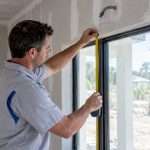
A trapezoid window has four different corner points, and treating it like a rectangle is the single most common measuring mistake. Before any order goes to fabrication, you need the full picture of the opening.
- Measure the width at both the top and bottom of the window, since they’re rarely identical.
- Measure the height on both the left and right sides to capture the slope.
- Record the angle of the sloped edge and the depth of the frame, since both affect how the headrail sits.
- Note any obstructions, trim, or hardware that could limit an inside mount.
The inside-versus-outside mount decision usually comes down to frame depth and how much light gap you can tolerate at the edges. An inside mount gives a cleaner, built-in look but needs enough frame depth to clear the headrail and avoid light leaking around the angled edge. An outside mount covers more of the wall and can hide an uneven opening, which is often the better call on a trapezoid window where the recess itself isn’t perfectly square.
Sharing clear photos, straight-line measurements, and notes on any trim obstructions with your fabricator cuts down on costly rework. Our guide on how to measure for blinds walks through the basics, and a measuring checklist from our fabric partner covers similar ground for standard windows.
Experimental testing on single-cell light-filtering cellular shades found heating load reductions as high as 24% on north and west exposures and 57% on south and east exposures, a reminder that orientation matters as much as fabric choice when you’re fitting a trapezoid window for performance.
Safety and standards: cordless preference and CPSC / ANSI guidance
Any trapezoid window high on a wall, over a stairway, or within a child’s reach deserves a safety-first look at the lift mechanism, not just the fabric.
The voluntary ANSI/WCMA A100.1 standard calls for stock and most custom window coverings to be cordless or to use cords that are inaccessible or too short to pose a hazard. The U.S. Consumer Product Safety Commission backs that same guidance, and recommends cordless coverings as the safest option in any home where young children live or visit.
Practical takeaways for a trapezoid window:
- Choose cordless lifts or motorization whenever the shade will be within reach of a child.
- If a corded option is unavoidable for a custom order, make sure cords are short, tensioned, or anchored out of reach per the standard.
- Treat motorization as a usability upgrade and a safety measure together, especially for windows set too high for a wand.
For angled or elevated trapezoid openings, motorized and cordless systems solve the reach problem and the safety concern at the same time. Our child and pet-safe window treatments guide goes deeper into cordless choices for families.
Practitioner perspective: why custom fabrication and professional installation matter
Experience shows that odd-shaped openings reward precision far more than standard windows do. A quarter-inch error on a rectangle is forgiving. The same error on a trapezoid shows up as a visible gap along the slope.
A typical project flow includes:
- An in-home consultation to assess the window, light, and style goals.
- Professional measurement that captures every corner point and the slope angle.
- Onsite fabrication to shorten the feedback loop between measuring and building.
- Installation and removal of old treatments as part of the service.
See more on our angled window treatment projects.
Maintenance and cleaning tips specific to trapezoid window shades
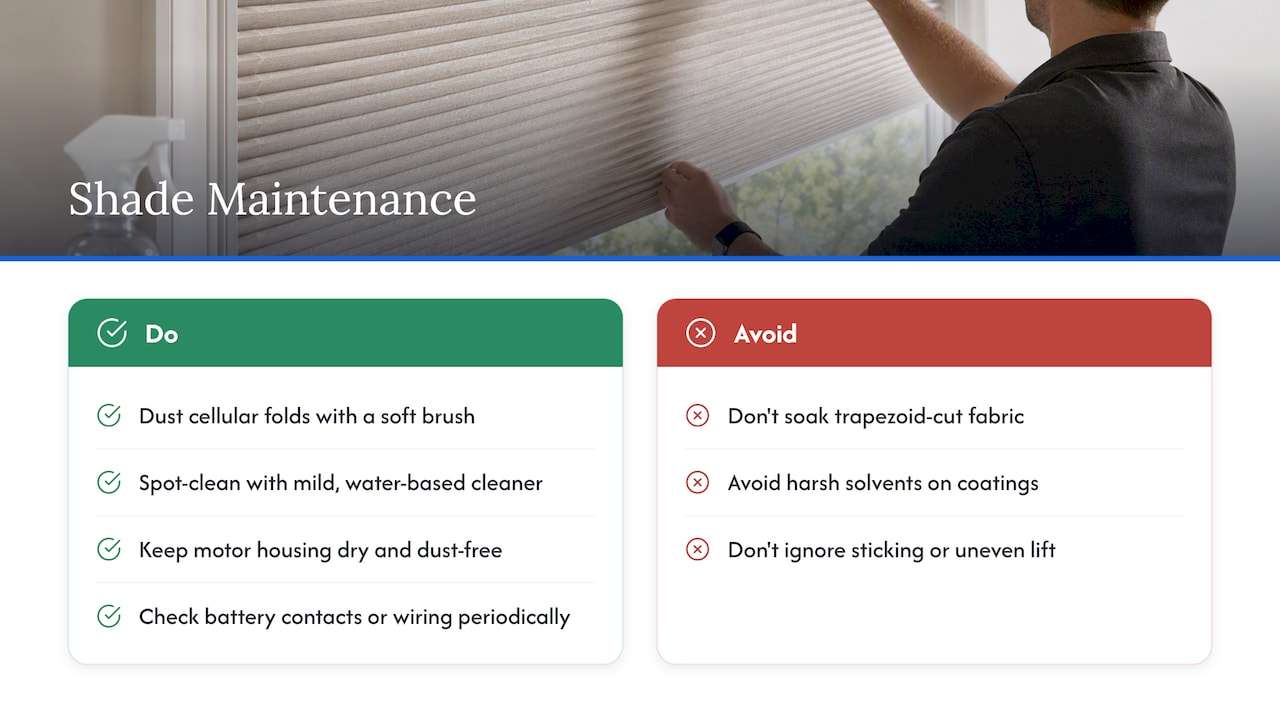
A sloped top edge collects dust differently than a flat one, and the angled corners of a trapezoid shade can trap debris that a straight shade would simply shed. A regular light dusting with a soft brush attachment or a microfiber duster keeps cellular shades from building up grime in the honeycomb folds, where dust tends to settle more than on a flat roller fabric.
For roller and Roman shades, spot-clean fabric with a mild, water-based cleaner rather than soaking the material, since trapezoid-cut fabric panels are reinforced at the angled edge and excess moisture can weaken that seam over time. Avoid harsh solvents on any light-filtering or blackout coating, as they can cause the coating to crack or peel at the fold lines.
Motorized components need their own light touch. Keep the motor housing dry and free of dust, and check battery contacts or wiring periodically if the unit is tucked into a hard-to-reach gable or stairwell space. A sticking or uneven lift is often the first sign that a track or headrail has shifted slightly, which is worth addressing quickly on an angled installation since the margin for misalignment is smaller than on a rectangular window.
Vacuuming with a brush attachment on the lowest setting works for most fabrics, and an annual professional check of the lift mechanism helps catch wear before it becomes a bigger repair, especially on a shade that sees daily motorized use.
Common design mistakes to avoid when selecting shades for trapezoid windows
The most frequent mistake is treating a trapezoid window like a slightly odd rectangle and ordering a standard-size shade to “make it work.” The fit never quite looks right, and the angled edge ends up either exposed or awkwardly trimmed.
A second common error is choosing a heavy, structured fabric for a shade that needs to stack cleanly at a sloped top. Stiffer materials resist folding evenly along an angle, which leaves a bulky, uneven stack when the shade is raised.
Skipping the inside-versus-outside mount decision is another trap. Defaulting to an inside mount without checking frame depth can leave visible light gaps along the slanted edge, undermining both the look and the light control you were aiming for.
Finally, many homeowners pick a corded lift out of habit, without considering that a trapezoid window is frequently set higher or at a harder angle to reach than a standard window. That makes the cord less convenient day to day and, where children are present, a safety concern the CPSC guidance specifically addresses. Settling on cordless or motorized operation from the start avoids a costly retrofit later.
Decorating perspective: emphasize or soften the trapezoid
Some homeowners want the window’s geometry to read as architecture. A custom-shaped shade that mirrors the slope exactly gives that modern, intentional look. Others prefer to visually smooth the wall plane, which is where full-height drapery or layered panels earn their place, drawing the eye past the angle rather than along it.
Fabric opacity should follow the room’s job: sheer for a sunlit reading nook, denser weaves where glare or privacy matters more than light.
How we solve trapezoid-window problems
Custom trapezoid shades and drapery panels are built around the exact window, with the process starting with an in-home consultation, moving through professional measurement, and continuing through fabrication that controls fit and quality at every step.
- In-home consultations to discuss the window and design goals.
- Professional measurement and mounting recommendations suited to frame depth.
- Fabrication of cellular, roller, Roman, or custom drapery for the exact slope.
- Cordless and motorized options included.
- Installation and removal of old treatments as part of the service.
Explore our custom window shades or book a residential consultation to get a quote for your trapezoid window.
FAQ
What are the best blinds for tilted windows?
Custom cellular shades tend to work best for tilted or trapezoid windows because their pleated structure can be templated to follow the slope while adding insulation. Custom-shaped roller or Roman shades are solid alternatives depending on the look and light control you want.
How much do trapezoid windows cost?
Pricing for custom trapezoid shades depends on the size, material, and whether you add motorization, so it’s best addressed during a consultation and quote rather than estimated in general terms. We provide project-specific pricing after an in-home measurement.
What is a window shade called?
“Shade” generally refers to a single fabric panel that raises and lowers, such as a cellular, roller, or Roman shade, while “blinds” typically describe slatted coverings like horizontal or vertical blinds. The terms overlap in everyday use, but the construction and operation differ.
Where should blinds be placed in recess?
An inside, or recess, mount places the headrail inside the window frame for a clean, built-in look, but it requires enough frame depth to clear the hardware without leaving light gaps. On angled or trapezoid windows, an outside mount is often chosen instead when the recess is too shallow or uneven to seat the shade cleanly.
Sources
- Cellular shades in commercial buildings (DOE/ORNL report)
- Updated voluntary window covering safety standard takes effect: Go cordless | CPSC


