Condo Window Treatment Rules in Tampa: What to Check First
October 21, 2026
Fade Resistant Drapery Fabrics for Tampa Bay Homes
October 23, 2026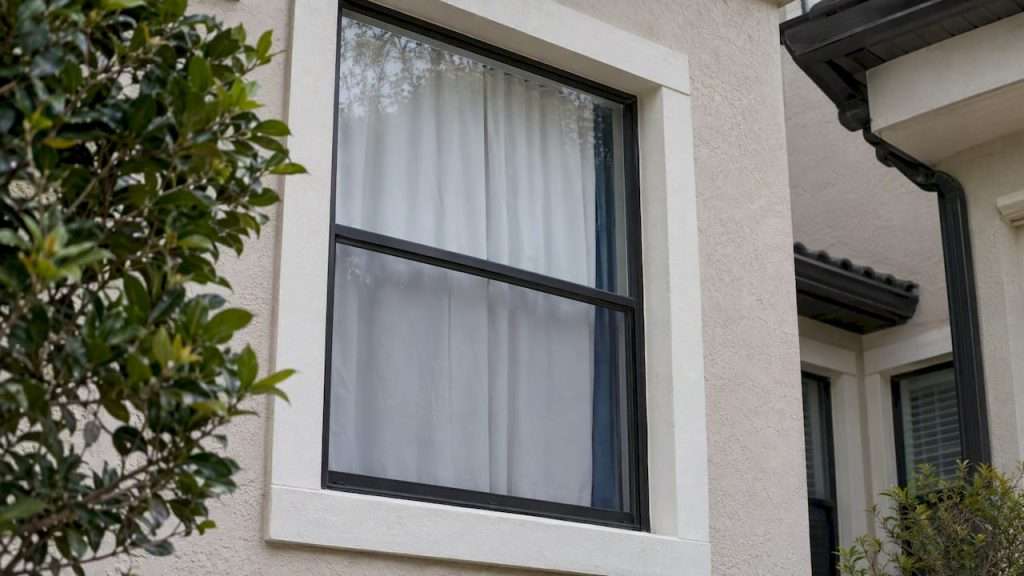
Most Tampa HOAs do not ban window treatments. They regulate what the street can see. In practice that usually means the side of the drapery, shade or blind facing outward must be white or off-white, or at least have a white backing, and anything reflective is out. Florida law also limits how far an association can go: it can enforce only the standards its recorded documents actually authorize, and it has to apply them equitably.
This guide explains where those limits come from, what Tampa-area architectural manuals typically ask for, how to get a custom order approved before fabrication, and what to do if you receive a violation notice. It is written for homeowners in HOA communities. If you live in a condominium, the rules come from a different chapter of Florida law, and we cover that distinction below.
TL;DR
- An HOA can regulate your windows only to the extent its recorded declaration or authorized guidelines say so, and it must apply those standards reasonably and equitably (Fla. Stat. 720.3035).
- The common Tampa requirement is a white or off-white face, or white backing, on anything visible from the street. Mirror tint and foil-type reflective material are usually prohibited.
- Submit your architectural request before you order. Custom fabric cannot be returned, so approval first is the cheapest rule to follow.
- Fines need 14 days’ written notice and a hearing before a committee of members who are not board officers, directors or employees (Chapter 720).
- Condo owners fall under Chapter 718, not 720, so check which one governs your home.
What Florida law lets an HOA control
The starting point is Florida Statute 720.3035. It covers architectural control committees and the standards they enforce on the appearance of structures and improvements on a parcel, windows included. Two ideas matter for anyone choosing window treatments.
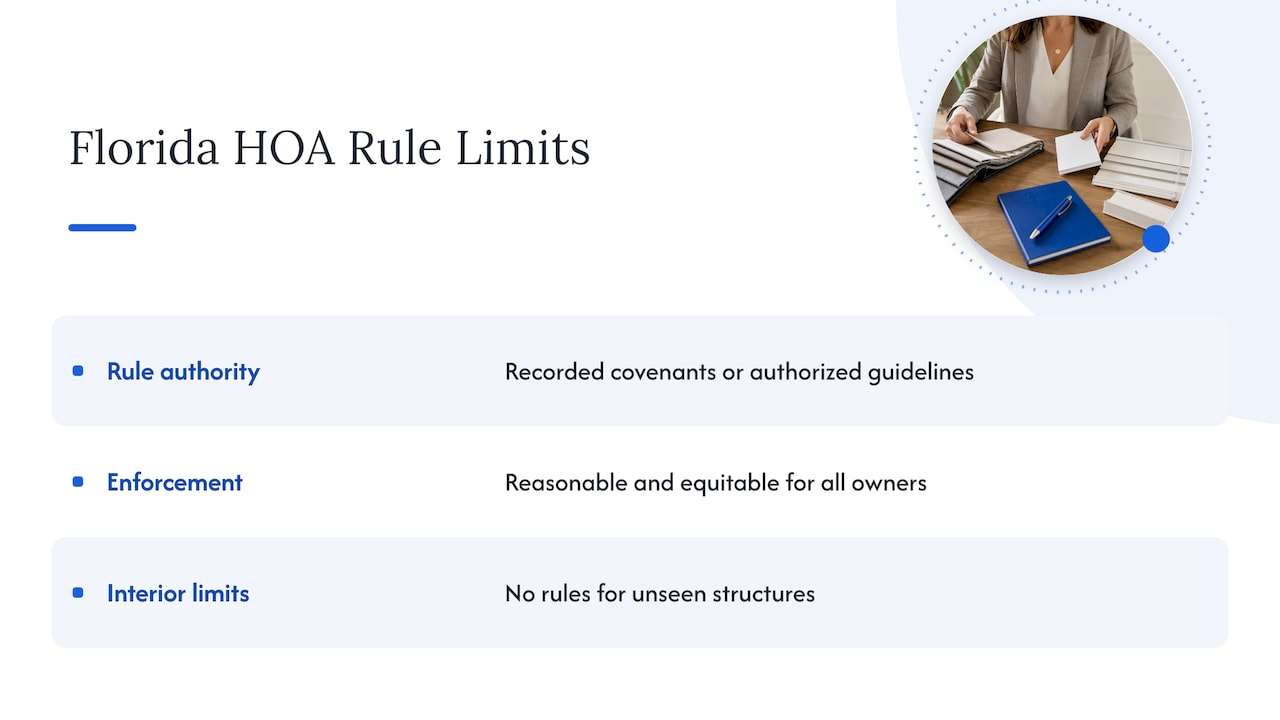
First, the authority has to come from somewhere. An association cannot invent a new aesthetic restriction on the spot. The rule must be authorized by the recorded declaration of covenants, or by published guidelines the declaration authorizes. A committee member’s verbal preference is not a rule.
Second, enforcement has to be even-handed. The statute requires the association to apply its standards reasonably and equitably to all parcel owners. If three neighbors on your street have cream-backed drapes approved, a denial for yours needs a reason grounded in the documents.
The same statute also draws a line at what is visible. It bars an association from enforcing interior requirements for structures that cannot be seen from the street, adjacent parcels, common areas or community golf courses. For windows, that has a practical reading: the outward-facing layer of a treatment is where the HOA has its strongest claim, and a room-side design choice that nobody outside can see is where its claim is weakest. Where the line falls for a specific window, such as a side window facing a neighbor’s lot, is a question for your documents and, if there is a real dispute, a Florida attorney who handles community association law.
The practical rule: ask for the section
If you hear “we don’t allow that,” ask the board or management company to point to the section of your Covenants, Conditions and Restrictions (CC&Rs) or the architectural guidelines that says so. This is the single most useful habit we can recommend. Sometimes the answer is a clear paragraph and you simply adjust your order. Sometimes there is no such paragraph, and the conversation changes.
What Tampa-area architectural manuals actually say
It helps to read real documents rather than guess. Tampa communities publish their manuals, and they show a consistent pattern.
White or off-white facing the street. The Tampa Palms architectural manual is a good example of how an association grounds its authority: it points to Article XI of the community’s recorded declaration. Across Tampa communities, the usual aim is a unified look from the exterior, so coverings visible from outside are expected to be white or off-white, or to carry a white backing. Your community’s exact wording may differ, so treat this as the common pattern, not a promise about your neighborhood.
No reflective material. The Eagle Creek ARC handbook, for instance, prohibits aluminum foil or other reflective material on any window or glass. Mirror tints and highly reflective films are routinely refused elsewhere too, partly for looks and partly because of glare toward neighbors.
Light tint with approval. Tampa Palms North’s architectural guidelines are one of the documents that illustrate how associations handle exterior-affecting changes through an application process. In many communities a light window tint can be approved, but only after an application, and the committee may ask to see a sample first.
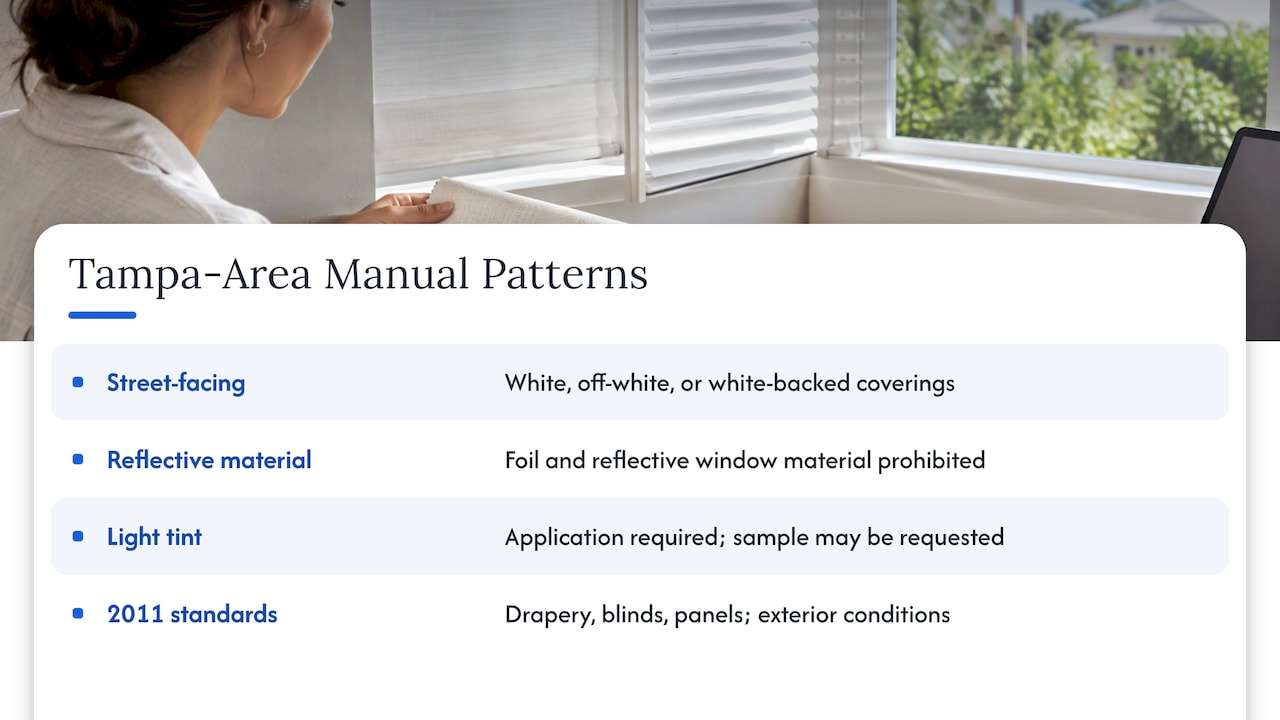
Older standards can be broader than you expect. One Tampa-area townhome association’s Book of Standards, dated 2011, allows window treatments consisting of drapery, blinds, decorative panels or other tasteful window covering, while setting conditions for anything visible from outside. Wording like “tasteful” leaves room for interpretation, which is exactly why a written approval matters.
Typical requirements at a glance
| Item | What associations commonly ask | What to do |
|---|---|---|
| Street-facing color | White or off-white face, or white backing | Specify a lining or backing in the order |
| Reflective film, foil, mirror tint | Usually prohibited | Choose a fabric or shade solution instead |
| Light window tint | Often allowed with prior approval | Submit a sample with your application |
| Interior-only appearance not visible from outside | Limited by Fla. Stat. 720.3035 | Confirm what your documents say |
| Shutters and exterior-visible hardware | Frequently reviewed for color and style | Include them in the application |
HOA or condo: check which one you live in
Before anything else, confirm what you own. Homes in a homeowners’ association are governed by Chapter 720. Condominium units fall under Chapter 718. The rules and your rights differ.
In many Tampa condos, window treatments are the unit owner’s responsibility, yet the association can still regulate exterior appearance, such as asking for white-backed drapery for a uniform building face. Chapter 718 also has its own provisions about what owners may install on the exterior and common elements, so read your condo declaration and rules. As an example of how a Tampa condo handles it, The Vineyard’s building rules include a section on maintenance of unit windows and doors, with owners responsible for the interior of their units.
If you cannot tell which applies, your closing documents or the association’s management company will say whether you hold a parcel or a unit.
How to get a custom order approved the first time
Custom drapery, shades and shutters are made to your measurements and cannot go back to a shelf. That makes the approval process the point where mistakes cost the most. This sequence keeps risk low.
- Get the documents. Under Fla. Stat. 720.303, associations have obligations about providing copies of rules and covenants. Ask for the declaration and the current architectural guidelines in writing, and check for amendments.
- Find the window treatment language. Search the guidelines for “window,” “drape,” “blind,” “shutter,” “tint” and “visible.” Note any color requirement and any approval requirement.
- Decide what is visible. Walk the street, the neighbor’s side and any common area. List the windows that can be seen from those vantage points. Those get the strictest attention.
- Choose the outward face first. Pick the white or off-white lining, shade fabric or shutter finish that meets the standard, then design the room side around it.
- Submit the application with specifics. Include fabric swatches, product type, operation style and where it goes. Committees approve things they can picture.
- Wait for written approval. An email from a board member is better than a conversation, and a signed form is better than an email.
- Order, then install. Keep the approval on file in case a new board or manager reads the rules differently later.
The timeline varies by community, so build it into your plans. If you are moving in or finishing a renovation, start the application early.
Treatments that tend to satisfy HOA standards
No product is automatically compliant, and your documents decide. But some constructions line up naturally with a white-facing requirement while leaving you freedom inside.
- Lined drapery. A white or off-white lining gives the exterior the neutral face associations ask for, while the room side can carry the color or pattern you want. Layering is also an option; our guide to layering window treatments shows how a neutral layer and a decorative layer work together.
- Roller, Roman and cellular shades. These sit close to the glass, so the visible face is a single, controllable fabric, often in a neutral tone that satisfies a uniform exterior.
- Shutters. White or neutral finishes are common and look consistent from the street. Because shutters are visible hardware, include them in your application.
- Motorized options. Motorization changes how a treatment operates, not what shows from outside, so it rarely raises appearance issues. It does help with hard-to-reach windows and consistent positioning, which keeps the street-facing look tidy.
For privacy, light control and heat, you rarely have to sacrifice anything to meet a color rule. Our pages on privacy window treatments and waterfront homes cover those tradeoffs in more depth. Homeowners who care about how a home reads as a whole may also find general thinking on architecture and design services that help a home stand out useful, though local HOA rules in Arizona are different from Florida’s.
Our perspective: the HOA is a design constraint, not an obstacle
We have fabricated window treatments in our Tampa Bay workroom for more than 30 years, and most HOA questions we hear come down to the same worry: will the board let me do what I want? Our honest answer is that the board’s rule is usually narrower than homeowners fear.
A white-backed requirement sounds limiting until you see how much of a drapery’s character lives on the room side: the fabric, the fullness, the heading style, the trim. The outward face is one layer. We treat it as a specification, like fit or stacking space, and design the rest around it.
Because we fabricate every product onsite, we can build a lining, a backing or a shade face to the exact standard a community’s guidelines name, and we can show you a sample for your application rather than a catalog picture. Our team measures and installs, and we remove the old treatments as a courtesy, so the approved design is the one that ends up on the window.
One habit we would urge on everyone: do not order until the approval is in writing. We would rather wait a week for your committee than remake a panel.
— The Drapery Company
If you get a violation notice
A notice is not the end of the road. Florida’s framework is built around notice and the opportunity to be heard.
- Written notice and a hearing. Under Chapter 720, a fine cannot be imposed without at least 14 days’ written notice and an opportunity for a hearing before a committee of members who are not officers, directors or employees of the association.
- Fine limits. Unless the governing documents provide otherwise, a fine can reach $100 per violation per day, capped at $1,000 in the aggregate for a violation. A fine of less than $1,000 may not become a lien against the parcel. Payment is due five days after the committee meeting that approves it.
- Open meetings. Board meetings where architectural decisions are made must be open to members, with at least 48 hours’ notice posted conspicuously unless an emergency exists. Members can attend and speak for at least three minutes on agenda items, per Fla. Stat. 720.303. Meetings with the association’s attorney about pending litigation and personnel matters are exempt.
The most common mistake is assuming the board has unlimited discretion. It does not. Attend the hearing, bring your approved application or your photographs, and ask which section of the documents is being enforced. For anything involving a lien, a lawsuit or a disagreement over what your documents mean, speak with a Florida attorney who practices community association law. The state’s Homeowners’ Associations FAQs from the Department of Business and Professional Regulation explain what that agency does and does not handle.
Mistakes that cause HOA trouble
- Ordering before approval. The costliest error, because custom goods cannot be resold.
- Relying on a neighbor’s treatment as precedent. It may have been grandfathered, approved under older guidelines or installed without approval. Rely on the current documents.
- Forgetting the lining. A beautiful patterned drapery with a dark or colored back can fail a white-facing rule. We list other common errors in our window treatment mistakes guide.
- Adding reflective film later. Mirror tint is the item most often refused, and removing it costs money.
- Skipping the hardware. Exterior shutters and visible hardware are often reviewed along with fabric.
Working with us on an HOA-governed home
If you live in an HOA community in the Tampa Bay Area, start with an in-home consultation. We look at your windows, talk through what your guidelines require, and design treatments that meet the outward standard and suit the room. You can learn more about in-home consultations, measurement and installation, browse our shades, blinds and shutters, or reach out through The Drapery Company. Property managers and interior designers who handle multiple units can also ask about our commercial window treatments.
FAQ
Can a Tampa HOA ban curtains or blinds?
It is unusual for an association to ban window treatments outright. Most set standards on color, material and what is visible from outside. Under Fla. Stat. 720.3035, whatever it enforces must be authorized by the recorded declaration or authorized guidelines and applied equitably.
Do I need HOA approval for interior drapes?
It depends on your documents and on what is visible. Florida law bars an association from enforcing interior requirements for structures not visible from the street, adjacent parcels, common areas or golf courses. Many communities still require approval for anything seen from outside, so check your architectural manual first.
Does my window covering have to be white?
Not by statute. Many Tampa associations require a white or off-white face, or white backing, on coverings visible from the street, but that comes from the community’s own guidelines. Do not assume it applies to you until you read them.
How much can an HOA fine me for a window violation?
Unless the governing documents provide otherwise, up to $100 per violation per day, with a $1,000 aggregate cap per violation. The association must give 14 days’ written notice and a hearing before a committee of independent members first.
Do condo owners follow the same rules?
No. Condominiums are governed by Chapter 718, and the association’s declaration and rules control what you can do. Confirm whether you own a parcel in an HOA or a unit in a condo, and read the corresponding documents.
Sources
- Florida Statutes 720.3035, architectural control covenants
- Florida Statutes 720.303, association powers and duties
- Florida Statutes Chapter 720 (printed)
- Florida Statutes 718.113, condominium maintenance and alterations
- Tampa Palms Architectural Manual
- Tampa Palms North architectural guidelines
- Eagle Creek ARC Handbook
- The Vineyard Condominium rules and regulations
- Florida DBPR Homeowners’ Associations FAQs