Curtain Track vs Rod: How to Choose for Your Windows
November 13, 2026
Heat Blocking Window Treatments for Tampa Homes
November 15, 2026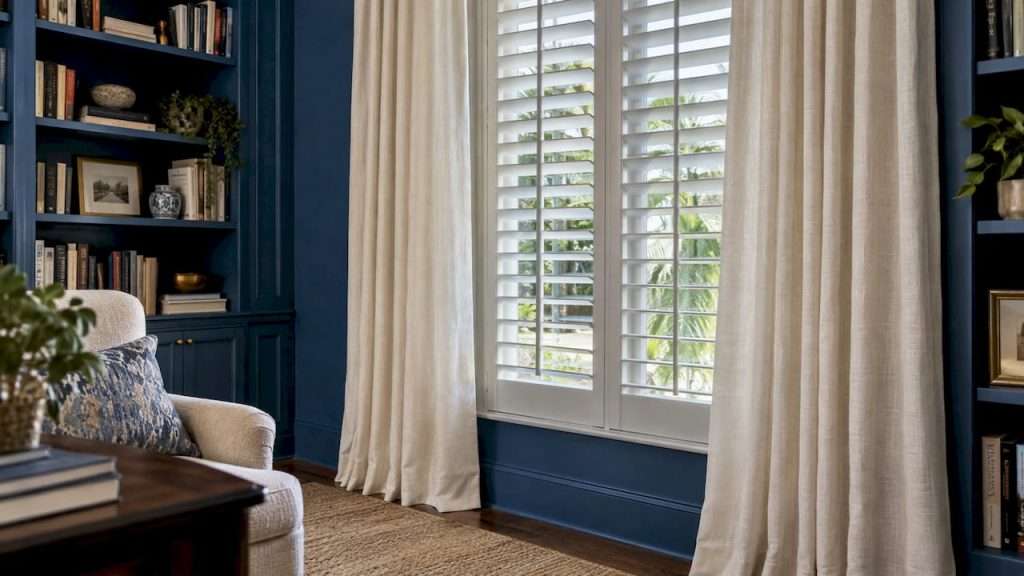
Yes, you can hang curtains with shutters, and in most rooms the pair does more than either one alone. Shutters give you precise control over light and view. Curtains add softness, color, height and, when they are lined, better privacy and a little more insulation. The details that decide whether it looks designed or crowded are rod placement, panel width, fabric weight and how the shutters open. Get those right at the measuring stage and the result looks intentional for years.
This guide is for Tampa Bay homeowners, new owners, designers and property managers who already have shutters, or are about to install them, and want to know how to add drapery without fighting the hardware. We build both, fabricate our drapery onsite, and measure every window before anything is cut, so the advice below follows the order of a real project.
TL;DR
- Curtains over shutters is a mainstream pairing: designers describe layering drapery over plantation shutters as a way to add beauty and an upscale finish.
- Mount the rod high and wide, and set it out from the wall so the panels clear the shutter frame and the panels swing freely.
- Use shutters for daily light and view control, and use lined or sheer panels for softness, color and extra privacy.
- Do not count on curtains as a major energy measure: loose panels insulate modestly. Lined, full-length drapery that is properly sized helps more.
- Measure for the open shutter, not the closed one. A professional measurement prevents the most common mistake.
Why curtains and shutters work together
Shutters and curtains solve different problems. A shutter is architecture: a fixed, hard-lined frame with louvers that tilt for exact light control. Curtains are the opposite. They bring texture, pattern and movement, and they hide the plain, hard edges that make a room feel finished only from the outside in.
Layering is not a fringe idea. In a 2026 House Digest feature, interior designer Amber Guyton said she is not opposed to layering plantation shutters with drapery, the way many people layer blinds and Roman or roller shades, because it adds beauty to a space. The same piece notes that wood slat shutters can feel heavy in today’s interiors, and suggests that updating the finish, painting them white or layering them with drapery can modernize them.
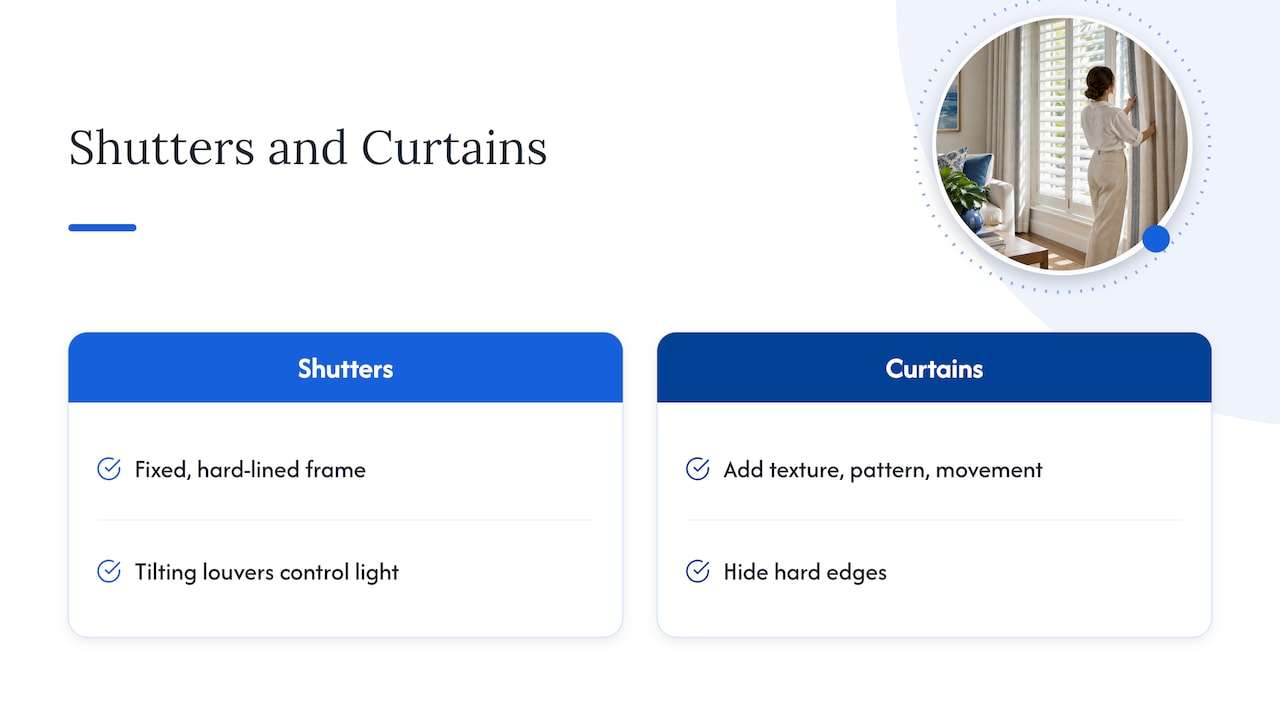
For a bedroom or living room, design guidance from The Spruce likewise points to layering blinds with curtains for a decorative look and for light and privacy options through the day. Shutters already do the hard work on that list. The curtain finishes the room.
What each layer does
| Need | Shutters | Curtains or drapery |
|---|---|---|
| Daily light control | Tilt the louvers to the exact angle | Open or close in full |
| View | Open the louvers or the panels | Pull aside completely |
| Softness and sound | Hard surface | Fabric absorbs echo |
| Color and pattern | Usually one finish | Almost unlimited |
| Height and proportion | Stays inside the window | Draws the eye up |
| Blackout at night | Closed shutters leave light at the louver gaps | Lined or blackout panels close the gap |
The last row is the practical one. The One Room Challenge’s window treatment encyclopedia lists lined curtains or drapes and closed shutters among the options for maximum privacy, and shutters among those for precise light control. Together they cover both jobs in one window.
The Tampa angle: sun, heat and glass
In Tampa Bay, window treatments work against strong, long sun. Shutters bounce and filter that light at the window. A fabric layer behind or in front of them takes the edge off glare in the afternoon, when the western exposure is hardest to live with.
Be realistic about energy. Efficient Window Coverings, a professional resource, says that interior curtains and drapes provide modest insulation, normally no more than R-1 when fully deployed, with heavier drapes performing slightly better than shades and blinds. Penn State’s Pennsylvania Housing Research Center adds that the benefit depends on sealing the perimeter and forming an air barrier, because gaps at the top, bottom and sides let air circulate behind the fabric.
What that means in practice: choose lined, full-length panels with enough fullness to close properly, and treat comfort as a design benefit alongside the look, not as a promise of a lower bill. A fitted, lined drapery that reaches the floor and clears the window on both sides does the job better than a short, thin panel hung to the frame.
How to hang curtains over shutters
The order below is the one we follow on a project, because each decision limits the next.
1. Decide how the shutters open
Shutters swing into the room, and bi-fold or hinged panels need clearance. Before you pick a rod, open every panel fully and note how far it travels. Louvers that tilt in place need very little room, while hinged panels need the full swing. A curtain that blocks the swing will be pushed aside every day, and it will wear and wrinkle where it is pushed.
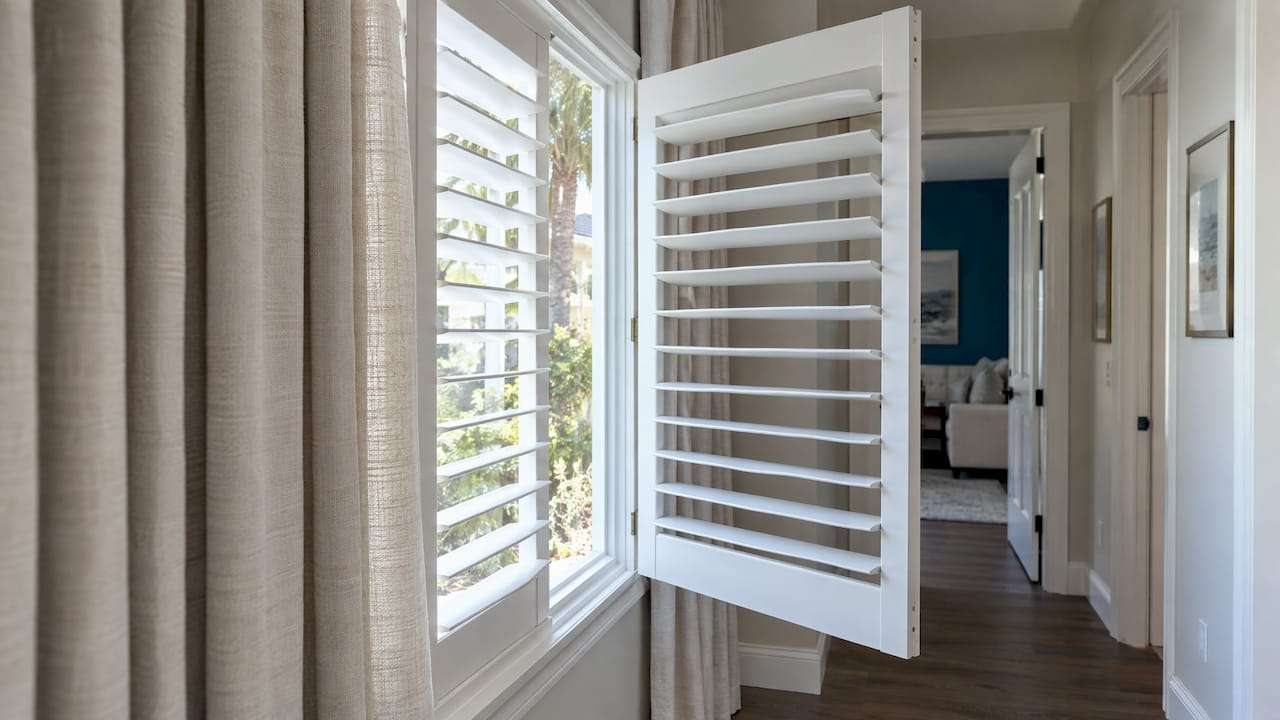
If you are choosing shutters at the same time, say so at the start. The shutter frame style and the curtain depth can then be planned as one system. Our guide to plantation shutter styles covers the frame and louver options that affect this.
2. Set the rod wider than the window
Hang the rod beyond the shutter frame on each side, so that when the panels are open they stack against the wall and leave the whole shutter exposed. This is the single most important detail. A rod that stops at the frame leaves fabric covering the louvers and the window looks smaller, not larger.
3. Mount the rod high
Architectural Digest’s starter guide advises installing the rod as close to the ceiling as possible to heighten the feel of a room. Drapery that hangs from high up makes the window look taller, which also gives the shutter more presence rather than less. In Tampa homes with lower ceilings, a rod hung a few inches above the frame is often the practical compromise.
4. Bring the rod out from the wall
Shutter frames project from the wall. Brackets with enough projection let the panels hang in front of the frame and shutters without touching them. A double rod is useful here: shutters stay clear, a sheer sits closest to the glass, and a heavier panel hangs in front. Our guide to a double curtain rod with sheers explains how the two layers stack.
5. Choose a length that finishes the room
Floor-length is the default for living rooms and bedrooms. Lindye Galloway, quoted by Architectural Digest, says that floor-to-ceiling drapery adds depth, dimension and height. Short panels that stop at the sill compete with the shutter’s horizontal line, so they rarely look right on a tall window.
6. Get the fullness right
Fullness is how much fabric is gathered across the width. Panels that are too narrow look flat and cannot cover the window when closed, which defeats their purpose. This is where custom fabrication matters: each panel is made to the width and drop your window needs, instead of the nearest standard size.
Choosing fabrics, colors and styles
Sheer panels
Sheers are the lightest touch. Maestri, quoted by Architectural Digest, says sheer panels add softness and diffuse sunlight. Over white shutters they soften the grid of louvers without blocking light. They suit rooms where you want the shutter to stay visible. See our page on curtains with sheers for how they work in a layered scheme.
Lined drapery
When the room needs real privacy or darker sleeping conditions, lined drapery is the right layer. Martha Stewart’s guide to drapery and curtains says drapery suits situations where you want to fully block light, protect privacy and insulate. It also says drapery is best for formal spaces like living rooms and bedrooms, while curtains are traditionally used in kitchens and children’s rooms. If you are choosing between degrees of darkness, our comparison of blackout curtains vs room darkening and the guide to blackout curtains for bedrooms set out the differences.
Color and finish
White shutters are the easiest base: nearly any fabric color works. Stained wood shutters are warmer and benefit from curtains in a neutral that picks up one tone in the wood. If you want to bring the room together, styling natural wood accents elsewhere in the space can echo the wood of the shutters so the whole room reads as one scheme. Patterned drapery works best when the shutters are plain, and the reverse is also true.
Hardware
Choose a rod whose finish matches other metals in the room, and keep the diameter in proportion to the fabric weight. Heavy lined drapery needs a sturdy rod and strong bracket anchors. Grommet panels give a modern, clean line, as Architectural Digest notes that grommets are incorporated seamlessly in the fabric for a modern look, while pleated headings suit more traditional rooms.
Curtains vs shutters: which one should come first?
If you are choosing between them instead of combining them, base the decision on the room, not on a trend.
- Choose shutters first for rooms where you want crisp, adjustable light control, such as a kitchen, a home office or a street-facing room. They are fixed to the window and stay tidy.
- Choose curtains first for rooms where you want softness, sound absorption, color and height, such as a living room or primary bedroom.
- Choose both in rooms where privacy, darkness and a finished look all matter. The One Room Challenge’s guide to window coverings maps each need to its best product, and for privacy and energy efficiency it lists both shutters and lined curtains.
When the question is whether shutters look dated, the answer in the same House Digest feature is balanced: Guyton calls them timeless, though not for every home. The point for a homeowner is that a plain, painted shutter with a well-chosen drapery layer reads as current. If your shutters are already in place and feel heavy, adding a fabric layer is a smaller step than replacing them. For a fuller view of the trade-offs of the shutters themselves, read our plantation shutters pros and cons.
Room-by-room ideas
Living room
Hang drapery from a high rod and let the panels stack well outside the shutter frame. Use a medium-weight fabric in a color close to the wall, so the shutters read as the focal point and the fabric as the frame around them.
Primary bedroom
Shutters handle daytime privacy. Lined or blackout drapery handles sleep. Close both at night: the shutter blocks view and the drapery closes the light gaps at the louvers. Our bedroom window design ideas cover other layers for sleep rooms.
Dining room and kitchen
Choose shorter, easy-to-clean fabrics that stay clear of splashes, or keep to shutters alone where humidity and grease are a factor. Where a curtain adds warmth, a simple panel at each side is enough.
Large picture windows and sliders
Standard hinged shutters do not always suit very wide openings. Drapery on a long rod can span the whole wall, while shutters cover the operable sections. For a layered approach, see our page on layered window treatments and our guide to layering window treatments for a luxurious look.
For designers, builders and property managers
If you specify window treatments for clients or manage several units, the same logic applies at scale: decide the shutter swing and frame depth first, then standardize rod projection, panel width and fabric across units so installs go in one pass. We fabricate our products onsite in our Tampa Bay workroom and handle professional measurement and installation, which keeps fit and materials under one roof. Our commercial window treatments page describes the drapery and motorized options for larger projects.
A point of view from our workroom
Layering is a measuring problem, not a style problem.
We see curtains and shutters as parts of one system. The shutter is the inner architecture of the window, and the drapery is the fabric wall that frames it. When a project is planned that way, the rod, the stack-back, the fullness and the shutter swing are decided together, and nothing needs to be moved afterward.
That is why we fabricate onsite. We control the width, the drop, the lining and the finish of every panel, so it fits the window as it actually is, not the nearest standard size. We also take away the old window treatments as a courtesy when we install the new ones, which means the day your drapery goes up is the day the window is finished.
If you are adding drapery to existing shutters, bring us the shutters as they are. If you are choosing both, we can design them together.
The Drapery Company
Get the layers measured and made together
We offer custom drapery, shades, blinds and shutters, with in-home consultations, professional measurement and installation across the Tampa Bay Area. A visit lets us see how your shutters open, check the wall space beside each window, and recommend a rod, fabric and fullness that suit the room. To start, book an in-home consultation, or explore our drapery and window treatment range. If you want a reminder of the wider choices, our guide to window treatment materials and styles is a good place to browse first.
FAQ
Can you hang curtains over plantation shutters?
Yes. Designers regularly layer drapery over plantation shutters for added beauty and an upscale finish. The key is to mount the rod wide and high, and set it far enough from the wall that the panels clear the shutter frame.
Should curtains cover the shutters when closed?
They can, but you do not have to. In most rooms the panels are left open and stacked at the sides during the day, so the shutters stay visible. You close the curtains at night, or for extra privacy or darkness.
Will curtains make my home more energy efficient?
A little. Interior curtains and drapes are generally rated at no more than R-1 when fully deployed, and their effect depends on how well the edges seal. Lined, full-length drapery with proper coverage works better than a loose decorative panel.
Do shutters and curtains look dated together?
Not when they are styled with intent. Painted white or lightly finished shutters with a simple, well-fitted drapery layer read as current. Heavy, dark slat shutters are the ones that benefit most from a softer fabric layer.
Do I need custom curtains for shutters?
Custom drapery is the easiest way to get the right width, drop and fullness for a window with shutters, since the rod and stack-back are measured from the frame. Ready-made panels come in set sizes, which often leave the shutter partly covered or the panel too narrow to close.
Sources
- Are Plantation Shutters Dating Your Home In 2026? We Asked… (House Digest)
- 56 Window Treatment Ideas for Every Budget and Style (The Spruce)
- The Complete Window Treatment Encyclopedia (One Room Challenge)
- Drapes & Curtains (Efficient Window Coverings)
- Retrofit Solutions for Energy Efficiency (Pennsylvania Housing Research Center)
- Window Treatments: Here’s Everything You Need to Know (Architectural Digest)
- 33 Stylish Window Treatment Ideas (Architectural Digest)
- Drapes vs Curtains: When to Choose Drapery, Curtains, or Blinds (Martha Stewart)