Motorized Sheer Shades: How They Work and How to Choose
November 9, 2026
Condo Window Treatments: What Works, What Boards Allow
November 11, 2026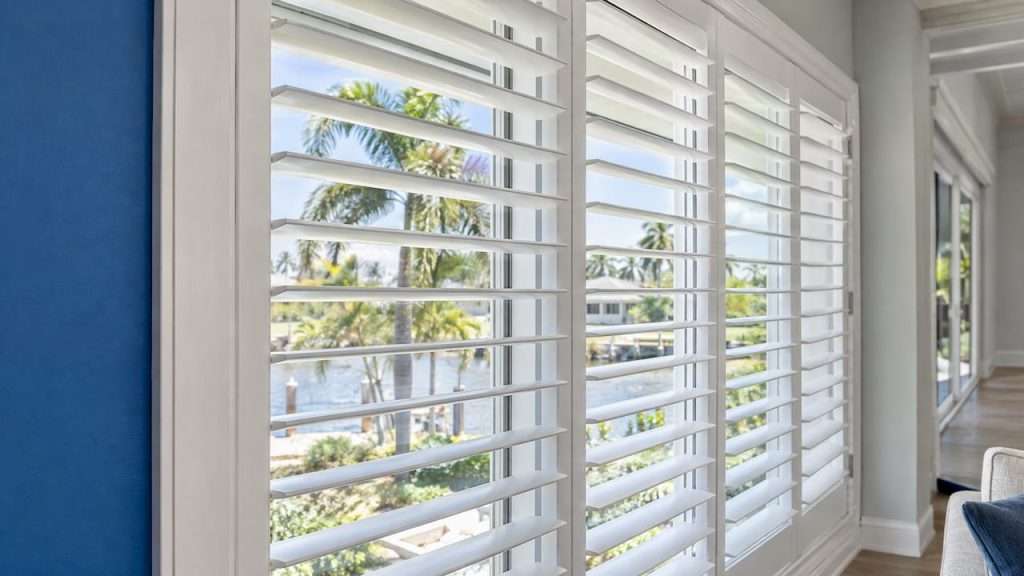
Hidden tilt shutters move the louver control out of sight. Instead of a vertical rod down the middle of each panel, the mechanism sits inside one stile or on the back of the panel, so you tilt the louvers by hand and the front stays clean. Hidden tilt bar shutters and rear tilt shutters are two names for the same idea. They suit homeowners who want a crisper face and a clearer view, and the right choice depends on louver size, panel height and how you use the room.
Below we cover how the mechanisms work, how hidden tilt compares with a standard front tilt rod, what split tilt (often searched as double hung shutters) does, and how panel configuration affects the decision.
TL;DR
- Hidden tilt shutters (also called rear tilt or clear-view) hide the louver control inside a stile or behind the panel, so no center rod crosses the front.
- Two common designs exist: a mechanism embedded in one stile, and a strip fixed to the back of the louvers.
- Split tilt, the “double hung” layout, divides a panel so the upper and lower louvers move independently.
- Fit depends on louver size and panel height, so measure before you choose a style.
- A professional in-home measurement settles louver size, layout and mounting in one visit.
What hidden tilt shutters are
A traditional plantation shutter has louvers linked by a tilt rod on the front of the panel. You push the rod and every connected louver turns together. A hidden tilt shutter links the louvers a different way, behind the scenes, so the face of the panel shows only louvers and frame.
You will see the same product under several labels: hidden tilt, hidden tilt bar, rear tilt, invisible tilt and clear-view. Manufacturers use the terms differently, but the goal is the same: less visible hardware and a less interrupted view when the louvers are open. If you are new to the vocabulary, our guide to plantation shutter parts names every component, from stiles and rails to louvers and pins.
How hidden and rear tilt mechanisms work
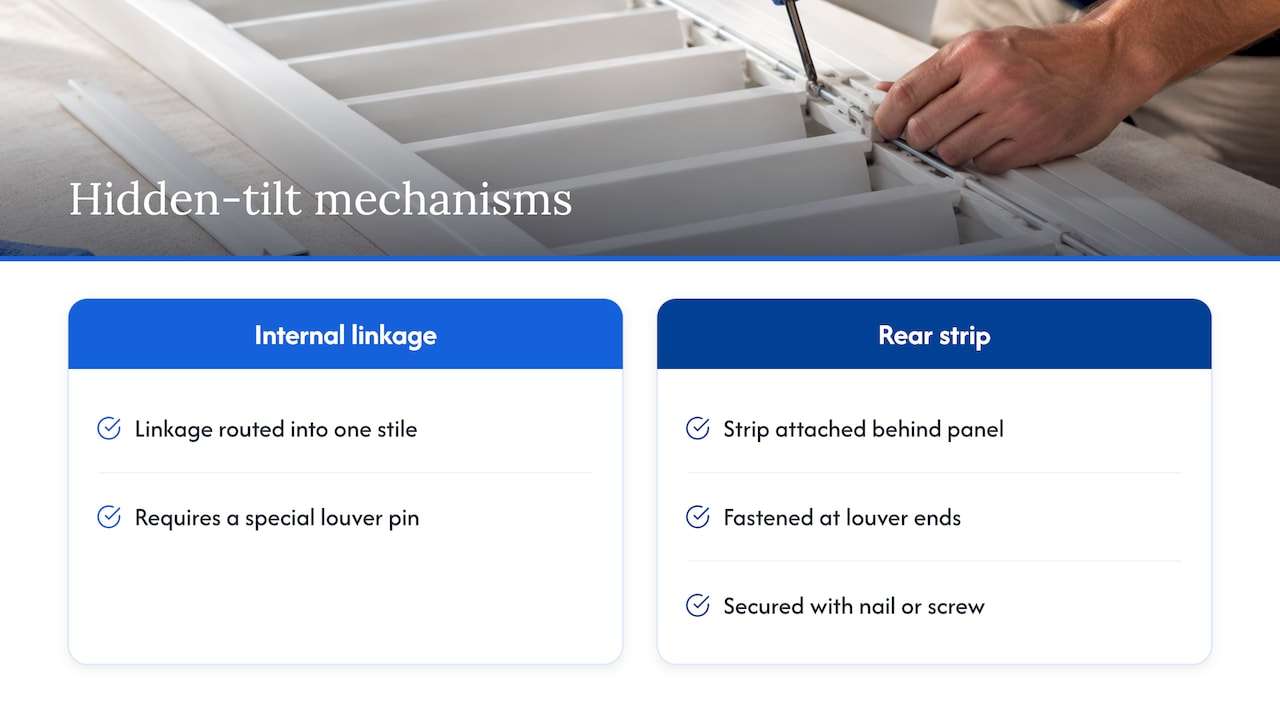
Hidden tilt systems come in two basic types: an internal mechanism built into one shutter stile, which needs a special louver pin on that side, or a metal or plastic strip attached to the back of the panel at the ends of the louvers with a nail or screw.
Embedded in the stile
In the embedded design, the linkage is routed into one stile. One system, Norman’s InvisibleTilt, uses a spring-loaded pin that sits in the stile hole and a small tension gear aligned parallel with the neighboring louvers. When a louver is replaced, it slides into the stile until the pin seats in its hole. The tension gear is what keeps the louvers holding their angle, so alignment matters.
Because the mechanism lives in the frame, the face of the shutter is completely free of hardware. That is the cleanest look, and it also means the frame has to be built for it from the start.
Strip on the back of the panel
In the strip design, a thin bar sits on the back of the louvers and connects them. On a clear-view style where louvers are joined by a hidden tilt bar, a single louver comes free once you remove the screw or nail holding it to the bar. Service work on this type includes detaching the louver from the strip, cutting the pin on the opposite side and reusing the pin on the hidden-tilt side. A replacement louver should be pre-drilled with a 1/16-inch bit at the fastening point to help prevent cracking.
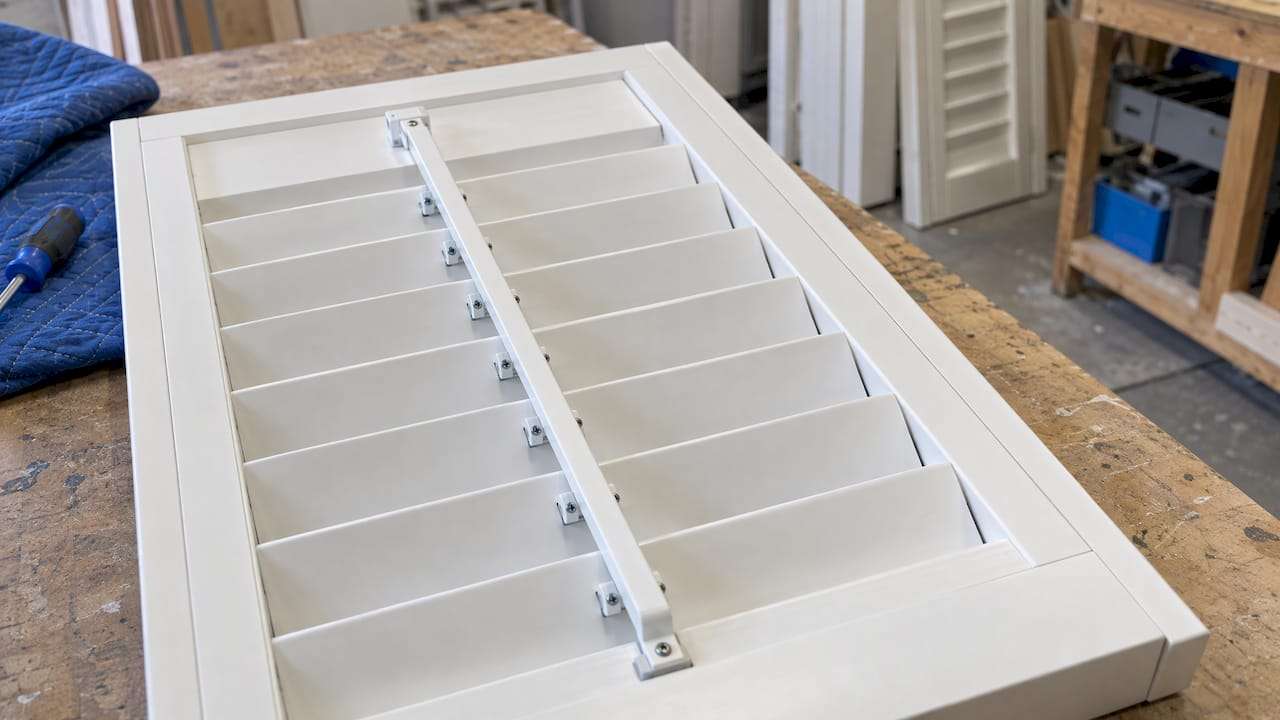
These details matter to you as a homeowner for one reason: a hidden tilt shutter is a precision assembly. Pins, gears and strips are sized to the louver, so repairs and replacements are best handled by the fabricator or an installer who knows the system.
Hidden tilt vs. front tilt in daily use
The difference shows up in three places: how the panel looks, how it feels in your hand, and how it behaves with light and view.
| Consideration | Front tilt rod | Hidden / rear tilt |
|---|---|---|
| Look | Classic plantation face with a visible center rod | Clean face, louvers and frame only |
| Operation | Push or pull the rod | Turn the louvers directly by hand |
| View when open | Rod crosses the sightline | Unobstructed sightline |
| Cleaning | Rod and its connection points to wipe around | Flat louver faces, simple to wipe |
| Construction | Widest range of louver sizes | Some louver sizes are not offered in every system |
Appearance and view
With louvers open, a front rod sits right in your line of sight. That rarely bothers anyone on a small window, but on a large picture window, a pool view or a bay overlooking water, many Tampa Bay homeowners prefer the uninterrupted glass line. Narrow windows benefit too: on a slim panel, a center rod takes up a noticeable share of the width.
Light and privacy control
The louvers still tilt closed, open and anywhere between. You angle them down to keep the street from seeing in while letting daylight bounce into the room, or close them fully for the afternoon sun on a west-facing wall. Since the louvers are linked together, they move as a set on one panel unless you choose a split design, covered below.
Cleaning and upkeep
Without a rod and its hardware, the face of the panel is easy to dust or wipe. In our climate, where humidity and sun are constants, a smooth surface is an advantage in kitchens and bathrooms. For the full picture of how finishes and materials hold up on the Gulf Coast, see our overview of plantation shutter styles.
Split tilt: what “double hung” shutters means
People searching for double hung shutters usually mean a split-tilt panel. The panel is divided horizontally by a rail, usually at the mid-point of the window, so the upper and lower sections tilt independently. It is the shutter equivalent of a double-hung window, where the two sashes work separately.
The practical payoff is simple. You close the lower louvers for privacy at eye level and leave the upper louvers open to let daylight in. Or you do the reverse in a bedroom, closing the top to cut glare while keeping a view of the garden below.
Split tilt works with hidden tilt, but the system has limits. For one major manufacturer’s embedded system, the maximum louver counts for split tilt are 24 louvers for 2½-inch louvers at panel heights of 54¾ to 57¼ inches, 16 for 3½-inch louvers at 54¾ to 58 inches, and 12 for 4½-inch louvers at 54¾ to 60 inches. The same document notes that the embedded system is not available for 7/8-inch louvers. Other fabricators build to their own specifications, which is why the in-home measurement matters.
Louver size and hidden tilt
Louver width changes the character of a shutter as much as the tilt style. Smaller louvers give a busier, more traditional pattern and more louvers per panel. Wider louvers give a bolder look, fewer lines and a better view when open. Our breakdown of shutter louver sizes and depths explains why 3½-inch louvers are the common choice for most homes, and it pairs naturally with a hidden tilt decision, because the louver width drives how many louvers a split-tilt panel can hold.
Panel configurations and how to choose
A panel configuration is how the shutter is divided and hinged across your opening. The main variables are:
- Number and width of panels. A wide window is divided into several panels so each stays a manageable size and can swing without hitting furniture.
- Hinged, bi-fold or track-mounted. Hinged panels fold back against the wall. Bi-fold panels stack to the side. Track-mounted systems slide, which suits patio doors and very wide openings.
- Single tilt or split tilt. One set of louvers per panel, or two independent sets.
- Tier arrangement. On tall windows, a horizontal division can be used so the top and bottom sections have separate controls and sometimes separate hinging.
- Shape. Arches, circles and angled windows use shaped panels, typically fixed in place.
Here is how we think through it in a typical Tampa home:
- Start with the window you look through most. A living room slider or picture window usually benefits most from a clear sightline, so that is where hidden tilt earns its place.
- Match privacy needs to the room. Street-facing bedrooms and bathrooms are the natural place for split tilt.
- Check the swing. Panels that fold back need clear wall space beside the window. Where that is tight, bi-fold or track options solve it.
- Choose louver size last, with the layout in hand. The louver width determines how many louvers fit in the panel height, which is what the split-tilt limits above are about.
Tall, wide and unusual windows
Hidden tilt is often chosen for tall windows because tall panels with a front rod can look heavy, and for very narrow windows where a rod crowds the face. For shaped windows, the tilting portion usually sits on the rectangular lower section while the shaped top is fixed. If a window has deep trim, a protruding crank or a handle, we also check whether the shutter will clear it in an inside or outside mount. Our plantation shutters guide covers mounting and material choices in more depth.
Repair and long-term care
A hidden tilt shutter is built to be operated by hand at the louver, so the habit worth forming is to turn the louvers gently and evenly, ideally from the middle of the panel, rather than pushing at the tips. Forcing a stuck louver is the quickest way to strain a pin or a strip fastening.
If a louver does come loose or a gear shifts, the repair sequence follows the system type described above, and the pieces must be seated and aligned correctly. Panels also stay more reliable when the surrounding window is sealed and square, so it is worth keeping weatherstripping around your windows in good condition, because drafts and moisture moving through a poorly sealed opening are hard on any interior treatment.
Our perspective on hidden tilt
We fabricate every product in our Tampa Bay workroom, and that shapes how we talk about hidden tilt. A mechanism that disappears into a stile or sits behind the louvers only looks effortless if the fit is right. The louver size, panel height, pin position and frame all have to agree, and that is far easier to control when the people who measure your windows are the same people building your panels.
For most homes, we think of hidden tilt as a design decision first and a hardware decision second. If you have a view worth keeping, or a narrow window that a center rod would crowd, the clean face is worth considering seriously. If you want privacy in the lower half of a room without losing daylight above, a split-tilt layout does that job.
Our approach is to look at your windows in person, talk through how you use each room, and then recommend a configuration that fits your budget and your daily routine. We handle design, measurement and installation, and we remove your old window treatments as a courtesy.
The Drapery Company
Plan your shutters with us
If you are weighing hidden tilt, split tilt or a classic front rod, the fastest way to a confident decision is to see the options against your own windows. We offer in-home consultations with professional measurement and installation across the Tampa Bay Area. You can also browse our blinds, shades and shutters to see the range, and if budget is on your mind, our plantation shutters cost guide explains what drives pricing. Because our pricing depends on your windows, we quote after the consultation.
FAQ
Are hidden tilt bar shutters and rear tilt shutters the same thing?
In everyday use, yes. Both describe shutters whose louver control sits behind the panel or inside a stile instead of in a visible front rod. Brand names such as clear-view or invisible tilt describe specific versions of the idea.
Can hidden tilt shutters still give full privacy?
Yes. The louvers close and angle just like those on a front-tilt shutter, so you can block the view in, angle them to admit light, or open them fully. For different settings on the top and bottom of one window, choose a split-tilt layout.
What does “double hung” mean for shutters?
It usually refers to a split-tilt panel divided horizontally so the upper and lower louvers tilt independently. It lets you shut out street views at eye level while keeping the upper part of the window open to daylight.
Is hidden tilt available with every louver size?
Not always. One major embedded system, for example, is not offered in 7/8-inch louvers, and split-tilt louver counts are capped by louver width and panel height. A measurement visit confirms what suits your windows.
Which rooms benefit most from hidden tilt?
Living rooms with a view, large sliders and picture windows, narrow windows, and any room where you want a clean, modern face. Bedrooms and street-facing rooms often pair well with split tilt.
Sources
- Confirming Tilt Rod Location
- InvisibleTilt Louver Replacement Instruction
- Woodlore shutter specifications
- Repair Directions