Motorized Wood Blinds: How They Work and What to Know
November 25, 2026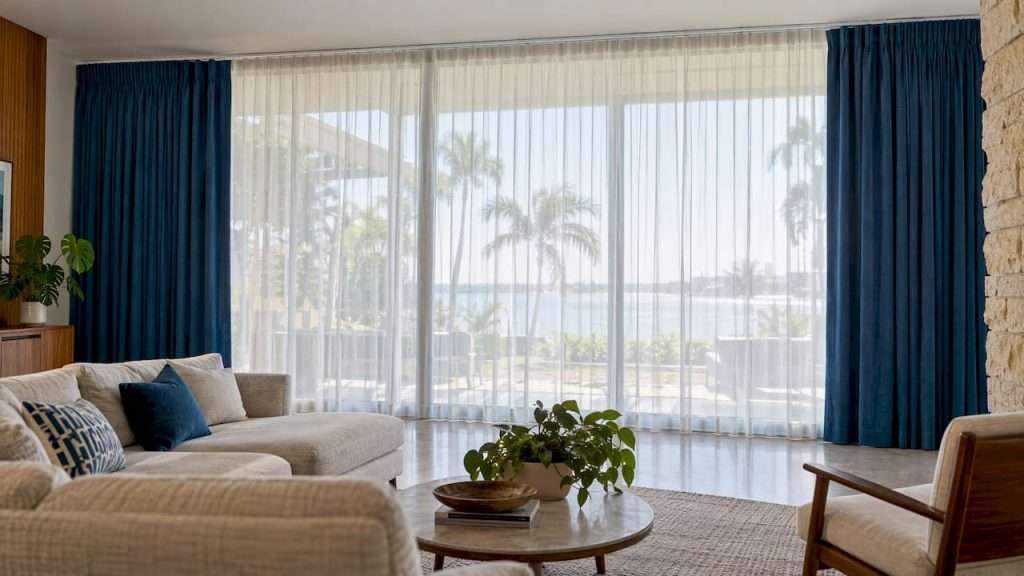
The best mid-century window treatments are the ones that respect the glass: floor-to-ceiling pinch-pleat curtains on a slim track, clean roller or cellular shades, and natural-texture blinds, all made to the exact size of your openings. Mid-century homes have wide panes, short high windows and odd proportions, so off-the-shelf sizes rarely sit right. In Tampa Bay, where sun and heat hit those big windows hard, the treatment also has to control glare and heat. At The Drapery Company we fabricate every product in our Tampa Bay workroom, so the fit, fabric and hardware can be matched to your windows rather than the other way around.
TL;DR
- Mid-century homes were built around large glass, so the treatment should frame the view and still deliver privacy, shade and insulation.
- Floor-length pinch-pleat curtains on a ceiling track or behind a slim valance are the period-correct choice. Roller, Roman and cellular shades give the same clean lines with modern performance.
- Layering a sheer with a heavier panel, or a shade under a curtain, handles privacy by day and darkness at night.
- Short, wide and high windows need a custom size and mounting plan, and the details of measuring decide whether the result looks designed or improvised.
- For Tampa sun, compare shades by openness percentage, not just by color.
What makes a window treatment “mid-century”
Mid-century modern homes made multiple large windows a standard feature, and those windows often took over the role the fireplace once played as the focal point of a room, according to the Cooper Hewitt, Smithsonian Design Museum. The same account describes designer Dorothy Liebes, who reinvented decorative blinds with woven bamboo reeds and textured yarns in blues, taupes and metallic gold, and held that a window should be something to look at as well as to look through.
That sentence is a good brief for your own home. A mid-century treatment is not a heavy, fussy swag. It is a plane of texture or color that sits quietly with the architecture, opens easily, lasts, and suits the room it is in. The Cooper Hewitt piece also points to the real problem: big glass gives you daylight by day and a dark mirror after sunset, so the treatment has to solve both.
Three traits tend to define the look:
- Clean geometry. Straight lines, flat fronts, simple hardware. Narrow panels with grommet holes read as a different era, and one mid-century guide specifically flags them as a poor fit.
- Natural or textured materials. Linen, cotton, wool, tweed and woven wood suit the period.
- Full-wall thinking. The treatment covers the glass wall as a unit instead of dressing each pane separately.
Curtains: pinch pleats, tracks and layers
Pinch-pleat drapery was the original answer to fully glazed curtain walls. A mid-century design blog describes them as often hung in two layers, a sheer for privacy plus a heavier curtain for insulation and light control, mounted on a ceiling track or hidden behind a minimal valance. That structure still works, and it is the one we would start from for a living room with a glass wall.
Why floor-to-ceiling matters
Floor-length panels hung high make the room feel taller and let the glass stay the star. Mount the hardware well above the frame, and extend it past each side of the window so the stacked fabric rests on the wall instead of covering the glass. With a ceiling-mounted track the curtain starts at the ceiling line and the hardware disappears, which is the cleanest effect for low-slung rooms.
Fullness and pleats
A pinch pleat needs enough fabric to fold into crisp, even pleats when the curtain is closed. A flat, stretched panel looks cheap. Fullness is a fabrication decision, which is why we make drapery onsite: the pleat spacing, panel width and hem can be set for your window, not for a stock size.
Fabrics, colors and patterns
Guides on the period commonly point to back-tab or pinch-pleat headings, tweed, wool and linen, and geometric patterns such as starbursts, atomic motifs and overlapping circles, with retro colors like turquoise, orange and yellow. For a calmer interpretation, mustard, olive and burnt orange in cotton or linen with a plain, unembellished panel keep the period feel without looking like a set.
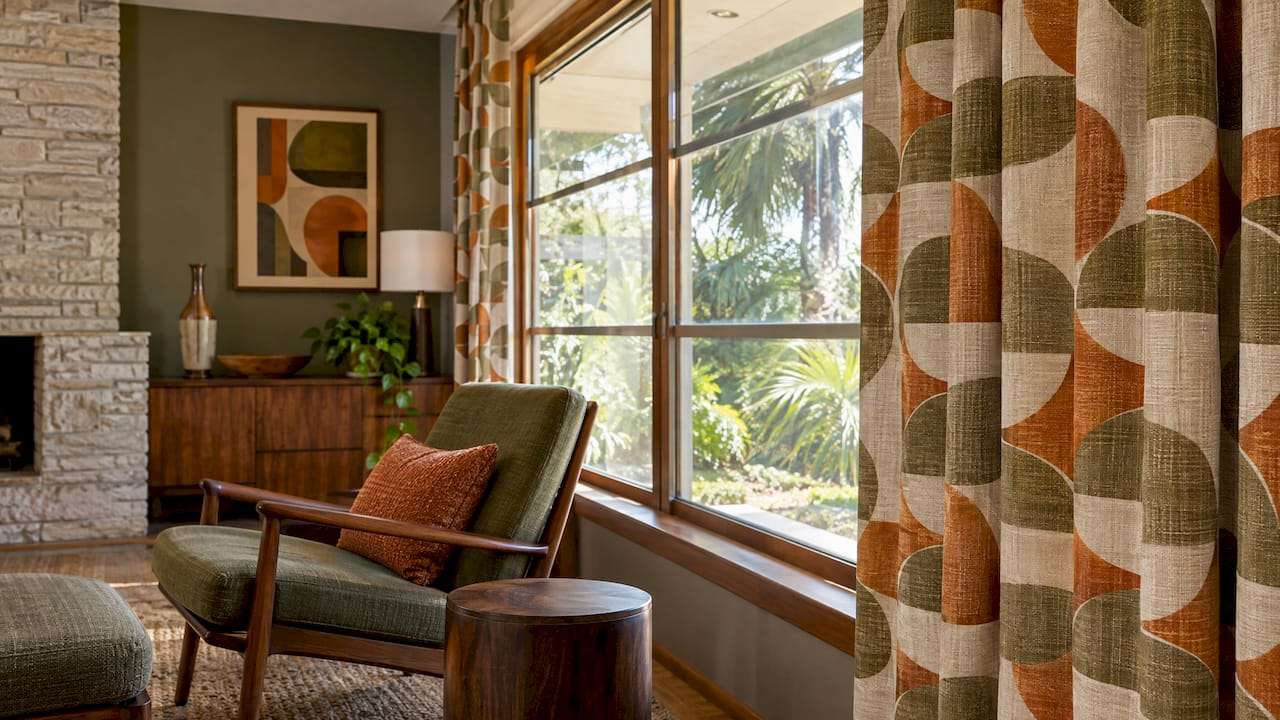
A practical way to spend your budget comes from long-time mid-century restorer Pam Kueber at Retro Renovation: where a treatment is a big investment, choose a conservative neutral so it lasts. Where it is a smaller investment, take a risk on pattern. Applied to a house, that often means neutral, well-made drapery on the large glass wall and bolder fabric in a bedroom or den.
If you want more ideas on how period fabrics and accessories coordinate with the rest of the room, these vintage living room ideas show how retro charm comes together around the windows.
Shades and blinds that suit the style
Many Tampa homeowners prefer shades to curtains because they keep the line of the window clear. Here is how the main types compare for a mid-century interior.
| Treatment | Look | Best for | Watch for |
|---|---|---|---|
| Roller shades | Flat, minimal, authentic to the period | Large panes, living areas, offices | Side light gaps on wide windows unless sized carefully |
| Cellular (honeycomb) shades | Soft, pleated, low-profile | Insulating older single-pane glass, bedrooms | Choose light-filtering or room-darkening to match the room |
| Roman shades | Tailored fabric folds, warm | Dining rooms, bedrooms, smaller windows | Fabric choice sets the style |
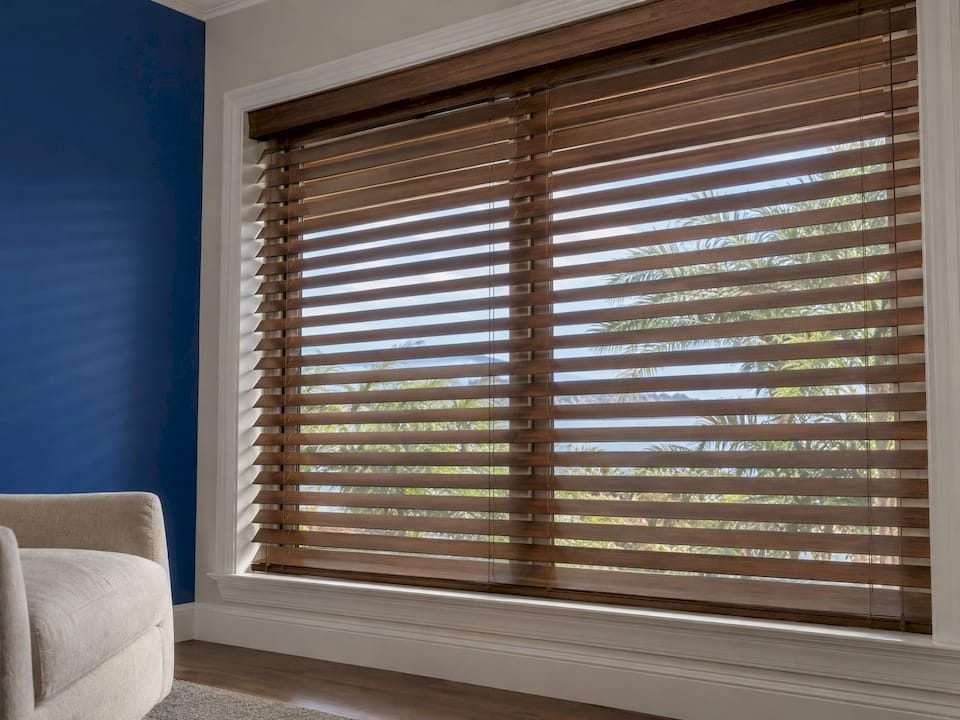
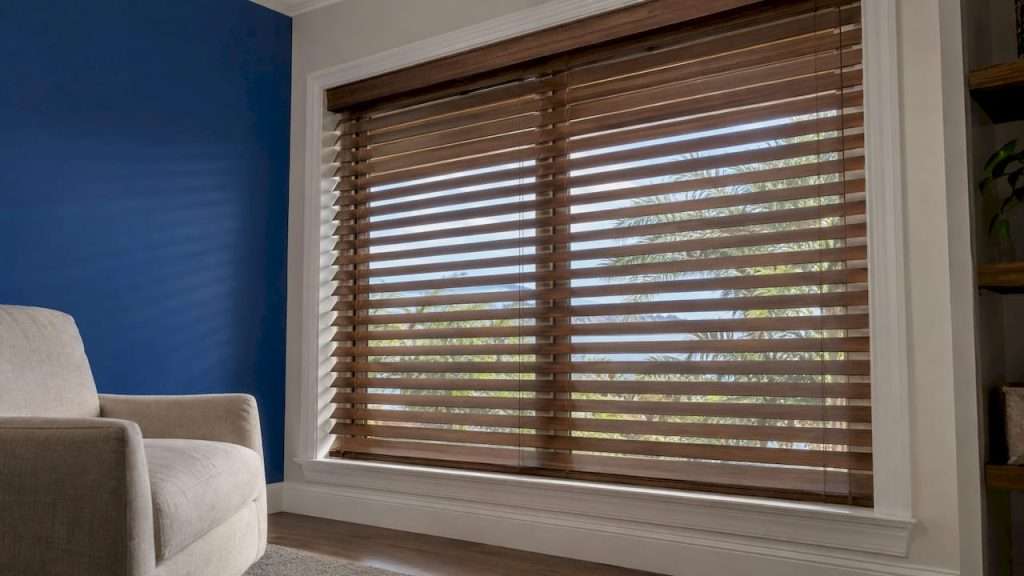
| Wood blinds | Natural, horizontal lines | Studies, kitchens, bedrooms | Slat size and finish should be kept simple |
| Solar shades | Sleek, view-preserving | Sun-facing glass, sliding doors | Pick openness for privacy and glare |
| Drapery over a shade | Layered, formal | Primary living spaces | Plan the hardware for both layers |
A few notes behind the table. A Spruce guide to blinds quotes a designer calling wood blinds a strong fit for midcentury spaces because they feel natural and light, and notes that solar shades filter UV and glare while keeping the view, help protect furniture, floors and art from fading, and can lower energy bills. The same guide describes cellular shades as trapping air in pleated cells to help regulate temperature, available in light-filtering, room-darkening and motorized versions.
An honest historical point: up-down insulating shades were not around in the mid-century era, but the mid-century design blog above notes they pair well with vintage windows, since they can cover just the part you need, such as an eyesore or a neighbor’s view, while keeping the yard or sky visible. Plain roller shades, on the other hand, are an authentic period choice for many windows.
We make roller, Roman and cellular shades, blinds, shutters and motorized window coverings, so you can compare these side by side in one consultation. Our Roman shades versus blinds guide is a good next read if you are torn between those two.
Short, wide and high windows
Mid-century floor plans often include windows that don’t behave like standard double-hungs: clerestory bands near the ceiling, short wide windows high on bedroom walls, corner glass and full-height fixed panes. Each wants a different answer.
- Short, wide windows high on the wall. Cover the full width with a single treatment rather than splitting into small pieces. A shade made to the exact width, mounted inside or just outside the frame, keeps the horizontal line intact. Where there is room, a curtain on a ceiling track that drops to the floor can turn an awkward window into a deliberate feature.
- Clerestory windows. They bring in light and sky and are rarely about privacy, so many owners leave them bare in living areas. In bedrooms, a motorized shade avoids reaching or using a pole, and the shade can open to bring daylight back in the morning.
- Glass walls and sliders. Use a track-mounted drape or a solar shade set up for a wide span. We cover that in more detail in our guide to window treatments for sliding glass doors and in solar shades for sliding glass doors.
- Floor-to-ceiling glass. Privacy without losing light is the main task, which we address in our piece on floor-to-ceiling window privacy.
Because these windows are rarely standard, custom fabrication is the practical route. It is also why a professional measurement matters, which brings us to the checks below.
Match the treatment to the job: privacy, light and heat
Start with what each window needs to do. The Spruce’s window treatment guide suggests blackout shades in bedrooms, privacy blinds or half-curtains in bathrooms, and layering blinds with curtains in bedrooms or living rooms to control light and privacy through the day. It also notes that south-facing rooms need more shading than east-facing ones. In Tampa Bay, that is a useful reminder: a west or south glass wall can overheat the room by mid-afternoon.
Read the openness rating
Solar and tinted shades are rated by openness percentage. House Digest explains that the lower the percentage, the darker the shade, and that a blackout shade at 0 percent is completely opaque. That makes openness the quickest way to compare light control between fabrics. For a living room where you want to keep the view and tame glare, a low openness percentage such as 3 to 5 percent is a common choice, and we explain the trade-offs in our article on daylight-friendly privacy. If you want the view as clear as possible, see our guide to shades that preserve your view.
Layer for day and night
The oldest mid-century answer is still the best: a sheer for daytime privacy and a heavier panel to close at night. Alternatively, put a roller shade on the glass and a plain floor-length panel at each side. You get blackout when you want it and an uncluttered line when you don’t. Our privacy guide for Tampa homeowners goes further into room-by-room choices.
What to check before you order
Most disappointments with mid-century treatments come from the details, not the style. Before you commit, check these.
- Measure each window separately. Mid-century openings are often not square, and builders varied sizes along a single wall. Measure width at the top, middle and bottom, and height at left, center and right. Our guides on how to measure window curtains and how to measure for curtains walk through the process. With us, professional measurement and installation is part of the service.
- Decide inside or outside mount. An inside mount shows off a deep frame but leaves a small light gap at the sides. An outside mount covers more of the wall and blocks more light.
- Plan the hardware first. A ceiling track, a slim rod or a concealed valance each need solid fixing into framing, and ceilings or beams in older homes can complicate that.
- Think about operation. Large panels and high windows are easier with a motorized system. Our motorized blinds and shades page shows what we offer.
- Match fabric to sun exposure. Fabric that faces west glass for hours needs to hold up, and the openness or lining you choose affects heat and fade.
- Remove old treatments. Old rods, brackets and blinds leave holes and marks. We remove old window treatments as a courtesy when we install the new ones.
Working with The Drapery Company
We serve homeowners, businesses, interior designers and property managers across the greater Tampa Bay Area, with over 30 years of experience and thousands of completed projects. Every product is fabricated onsite in our workroom, so the pleats, widths, hems and shade sizes are made to your windows. The process covers design consultation, professional measurement, installation and removal of your old treatments.
If you are restoring a mid-century home, a new homeowner planning window designs, or a designer who needs a dependable custom fabricator, start with an in-home consultation. To see the product range, browse our shades and blinds or our custom roller, Roman and cellular shades. For existing curtains that need a new length, we also handle hemming and repair. Property managers and commercial clients can look at our commercial window treatments, and our guide on specifying multifamily window treatments covers work at scale. You can reach us at (813) 949-3100.
Our perspective
Mid-century windows are architecture, and a window treatment is architecture with fabric instead of drywall. It should look planned, not added on.
That is why we fabricate everything in our Tampa Bay workroom. A pinch-pleat panel that is cut and pleated for your glass wall hangs differently from a stock panel stretched to fit. A roller shade sized to your exact opening leaves a cleaner edge than a standard width trimmed down.
We think the right sequence is design first, then measurement, then fabrication and installation by the same team, with old treatments removed so the new ones sit on a clean wall. After more than 30 years of working in Tampa Bay homes and commercial spaces, we have found that the design and the practical needs, such as light control and energy efficiency, belong in the same conversation.
Whether you choose floor-length drapery, quiet roller shades or a layered mix, we will help you tailor it to your budget and the way you use the room.
The Drapery Company
FAQ
What is a mid-century modern window treatment?
It is a treatment that suits the clean lines and big glass of a mid-century home. The classic examples are floor-length pinch-pleat curtains on a track, simple roller shades and natural-texture blinds. Heavy swags, ornate valances and fussy trim work against the style.
What kind of blinds work for mid-century modern?
Wood blinds in a simple finish suit the period, as do flat roller shades and cellular shades with a low profile. Keep slats and hardware plain, and let the texture or color do the work. We make blinds, shades and shutters to the size of your windows.
Can I use modern shades in a vintage mid-century house?
Yes. Modern shades such as cellular and up-down designs did not exist in the period, but they pair well with vintage windows and add insulation and light control. Choose neutral, simple fabrics so the shade supports the architecture rather than competing with it.
What colors and patterns fit mid-century interiors?
Retro colors like turquoise, orange and yellow work, and so do muted mustard, olive and burnt orange. Geometric and atomic patterns suit the era. For a long-lasting result, use a neutral on the biggest windows and bring pattern into smaller spaces.
How do I keep privacy without losing the view?
Layer a sheer with a heavier panel, or choose a solar shade with a low openness percentage so you keep light and outlook while limiting what people can see in. Our team can show you openness options during an in-home consultation.
Sources
- Enhancing the View, Cooper Hewitt, Smithsonian Design Museum
- How to Choose Window Treatments for Your Mid-Century Home
- Vintage Vibes: Find the Best Mid-Century Modern Curtains
- 11 window treatments for midcentury homes, Retro Renovation
- 16 Types of Blinds to Know Before Buying, The Spruce
- 56 Window Treatment Ideas for Every Budget and Style, The Spruce
- 10 Modern Alternatives For Outdated Vertical Blinds, House Digest
- Vintage living room ideas