Condo Window Treatments: What Works, What Boards Allow
November 11, 2026
Curtain Track vs Rod: How to Choose for Your Windows
November 13, 2026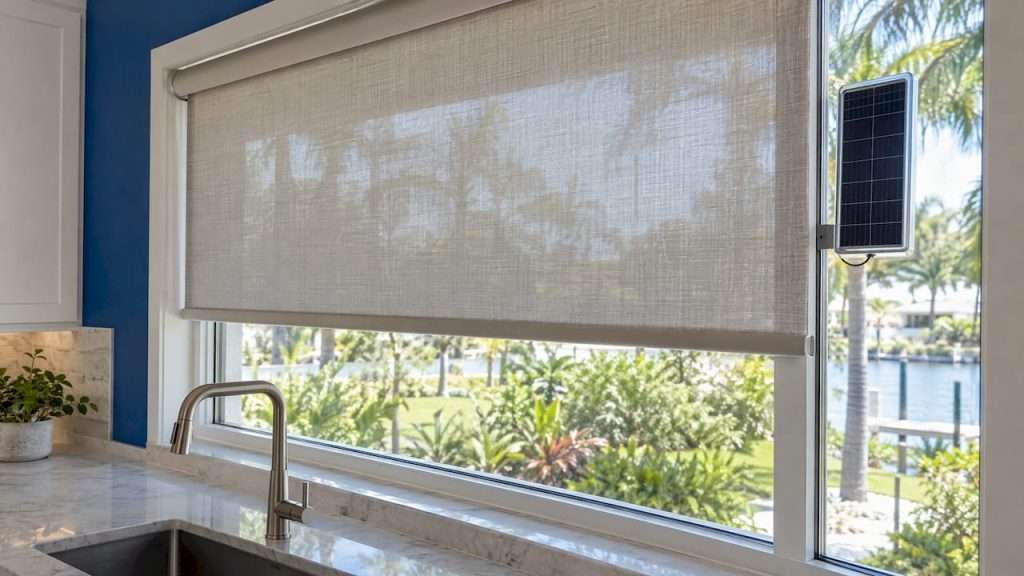
Solar powered shades are motorized shades whose battery is topped up by a small solar panel mounted at the window. Sunlight becomes electricity, the electricity charges a lithium-ion battery, and the battery runs the motor that raises and lowers the shade. You get no wires, no outlet and, in the right window, very little recharging by hand. The phrase also gets confused with “solar shades,” which are a fabric type that blocks glare and UV. The two work well together, and this guide explains both so you can choose with confidence.
TL;DR
- “Solar powered” describes how the motor is charged. “Solar shade” describes the fabric. A shade can be either one or both.
- The panel sits inside the window opening and charges a lithium-ion battery. It needs light passing through the glass, so placement matters.
- South-, east- and west-facing windows without heavy tint, deep overhangs or foliage give the panel the most light.
- Solar-screen fabrics cut glare and UV while keeping your view, and the right openness depends on the room.
- We fabricate, measure and install onsite for Tampa Bay homes and businesses, so the motor, panel and fabric are planned as one system.
Solar powered shades, solar powered blinds and solar panel shades: what each term means
Readers type three phrases for what is mostly the same product, and each one points to a slightly different idea.
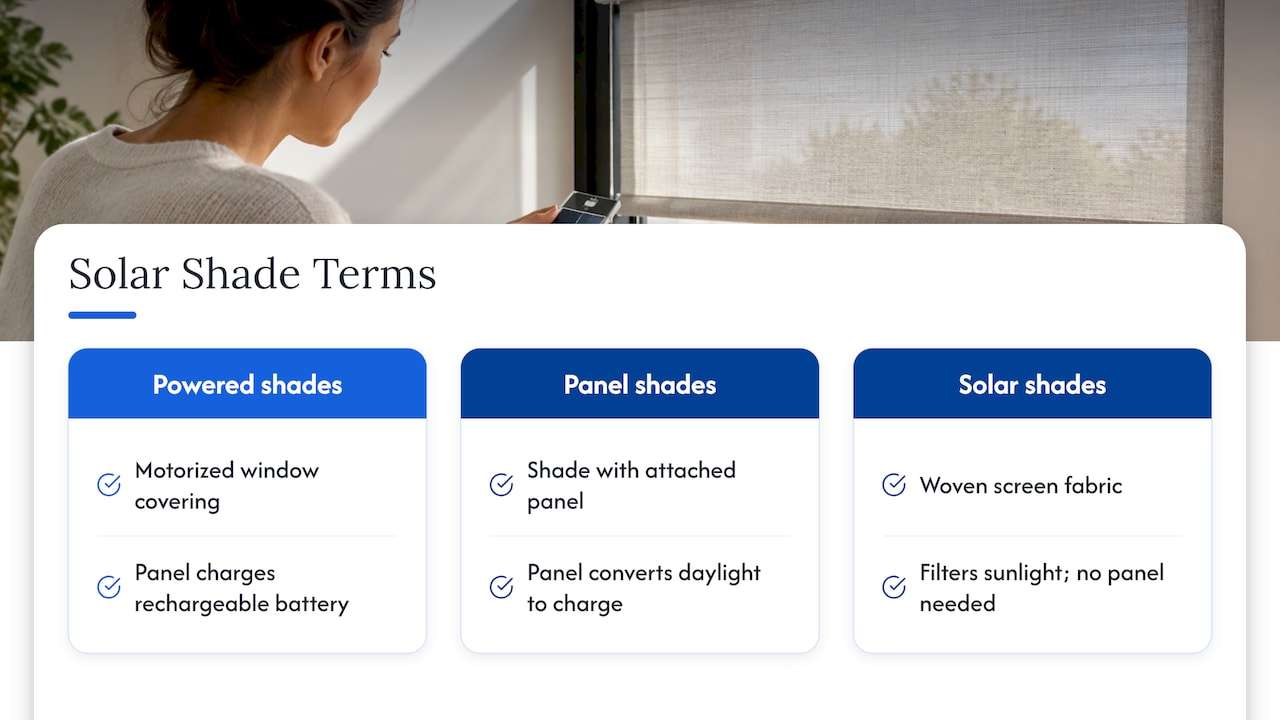
Solar powered shades and solar powered blinds are motorized window coverings with a rechargeable battery that a solar panel keeps charged. The covering itself can be a roller shade, a Roman shade, a cellular shade or a horizontal blind. Roller shades are the most common pairing.
Solar panel shades usually means the same thing seen from the hardware side: a shade plus the compact panel attached to the window area. Motionblinds describes these panels as low-profile units that convert daylight, not only direct sun, into a continuous charge for the motor’s battery.
Solar shades are something else entirely. They are roller shades made from a woven screen fabric that filters sunlight. Their job is glare control, UV reduction and a preserved view. They do not need a solar panel, and a solar-panel-charged shade does not need a screen fabric. Many of our clients choose both: a screen fabric for the light, and a battery motor with a panel for the convenience.
Keeping those two decisions separate makes everything easier. One is about power. The other is about light.
How the solar panel powers the motor
The mechanism is simple. According to Somfy’s installation guidance, the panel mounts inside the window opening and converts sunlight into electrical energy stored in a lithium-ion battery, and that battery powers the motor. Somfy advises one panel per window covering.
A few specifics from Somfy’s service document for its WireFree Zigbee panel (item 9029114, May 2025) show what to expect from this kind of hardware:
- It is rated at a maximum power of 1.5W, with an IP30 rating, which means indoor use only.
- It is designed to extend battery autonomy of WireFree motors by up to five years.
- It relies on sunlight transmitting through the window opening to perform well.
That last point is the practical one. The panel sits behind the glass, so the glass, the exposure and anything outside the window all affect how much light it collects.
How long a battery lasts without a panel
A battery-only motor is a perfectly workable setup too. Motionblinds states that USB-C rechargeable battery motors typically last six to twelve months on a full charge. Rollease Acmeda’s FAQ says its Li-ion battery motors are estimated at 500 up and down cycles per charge, can be recharged about 500 times, and carry a five-year warranty, with only nominal annual degradation and no sudden cliff where the battery stops holding a charge.
The solar panel’s role is to take the recharging chore off your list. If you want the full picture of charge intervals, our guide on motorized shade battery life walks through what affects it, and our overview of battery operated motorized shades covers how these systems fit into a smart home.
Where the panel works best
Placement decides performance more than any spec sheet. Somfy recommends favoring south, east and west window orientations, because northern exposures typically do not provide adequate sunlight transmission. It also advises avoiding tinted windows, overhangs, deep roof eaves, awnings and vegetation in front of the panel. Motionblinds adds that panels do best on windows with regular daylight, south- or west-facing rooms in most US and European climates.
Here is the checklist we run through at the window during a consultation:
- Exposure. Which way does the window face, and how many hours of daylight reach the glass?
- Glass. Is it clear, or does it carry a heavy tint or film that cuts the light reaching the panel?
- Obstructions. Do a porch roof, a deep eave, an awning or a tree shade the opening for much of the day?
- Mounting depth. Is there room inside the opening for the shade, the panel and a clean line?
- Usage. Will the shade move several times a day or only a few times a week?
If a window is shaded by a lanai or a mature oak, a panel there will collect less light. That is not a dead end. It means that window may be better served by a standard rechargeable battery motor, while the sunnier windows use panels. Mixing is common, and a professional measurement is the quickest way to sort it out.
Choosing the fabric: openness, color and room use
Once the power question is settled, the fabric does the work you actually feel in the room. Solar-screen fabrics are woven tightly enough to filter UV and tame glare while still letting you see out. Their openness factor, the percentage of the weave that is open, controls the trade-off.
| Openness | What you get | Where it tends to fit |
|---|---|---|
| Lower (around 1% to 3%) | More glare and UV filtering, a softer view | West-facing living rooms, media rooms, home offices with screens |
| Mid (around 5%) | Balanced light and view | Kitchens, dining rooms, family rooms |
| Higher (around 10%) | Clearer view, more daylight | Rooms where the view matters most and glare is moderate |
Treat that table as a starting point. Light, color and the view differ in every home, and our guide to solar shade openness and the specs to demand goes deeper on reading a fabric spec. For softer, more diffused light, our piece on sheer shades and 1% to 5% openness shows another option.
A few rules of thumb we use in the workroom:
- Darker fabrics generally give the clearest view out and reduce glare more noticeably. Lighter fabrics tend to look brighter from inside.
- Glare-sensitive rooms such as media rooms and offices usually call for a lower openness.
- View-first rooms such as a lanai-facing great room usually call for a higher openness, with the shade lowered only when the sun is strongest.
Our page on shades that preserve your view shows how to weigh these choices room by room.
Do solar shades actually work?
They do, and the evidence comes from federal laboratory testing. In field tests at three occupied homes in Richland, Washington, PNNL found that closing exterior shades during peak solar hours reduced indoor temperatures by 0.5°F to 4.0°F. Rooms with exterior shades ran 2°F to 3°F cooler than the same rooms with vinyl blinds. Homeowners at all three sites reported less glare, and the most appealing feature to them was being able to see outside with the shades closed.
Two honest notes on that research. It tested exterior shades, which intercept heat before it reaches the glass, so interior results will differ in degree. And Richland is not Tampa. What it does show is the principle: screen fabrics reduce glare and heat gain while keeping the view.
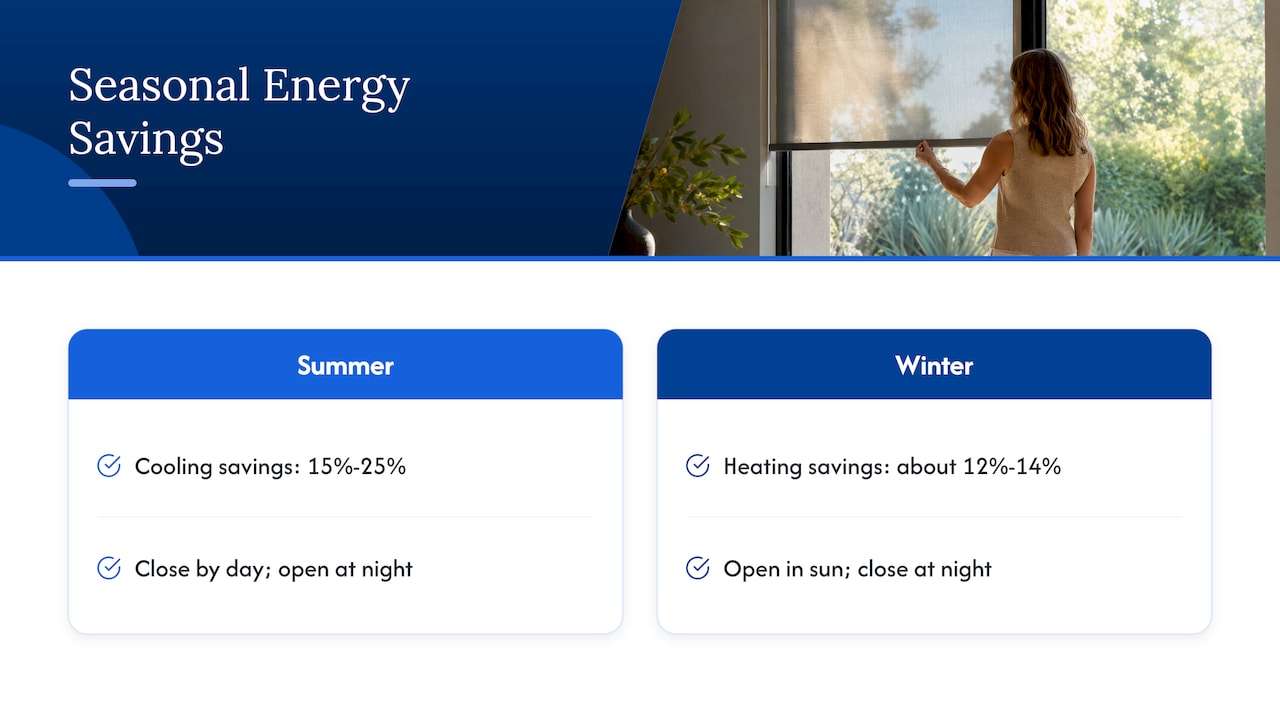
On whole-home energy, the Department of Energy field studies summarized by the Building America Solution Center found summertime cooling savings of 15% to 25% from optimized use of high-efficiency shades, and wintertime heating savings of about 12% to 14%. The word “optimized” matters. The guidance there is to close window attachments during the day and open them at night when it is cooler outside than inside. For winter heating, keep them open while the sun shines and closed at night and on cloudy days.
That daily rhythm is where motorization earns its keep. A shade that moves on a schedule or from your phone gets used at the right times, and a shade you have to remember to adjust often does not. For more on heat management, see our guides to window shades for heat reduction and how to block heat from windows.
Getting the most from solar shades: what to plan for
Every window covering involves choices, and solar shades are no different. Knowing them upfront is how you end up with a setup you love.
Privacy. Screen fabrics are designed to preserve the view, and daytime views out generally mean some visibility in as well, particularly when it is dark outside and lights are on inside. For bedrooms and bathrooms, we often pair a screen shade with drapery or a blackout or room-darkening layer. Layering gives you light control by day and full privacy at night.
Heat and light control. An open weave filters sunlight rather than stopping it. For rooms where you want the strongest control, a lower openness or a layered treatment gets you there.
Panel placement. As covered above, a panel needs light through the glass. Planning each window’s exposure first keeps the system dependable.
Operation. Following the Building America guidance, use the shades actively: closed through the sunny part of the day to cut heat gain, open at night when it is cooler outside. Motorization makes that routine easy.
Our Florida sun window treatments guide covers how these decisions play out in strong Gulf Coast light.
What Tampa Bay homeowners and businesses should check
Whether you are outfitting a Tampa bungalow, a Davis Islands condo or a commercial office, the same questions apply.
- List the problem windows. Note which rooms have glare on screens, faded furniture or hot afternoons, and which direction each window faces.
- Decide on power per window. Sunny, unobstructed windows suit solar-charged panels. Shaded windows may suit a rechargeable battery motor. A professional can map this in one visit.
- Choose the fabric for the room. Pick the openness for the glare and view you want, and consider a second layer where privacy matters.
- Think about the whole system. Consider remotes, voice control or app control, and how the shades will be grouped by room.
- Plan for maintenance. Battery checks, panel cleaning and fabric care keep a system working for years. Our motorized shades maintenance guide lays it out.
- Check building rules. Condo associations, HOAs and commercial landlords sometimes have rules about window coverings visible from outside. Ask before you order.
If you are building or renovating, it also pays to think about windows and power early. Resources on solar-ready building planning explain how reserving conduit and inverter space ahead of time makes later solar additions simpler, and the same forward thinking applies when you choose windows and plan shade installation.
For commercial projects, property managers often need a consistent look across many units or offices. Our commercial window treatments team handles installation at scale, and we serve interior designers who need a reliable custom fabricator.
Our perspective: treat power and fabric as one design
We have spent over 30 years fabricating window treatments in our Tampa Bay workroom, and the pattern is consistent: the best results come when the power source, the fabric and the window are planned together.
A solar panel is a small piece of hardware, but it changes how a window behaves. It tells us where the shade should sit in the opening, how much room the mounting needs and whether that window is the right place for a solar-charged motor at all. That is why we measure and install ourselves instead of handing you a box of parts.
Because we fabricate every product onsite, we can match the shade to the window, not the other way around. We can build a screen shade for a glare-heavy west wall, layer drapery over it for the bedroom, and set up motorization so the whole room works from one remote. Think of it as architecture with fabric instead of drywall: the treatment defines how the room feels through the day.
Our approach is end-to-end, from the design consultation through installation, including removal of your old window treatments as a courtesy, tailored to your budget and practical needs.
The Drapery Company
Plan your solar powered shades with us
If you would like motorized shades matched to your windows, we start with an in-home consultation, then handle measurement, fabrication and installation. Explore our motorized blinds and shades, see the range on our custom window shades page, or book an in-home consultation to talk through which windows suit solar charging and which fabric fits each room.
FAQ
Do solar powered shades work on cloudy days?
Yes, in most cases. Motionblinds notes that panels convert daylight, not only direct sunlight, into a charge for the battery. Because the battery stores the energy, the shade keeps working through cloudy stretches. Windows with consistent light exposure are where the system performs best.
Do solar powered blinds need a north-facing window to avoid problems?
The opposite. Somfy advises favoring south, east and west orientations, since north exposures typically do not give a panel adequate sunlight. For a north-facing room, a rechargeable battery motor is often the simpler choice.
How long do the batteries in solar powered shades last?
It depends on the motor and how often the shade moves. Rollease Acmeda estimates 500 up and down cycles per charge, about 500 recharges and a five-year warranty on its Li-ion battery motors. A panel is designed to keep topping up the battery, which Somfy says can extend battery autonomy by up to five years for its WireFree motors.
Are solar shades and solar powered shades the same thing?
No. Solar shades are a screen fabric that cuts glare and UV while keeping your view. Solar powered shades are motorized shades charged by a solar panel. You can have either one alone, or combine them in the same window.
Can I use a solar panel on a tinted window?
Somfy recommends avoiding tinted windows for panel placement, since tint reduces the light reaching the panel. If a window is tinted, a standard rechargeable battery motor is usually a better fit, and we can assess it during measurement.
Sources
- Evaluation of Exterior Shades at PNNL Lab Homes (PNNL-30536)
- Window Attachments for Solar Control and Energy Efficiency, Building America Solution Center
- Somfy solar charging options and WireFree solar panel instructions
- Somfy Solar Panel WireFree Zigbee service document, May 2025
- How do smart blinds get power?, Motionblinds
- Li-ion Battery Motors FAQ, Rollease Acmeda