Curtains with Shutters: How to Layer Them in a Tampa Home
November 14, 2026
Minimalist Window Treatments for Tampa Homes and Offices
November 16, 2026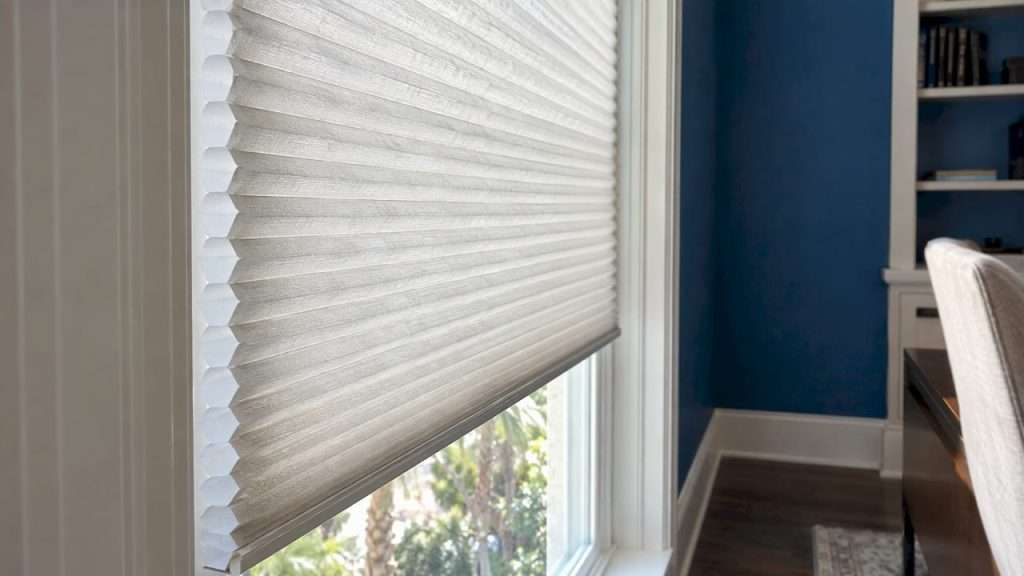
The window treatments that block the most heat are cellular shades, solar or reflective roller shades, and tightly fitted custom drapery, and shading placed outside the glass beats anything hung inside. How well any of them performs depends less on the product name than on three things: the window’s exposure, how closely the treatment fits, and whether it is closed during the hours the sun is on the glass. We fabricate every treatment in our Tampa Bay workroom, so we can build each one to the window it will cover.
TL;DR
- Cellular shades, solar and reflective roller shades, Roman shades and lined, tightly woven drapery are the main interior options for reducing heat gain. Each works differently, and the right mix depends on the room.
- DOE field studies found that optimized use of high-efficiency shades yielded 15% to 25% whole-home summertime cooling savings.
- For Florida’s east and west windows, the Florida Solar Energy Center recommends exterior operable shading or white or highly reflective interior shades.
- Edge fit, distance from the glass and daily operation matter as much as the fabric. Motorization takes the daily operation off your hands.
- Decide window by window: orientation first, then privacy, light and style.
Why heat blocking is about where the sun hits
Heat enters a home mainly as sunlight passing through glass. Once the energy is inside, it warms floors, furniture and air, and your air conditioner has to remove it. A treatment’s job is to intercept sunlight before that happens, or to slow the exchange of warm air at the glass.
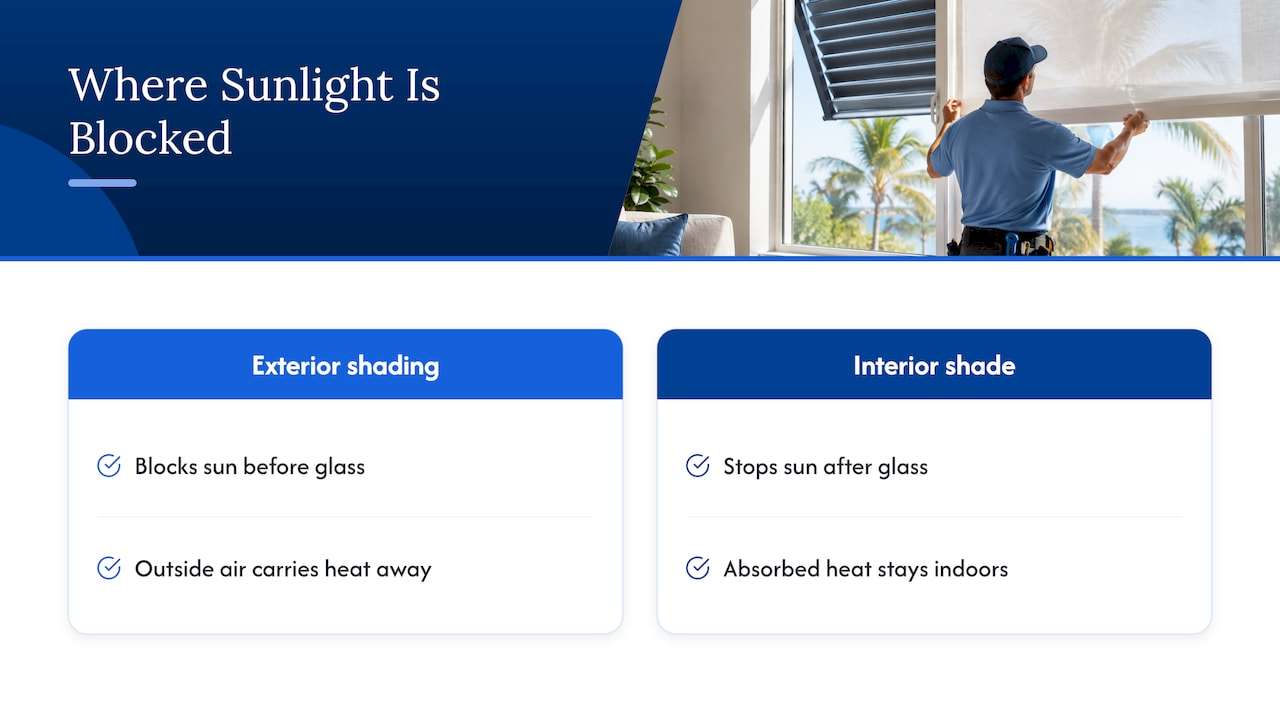
This is why placement matters. The Florida Solar Energy Center’s guide for the state notes that the most effective approach is to block sunlight before it reaches the window, so that air moving outside can carry the absorbed heat away. An interior shade stops sunlight after it has already passed through the glass, and the heat it absorbs stays in the room. That is not a reason to leave interior windows bare. It is a reason to choose interior treatments that reflect sunlight, close tightly and are used consistently.
What the research says you can expect
The numbers vary with the product and how it is used, so read them as ranges, not promises:
- Optimized use of high-efficiency shades produced 15% to 25% whole-home summertime cooling savings in DOE field studies.
- The Department of Energy says highly reflective interior blinds, when completely closed, can reduce heat gain by around 45 percent. It also says smart management of window coverings can reduce heat gain by up to 77 percent.
- Pacific Northwest National Laboratory tested exterior shades on three west- and south-facing windows in lab homes. They produced about 20% air-conditioning energy savings compared with leaving those windows uncovered.
The pattern is clear: the best results come from a good product, closed at the right times, on the right windows.
The main types and how each one handles heat
The Department of Energy’s resource guide, published through Pacific Northwest National Laboratory, describes each attachment type a little differently. Here is how those descriptions translate into choices for a Tampa home or building.
| Treatment | How it reduces heat | Best for |
|---|---|---|
| Cellular (honeycomb) shades | Can block and reflect solar heat and add insulation through trapped air pockets | Bedrooms, living areas, any window where you want insulation and a clean look |
| Solar shades (a type of roller shade) | Reduce heat gain and glare while keeping the view | Large west- and south-facing windows, sliding glass doors, offices |
| Reflective roller shades | Adjustable shading, with some models offering diffuse daylight | Kitchens, home offices, commercial spaces |
| Roman shades | Adjustable shading with a softer, tailored look | Dining rooms, living rooms, spaces where style leads |
| Lined, tightly woven drapery | Adds a layer at the glass and can be fitted closely at the edges | Formal rooms, primary bedrooms, layered designs |
| Exterior shades and outdoor drapery | Stop sun before it reaches the glass | Lanais, patios, sun-baked west elevations |
Cellular shades
Cellular shades have pockets of air within the fabric. That structure is why they come up first in any list of insulating options. They suit rooms where you want both heat control and a quiet, finished look, and they can be built to sit tight within the window frame. We make them in our workroom as part of our custom shades line.
Solar and reflective roller shades
Solar shades are woven screens that cut glare and heat while leaving you a view of the pool, the bay or the street. Their openness factor, the percentage of sunlight the weave lets through, is what you choose: a lower percentage blocks more. Our guide to UV-blocking shades walks through how we zone openness by room, with tighter weaves on south and west windows. Solar shades are especially useful for sliding doors, which we cover in our page on solar shades for sliding glass doors.
A reflective roller shade does the same job with a surface that turns sunlight back out through the glass. If you are choosing between roller and Roman styles, our roller and Roman shade comparison covers the look and function of each.
Roman shades and drapery
Roman shades and drapery earn their place when the room has to look as good as it performs. Cornell Cooperative Extension’s guidance points to something many homeowners overlook: for draperies, installation matters more than fabric type for reducing heat transfer, because sealing the edges limits air movement around the treatment. A well-made drapery with generous fullness, hung to the right height and width, will outperform a fashionable but poorly fitted one. Fit, fullness and lining are what separate custom work from ready-made panels.
Exterior shading
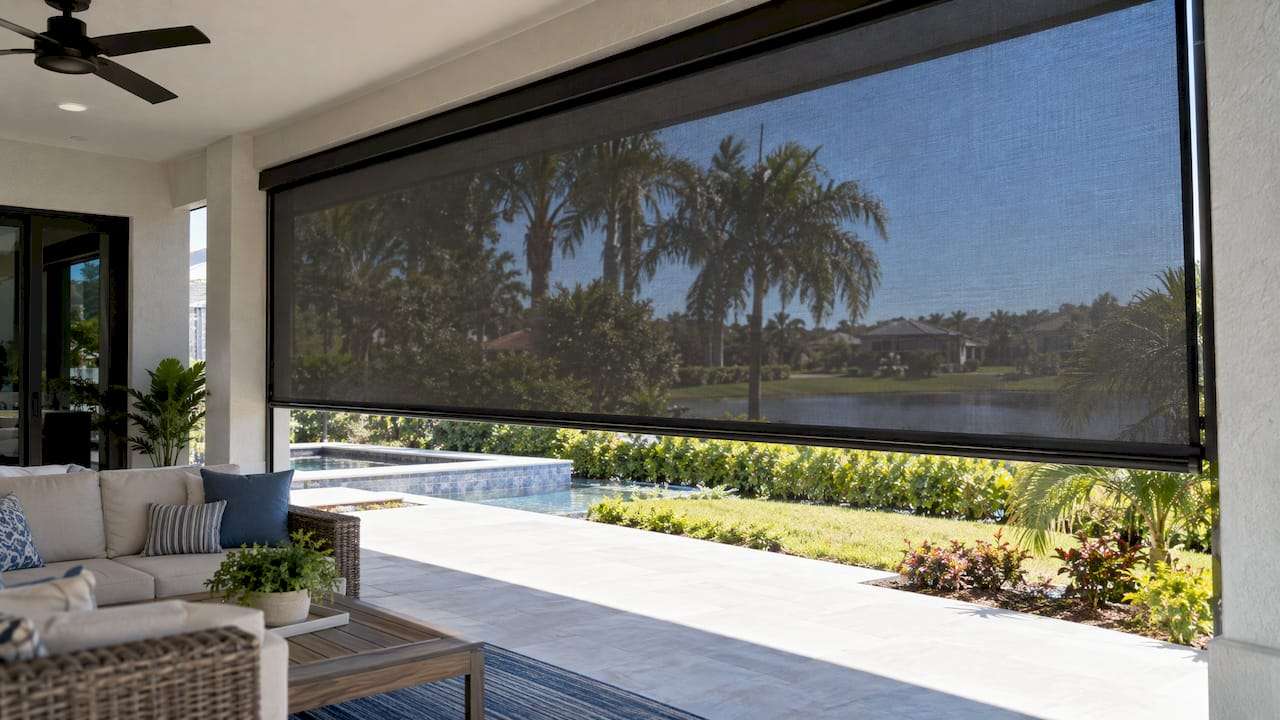
Exterior shading is the most effective placement, and in Tampa it often goes on lanais, porches and the sunniest elevations. We build outdoor drapery and shades alongside our interior lines, so the exterior and interior treatments of a room can be designed together.
Match the treatment to the window’s exposure
East windows get strong, low morning sun. West windows get the hottest, longest afternoon exposure, usually when the air conditioner is already working hardest. South windows get high sun for much of the day. North windows rarely need heat control at all.
For Florida homes, the Florida Solar Energy Center recommends considering exterior operable shading for east- or west-facing windows, with white or highly reflective operable interior shades as another option. In practice, we usually point homeowners this way:
- West-facing windows: the highest priority. A tight-weave solar shade or reflective roller shade, sometimes layered with drapery for evenings. Our page on west-facing window glare in Tampa Bay goes deeper.
- East-facing windows: a shade you can raise once the morning sun passes, so you keep your light and view for the rest of the day.
- South-facing windows: solar shades or cellular shades that cut the high sun while keeping daylight.
- North-facing windows: choose for privacy and style.
Orientation is also part of how new homes are planned in Florida. This overview of features of green homes shows how builders think about exposure and energy performance, the same logic you can apply when dressing your windows.
For more on this, see our guides to Florida sun window treatments and to energy-efficient window treatments by climate.
Fit and daily use decide the result
Two sources agree on the basics. Cornell’s guidance says interior treatments must trap and hold air by being tightly fitted at all edges and placed about one inch from the glass. Cornell’s data also shows how much edge control matters: conventional roller shades mounted inside the frame cut heat loss by about 27 percent without side tracks and 40% to 45% with side tracks. That study measured heat loss, not summer heat gain, but the principle carries over: gaps let air circulate and undo the work of the fabric.
The DOE guide adds the operating rule: for cooling savings, close window attachments during the day and open them at night if it is cooler outside than inside.
That gives you a short checklist for any heat blocking treatment:
- Measure precisely. An eighth of an inch matters when a shade has to sit within a frame or a drapery has to reach the floor and the wall.
- Control the edges. Choose mounts, returns or side channels that limit light and air leaks at the sides.
- Keep the gap consistent. About an inch between treatment and glass is the target for interior products.
- Choose a weave or lining for the exposure. Tighter and more reflective on west and south windows.
- Plan for operation. A shade nobody lowers saves nothing.
Professional measurement and installation is where this checklist is won or lost. We measure each window in your home and install the finished work ourselves, and we remove your old treatments as a courtesy. Because we fabricate onsite, we can adjust the build to the window it will cover.
Why motorization pays off
The DOE figure of up to 77 percent for smart management of coverings assumes the covering is in the right position at the right time. Motorized blinds and shades make that automatic. The DOE guide notes that automation can manage solar gains, which is useful for west-facing walls, high windows and second-floor glass you will not reach every afternoon. For property managers and offices, it also means consistency across many windows without relying on each occupant.
Balancing heat control with privacy, light and style
Nobody wants a dark house in exchange for a lower bill. The DOE guide suggests choosing light-filtering or blackout attachments to balance daylight, glare, privacy and views. Here is how that plays out in a typical home:
- Living areas: a solar or light-filtering shade for daytime heat and view, with drapery on a track or rod for softness and evening privacy.
- Bedrooms: blackout or heavily lined options on sun-exposed windows, in cellular shades or drapery.
- Kitchens and offices: roller shades, which stay out of the way and handle glare on screens.
- Sliding doors and large glass walls: solar shades with a low openness factor on the sunny side.
For commercial spaces, the same principles apply on a larger scale: uniform appearance across a facade, glare control at workstations, and shades that stand up to daily use. Our commercial window treatments cover drapery and motorized systems for offices, hospitality and multi-unit properties. Interior designers can specify our workroom as a fabricator for custom fabrics and made-to-order dimensions.
Perspective: why custom beats off-the-shelf for heat
Heat control is a fit problem before it is a fabric problem. A shade that leaves a gap at the side or hangs three inches from the glass lets warm air move around it, and no label fixes that.
That is why we fabricate every treatment in our Tampa Bay workroom. We control the dimensions, the materials and the finishing, so the shade or drapery is built for your window, not trimmed to approximate it. Over more than 30 years and thousands of projects, we have learned that the homes that stay comfortable are the ones where the right product went on the right window and was installed properly.
We also think of window treatments as architecture with fabric instead of drywall. They shape how a room looks and how it feels at 4 p.m. in August. Our approach is to design for both at once, from the first consultation through installation, tailored to your budget and the way you use each room.
The Drapery Company
What to do next
Start with a walk-through at the hottest time of day. Note which rooms feel warmest, which windows face east and west, where glare hits screens or seating, and where you need privacy. That list is the brief for a good consultation.
We offer in-home consultations across the Tampa Bay Area for homeowners, and design, fabrication, installation and removal of old treatments for commercial clients, designers and property managers. To see how we work through shades by room, read our guide to window shades for heat reduction, or request a consultation and we will recommend treatments window by window.
FAQ
What are the best heat reducing blinds?
For blinds, the DOE says highly reflective interior blinds, fully closed, can reduce heat gain by around 45 percent. Slat color and closing the blinds completely matter. If heat is your top priority, cellular and solar shades usually give you more control than slatted blinds, and our guide to energy-efficient blinds compares the options.
Are thermal window coverings worth it in summer?
Yes, when they are closed during the sunny part of the day. DOE field studies found 15% to 25% whole-home summertime cooling savings from optimized use of high-efficiency shades. Results depend on the product, the window’s exposure and how consistently the shades are operated.
Do heat reflective roller shades block the view?
Not necessarily. Solar roller shades reduce heat gain and glare while preserving the view outward. A lower openness percentage blocks more heat and light, so we usually choose it by exposure: tighter on west and south windows, more open on shaded ones.
Which windows should I treat first?
Start with west-facing windows, then east, then south. Those get the most direct sun. Exterior shading, where it is practical, is the strongest option, and interior shades or drapery can handle the rest.
Do heat blocking treatments work with impact windows?
Yes. Impact glass protects against storms, but sunlight still comes through it. Window treatments handle the heat and glare. See our page on window treatments for impact glass.
Sources
- Window Attachments for Solar Control and Energy Efficiency, Building America Solution Center
- Industry Guide to Selecting the Best Window Treatments, Florida Solar Energy Center
- Evaluation of Exterior Shades at PNNL Lab Homes
- Energy-Saving Window Treatments, Cornell Cooperative Extension
- Lower Your Energy Costs With Window Coverings, Consumer Reports
- 4 Key Features of Green Homes
Recommended
- A Guide To Energy Saving Window Treatments In Tampa Bay
- Save Up to 77% on Solar Heat: Tampa Bay Impact Window Treatments
- Enhance Your Tampa Home with the Best Window Treatments: a Comprehensive Guide to Functionality, Style, and Energy Efficiency
- Transform Your Tampa Home with Custom Window Treatments: Elevate Your Living Experience with Perfect Fits, Personal Style, and Energy Efficiency