Heat Blocking Window Treatments for Tampa Homes
November 15, 2026
Glass Block Window Coverings: Custom Options That Fit
November 17, 2026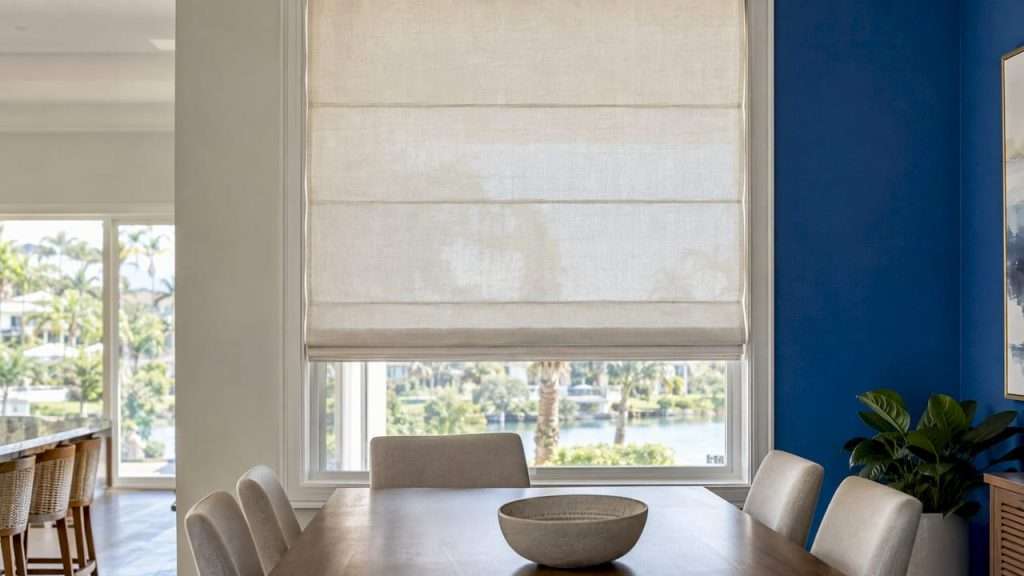
A minimalist window treatment does one job cleanly: it controls light and privacy, then gets out of the way of the room. In Tampa, where the sun is strong most of the year, the best simple window coverings are usually custom-made roller shades, Roman shades, cellular shades or plain, full-length drapery panels, sized so exactly that nothing looks bulky, gapped or improvised. Minimalism is unforgiving. With no pattern, trim or valance to distract the eye, fit and fabric quality are the whole design. That is why we fabricate every product in our Tampa Bay workroom and measure and install it ourselves.
TL;DR
- Minimalist means clean lines, a quiet neutral palette and hardware you barely notice. The window covering supports the architecture instead of competing with it.
- Roller shades, Roman shades, cellular shades and simple drapery panels are the four workhorses. Which one fits depends on window size, the room and how much light you need to control.
- In a hot climate, a simple shade also does real work: the U.S. Department of Energy’s PNNL guide says interior light-filtering roller shades can reduce heat gain while keeping soft natural light.
- Mount shades inside the window frame and hang drapery higher and wider than the glass for a taller, calmer look.
- Custom measurement matters more here than anywhere else, because a minimalist design shows every gap and uneven edge.
What makes a window treatment minimalist
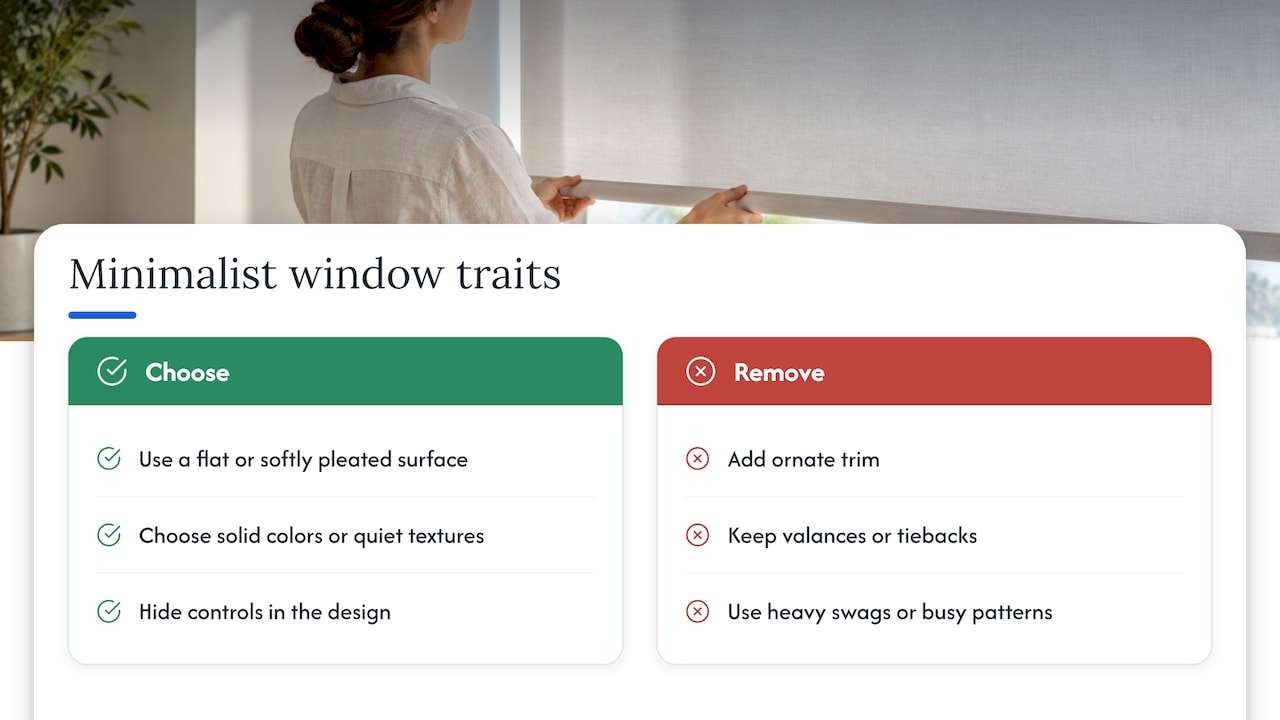
Minimalism in a window covering comes down to a few visible traits: a flat or softly pleated surface, no ornate trim, a solid color or a very quiet texture, and controls that disappear into the design. Architectural Digest’s guide to minimalist interiors lists the same ingredients for the room as a whole: clean lines, neutral or monochromatic palettes, limited ornamentation, uncluttered surfaces and plenty of natural light. A window treatment that fits that description supports the room instead of decorating it.
A useful test is subtraction. Remove the valance, the tiebacks, the heavy swag and the busy pattern, and ask what the window still needs. Usually the answer is three things: privacy when you want it, control over glare and heat, and a finished look at the edges. A minimalist treatment delivers those three and nothing else.
It also helps to separate “minimal” from “cheap.” A flat roller shade can look expensive or look like an afterthought, and the difference is almost entirely in the measurement, the fabric weight and the installation. Architectural Digest’s window treatment starter guide notes that blinds and shades suit a minimal look because they cover only the window opening and let you adjust light and privacy with a simple control. Whether that comes across as tailored or temporary depends on how precisely the shade is made for the opening.
The main types of simple window coverings
Roller shades
Roller shades are the first thing most people picture for a minimalist window: one flat panel of fabric on a slim roller. The same Architectural Digest guide describes them as tailored and clean. They come in sheer, light-filtering and blackout fabrics, so a single style can serve a living room, a bedroom and a home office. If you want to see how they work before deciding, our guide explains what roller shades are and how they control light. We make roller shades in our workroom, so width, drop and fabric are matched to your window instead of cut down from a stock size.
Roman shades
Roman shades fold into soft, even horizontal pleats when raised and lie flat when lowered. They are the minimalist choice when you want a little warmth and texture without full drapery. Architectural Digest credits them with combining the softness of drapery with the function of a shade. A flat-fold style in a linen-look or solid fabric keeps the look quiet. For bedrooms, our page on blackout Roman shades covers style and light control together.
Cellular shades
Cellular (honeycomb) shades are pleated shades with air pockets built into the fabric. They have a very slim, clean profile, and Wirecutter’s blackout shade testing found that the honeycomb construction helps insulate against heat and cold and muffles noise. In The Spruce’s tests, a double-cell blackout cellular shade blocked roughly 97% of light and kept the room warmer. For a Tampa bedroom facing east or west, that combination of darkness, insulation and a barely-there profile is hard to beat.
Solar shades
Solar shades are roller shades woven to cut glare and UV while preserving the view. Bob Vila’s room-by-room guide reports that solar shades can block up to 90% of UV rays while keeping the view, which is why they suit living rooms with large windows. They are also a natural fit for big sliding doors, which we cover in our guide to solar shades for sliding glass doors. If the view is the reason you bought the house, our article on shades that preserve your view explains how to choose the right openness.
Simple drapery panels
Drapery can be minimalist too. Think one color, a straight hang, no pattern, no trim. Architectural Digest’s gallery of window treatment ideas quotes designer Joshua Smith saying simplicity is timeless and never really goes out of style, and it points to tailored pinch pleats and classic Roman shades as examples. Designer Susan Spath adds that clients want light, airy fabrics such as linens and sheers that frame windows without feeling heavy. A full-length panel in a soft linen weave, hung on a slim rod, is often the quietest solution for a tall window or a wall of glass.
Blinds and shutters
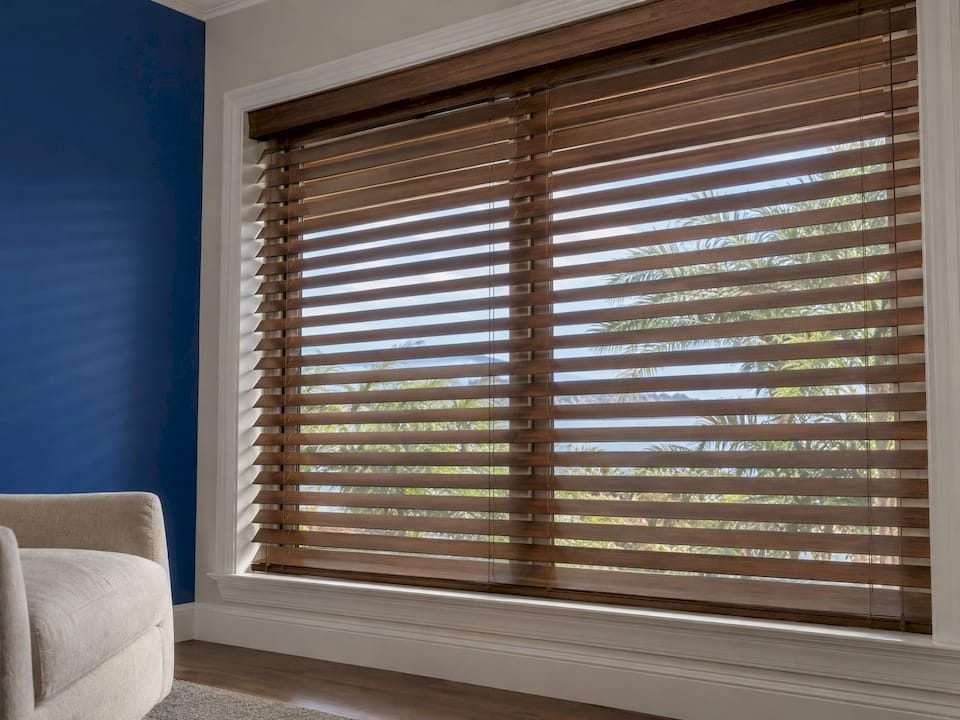
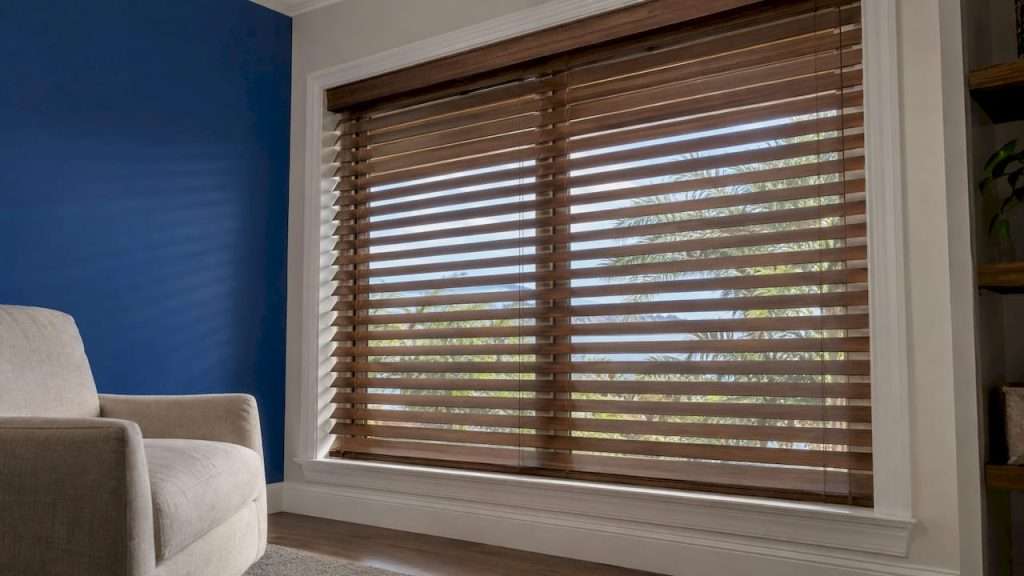
Wood-look blinds and shutters offer a linear, architectural look and precise control over the angle of light. Bob Vila’s guide recommends wood blinds in living rooms for exact light control with a furniture-grade appearance. Shutters add a built-in quality that suits many Florida homes. Both are part of what we make and install; our blinds, shades and shutters page shows the range.
Quick comparison
| Style | Look | Best for | Light and privacy |
|---|---|---|---|
| Roller shade | Flat, tailored, very clean | Almost any room, modern and transitional homes | Sheer to full blackout, depending on fabric |
| Roman shade | Soft, even folds | Bedrooms, dining rooms, spaces that want warmth | Light-filtering to blackout with lining |
| Cellular shade | Slim pleats, compact when raised | Bedrooms, west-facing rooms, quiet spaces | Strong darkening, added insulation |
| Solar shade | Sheer, view-preserving | Living rooms, big glass, sliding doors | Cuts glare and UV, keeps the view |
| Drapery panel | Floor-length, soft vertical line | Tall windows, wide walls of glass | Light-filtering to blackout with lining |
| Blinds and shutters | Linear, architectural | Rooms needing adjustable light angles | Adjustable by slat angle |
Choosing by room
Living room. Large windows and glare are the usual issues. Solar shades handle glare and UV without hiding the view, and a pair of simple drapery panels can add height and softness. If the room has a wall of glass, a single clean shade per opening in the same fabric keeps the wall reading as one calm surface.
Bedroom. Darkness matters more than the view. Bob Vila’s guide suggests cellular or roller shades in blackout or room-darkening fabric, layered with drapery to close the small gaps of light between the shade and the trim. For a minimalist bedroom, choose one color family for both layers so the window still reads as simple.
Kitchen and bath. Choose washable, moisture-tolerant fabrics and a flat shade with no folds to collect dust. A roller shade in a light-filtering fabric gives privacy while still letting the room feel bright.
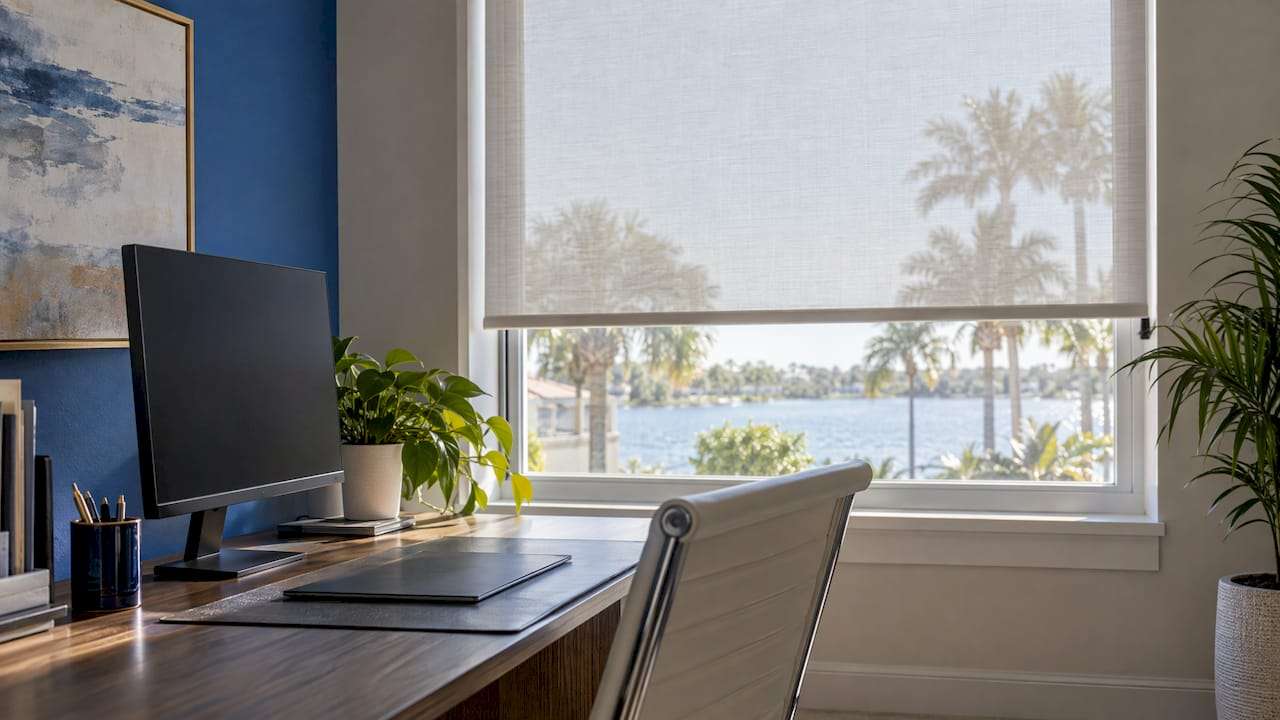
Home office. Glare on the screen is the enemy. A solar or roller shade that cuts glare while keeping daylight gives you a clear screen without turning the room into a cave.
Small windows. Our article on drapery ideas for small windows covers how to make a narrow opening feel larger without adding clutter.
Window size and proportion
A simple rule of thumb from designers is to match the treatment to the scale of the opening. Wide, tall windows take drapery well because a single wide shade can look like a large hanging sheet. Narrow windows suit shades because drapery can overwhelm them. Neither rule is absolute, and a good measurement visit reveals exceptions: a deep window with a wide casing may look better with an inside-mount roller, while a short window above a sofa may want a panel that runs to the floor to add height.
Mounting and layering for a clean line
Where a treatment sits matters as much as what it is. In Architectural Digest’s layered drapery feature, architect Suzanne Lovell advises placing shades and blinds inside the window trim and hanging curtains outside, closer to the ceiling, to lengthen the visual line and create the illusion of higher ceilings. She describes shades and screens as the answer to functional demands like limiting sunlight, with drapery lifting the architecture. Boston designer Nina Farmer adds that some contrast between layers makes them feel purposeful instead of overly matched.
For a minimalist result, this translates into a few practical rules:
- Inside mount for shades when the frame is deep and square enough. The shade sits flush and the trim stays visible.
- Outside mount when the frame is shallow or you want to hide an uneven opening, or when you want the shade to look slightly larger than the glass.
- Hang drapery high and wide. Mount the rod near the ceiling and extend it past the window frame so panels stack off the glass when open.
- Choose one hardware finish. A slim rod and matching brackets in black, white or brushed metal read as a single line.
- Hide the controls. Cordless, wand or motorized operation removes the dangling cord that clutters a clean wall.
Color, fabric and texture
Minimalism leans on neutrals. White, ivory, greige, soft gray and muted blue-gray all work, and a monochrome scheme in which the window covering is a shade or two off the wall color makes the window blend into the room. Texture does the work pattern would otherwise do: a linen weave, a subtle basket texture or a matte solid gives depth without visual noise.
A few fabric guidelines help in Florida:
- Light-filtering fabrics keep the room bright and the daylight diffuse. The PNNL guide notes that diffuse natural light carries less waste heat than nearly any electric lighting, so good daylighting can save on both cooling and lighting.
- Blackout linings belong in bedrooms and media rooms. A lining also adds body to a drapery panel so it hangs straight.
- Fullness for drapery. Even a minimalist panel should have enough fabric to fall in soft, regular folds. A flat, stretched look reads as cheap. This is a matter of fabrication, which is exactly where a workroom earns its keep.
- Sun resistance. Rooms with strong afternoon sun benefit from fabrics chosen for fade resistance, so the neutral color you picked stays neutral for years.
For a deeper look at fabrics and styles, our guide to window treatment materials and styles walks through the options.
Sun, heat and energy in Tampa
Tampa homeowners and business owners think about cooling costs every summer, and a simple shade can help. The PNNL Building America Solution Center recommends interior light-filtering roller shades as a way to reduce heat gain while keeping diffuse daylight, and suggests choosing shading products rated by the Attachments Energy Rating Council, with ratings for warm and cool climates matched to your needs. For Florida, the warm-climate rating is the relevant one.
The same guide describes a simple operating habit for cooling savings: close window attachments during the day and open them at night when it is cooler outside. In winter, the logic reverses: open them when the sun hits the window, and close them at night and on cloudy days. Tampa winters are mild, so the daytime-closed habit matters most.
This is one reason motorized control suits minimalist design. A shade that lowers on a schedule or with a tap removes the need for a visible cord and makes the daily routine automatic. We offer motorized blinds and shades, including battery-operated motorized shades for windows without a nearby outlet.
When no covering is the right answer
Sometimes the most minimal choice is nothing. Architectural Digest quotes Washington, DC designer Christopher Boutlier saying that leaving windows unadorned can feel fresher and more architectural where privacy allows, and that simplicity in form and material tends to age better. That works for upper-floor windows, windows facing a private yard or a window with a beautiful frame. For any window that faces a neighbor, a street or a pool deck, a sheer roller shade is the lightest way to add privacy without hiding the architecture.
Outdoor spaces follow the same logic. A lanai or covered patio with large openings can use exterior-rated drapery or shades to cut glare and add privacy while keeping a clean line. We make outdoor drapery and shades for that purpose.
Why custom matters more with minimalism
A busy room hides a poor fit. A minimalist room does not. A one-quarter-inch gap on a roller shade, a hem that is slightly off the floor, a panel that does not stack evenly: each of these shows up immediately when the surrounding design is quiet. Three details decide whether a simple treatment looks high end:
- Measurement. Windows are rarely perfectly square. Measuring each opening individually, rather than assuming the same size across a row of windows, keeps the shades lined up and the reveals even.
- Fabrication. Every product we sell is fabricated in our Tampa Bay workroom, which gives us control over fit, materials and quality. When a shade or panel needs adjusting, the people who made it are down the road.
- Installation. Brackets set level and consistent, shades aligned across multiple windows and hardware that matches the line of the room all come from careful installation. We install what we make, and we remove your old treatments as a courtesy.
If you are comparing how a shade is installed, our article on how to install roller shades shows what a precise installation involves.
For designers, businesses and property managers
Minimalism is especially popular in offices, clinics, model homes and rental properties, because it is clean, consistent and easy to keep looking good. The same shade style repeated across a floor of windows creates a uniform exterior and a calm interior. This Old House reports that hanging roller and solar shades are a current trend, helped by more color and pattern options, and lists roller blinds, Roman shades and cellular shades among budget-friendly choices.
For commercial and multi-unit work, consistency is the priority: identical fabric lots, uniform mounting heights and a single installer across every opening. Interior designers can bring us a specification and rely on in-house fabrication for custom sizes. We handle commercial window treatments as well as residential, and we also offer drapery repair, curtain repair and hemming for existing installations.
A well-chosen treatment also helps a property show well. Our piece on window treatments in home staging and interior design explains why clean, uniform coverings read as well maintained to buyers and tenants.
Plan your minimalist windows
If you are ready to turn a Pinterest board into real windows, we can help with every stage: design, in-home consultation, precise measurement, onsite fabrication, installation and removal of your old treatments. Start with our residential consultation page, or look at our custom shades in roller, Roman, cellular and outdoor styles. Business owners can reach us through the commercial window treatments page. If you want to understand how choices affect the project before you call, our guide on choosing window treatments for a luxurious home is a good starting point.
Our perspective
We have spent over 30 years making window treatments for Tampa Bay homes and businesses, and we think of minimalist design as architecture with fabric instead of drywall. You are shaping how light enters a room and how tall and calm it feels, using as few elements as possible.
That is why we do not treat minimalism as the easy option. With no pattern to hide behind, the quality of the fabric, the evenness of the pleats and the precision of the fit are the design. Because we fabricate everything in our own workroom, we can match a roller shade to a window that is not quite square, set the fullness of a drapery panel so it falls the way it should, and keep a whole row of shades visually identical.
Our advice is simple. Start with how you use the room: where the sun lands, when you want privacy, what you want to see. Choose one style, one color family and one finish, and let the measurement do the rest. We come to your home, measure, install and take your old treatments away, so the finished window looks the way you pictured it.
The Drapery Company
FAQ
What is the most minimalist window treatment?
A flat roller shade is usually the cleanest option because it has no folds, trim or visible hardware beyond a slim roller. Inside-mounted in a solid, neutral fabric, it nearly disappears. Floor-length drapery panels in a single color are the other classic minimalist choice for taller windows and walls of glass.
What can I use instead of curtains or blinds?
Shades are the usual answer: roller, Roman, cellular and solar shades all cover only the window opening. Architectural Digest also lists inset-mounted woven shades and exterior solar shades as options that do not detract from the architecture. On upper floors with privacy, you can leave the glass bare.
Do minimalist roller shades work in a hot climate like Tampa?
Yes. The PNNL guide says interior light-filtering roller shades can reduce heat gain while still letting in soft natural light. Choose a fabric suited to the amount of sun the window gets, and consider motorization so the shades close during the hottest part of the day without any effort.
Should minimalist shades go inside or outside the window frame?
Inside the frame is the cleanest look when the opening is deep and square, since it keeps the trim visible. Outside mounting works for shallow frames or when you want the shade to look slightly larger than the window. Drapery goes outside the frame, ideally hung high and wide to make the wall look taller.
Can The Drapery Company handle a whole house or building?
Yes. We serve both residential and commercial clients in the Tampa Bay area, from a single room to many windows, with in-home consultation, measurement, onsite fabrication, installation and removal of old treatments. Contact us through our website to arrange a consultation.
Sources
- Window Attachments for Solar Control and Energy Efficiency, PNNL Building America Solution Center
- Minimalist Interior Design: Everything You Need to Know, Architectural Digest
- Window Treatments: Here’s Everything You Need to Know, Architectural Digest
- 33 Stylish Window Treatment Ideas, Architectural Digest
- Layered Drapery is the Trick to Elevated Interiors, Architectural Digest
- 13 Home-Decor Faux Pas That Date Your Interiors, Architectural Digest
- The Best Window Treatments for Every Room in Your Home, Bob Vila
- The 4 Best Blackout Shades of 2026, Wirecutter
- The 8 Best Blackout Shades The Spruce Has Tested, The Spruce
- 20 Window Treatment Ideas, This Old House