Minimalist Window Coverings: Simple Styles for Tampa Homes
November 18, 2026
Commercial Motorized Shades: A Tampa Bay Buyer’s Guide
November 20, 2026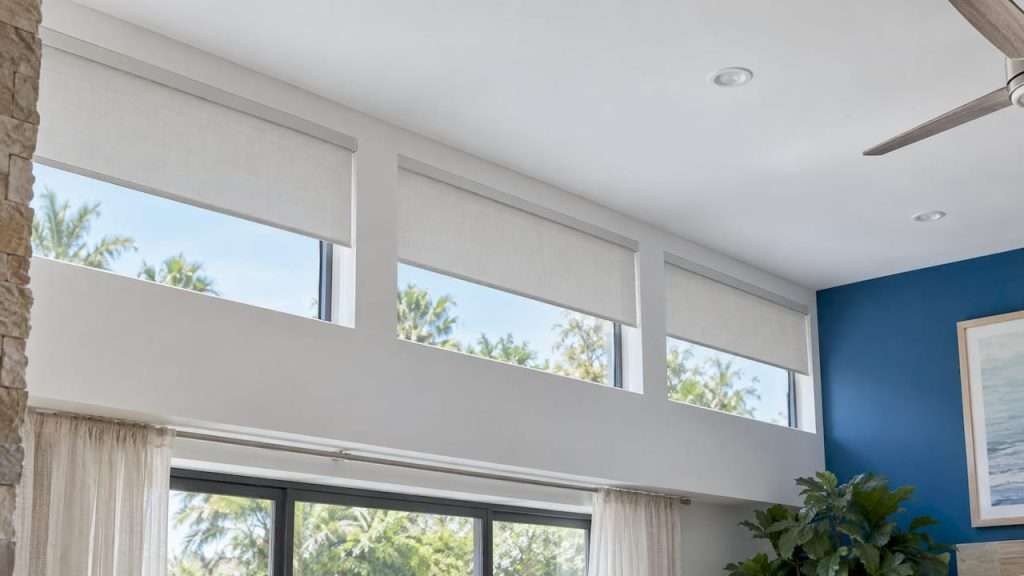
The best shade for a clerestory window is a custom-made, motorized one: a roller, solar, cellular or Roman shade built to the exact opening and operated by remote, wall switch or app, so nobody climbs a ladder to adjust it. Clerestory windows sit above eye level, so the usual cord, wand and stock-size answers fail there. In Tampa Bay, where afternoon sun is strong, a measured, motorized shade fabricated for the opening is what keeps the light you want and removes the glare and heat you don’t.
TL;DR
- Clerestory windows sit high on the wall, so choose shades you can operate without reaching: motorized, either hardwired or battery operated.
- Match the fabric to the exposure: west- and east-facing windows need glare control, while north-facing ones usually need very little.
- Roller, solar, cellular and Roman shades all work on high windows. The right one depends on the light level, privacy and look you want.
- Custom measuring matters more on high windows than anywhere else, because the opening is hard to reach and hard to correct after installation.
- Museums, galleries and collectors need light measured in lux and shades that can close completely when the room is empty.
What makes clerestory windows hard to cover
A clerestory is a band of windows set high in a wall, above eye level, usually in a row. Architects use them to bring daylight deep into a room while keeping wall space below for furniture, art and privacy. You see them in modern Florida homes, great rooms with vaulted ceilings, entry halls, offices, restaurants and churches.
The same height that makes them useful makes them awkward to cover:
- You can’t reach them. A standard cord or chain is useless if the shade sits ten or more feet up. Raising and lowering a shade twice a day from a ladder is not a realistic routine.
- They are often odd shapes. Long and narrow, trapezoids, arches or a row of identical panes. Stock sizes rarely fit.
- They take the harshest light. Because they face the sky rather than the street, they collect sun at sharp angles, including low morning and evening sun.
- Errors show. A shade that is a quarter inch off at ten feet up reads as crooked from the whole room.
These are problems of reach, size and light, and a custom shade solves all three.
Match the shade to the sun
Orientation decides what the shade has to do. According to Chairish’s guide to clerestory windows, north-facing clerestories give the most even light without harsh glare, south-facing ones maximize winter light but need overhangs to keep out summer heat, and east and west ones create glare at sunrise and sunset.
In practical terms for a Tampa home:
| Exposure | What you will notice | What the shade should do |
|---|---|---|
| North | Soft, steady light | Mostly privacy and a finished look; a light filtering fabric is enough |
| South | Bright midday light, strong heat in summer | Reduce heat and UV while leaving the room bright |
| East | Early glare, low sun angle | Cut glare in the morning, then open fully later |
| West | Late-afternoon glare and heat, the hardest case | Low-openness solar fabric or a layered setup that can be closed on a schedule |
The fabric’s “openness” is the share of the weave that lets light through. A 1% to 3% openness fabric blocks the most light and heat, and a 5% fabric keeps more brightness and a clearer sense of the outdoors. We explain how that choice works for south and west glass in our guide to UV-blocking shades and openness, and for softer light in our piece on sheer shades and 1%–5% openness.
Glare is a separate issue from heat. If the clerestory throws a bright patch on a TV wall or a desk, the fix is a fabric and a position that you can change through the day. Our article on home office glare control covers that problem in detail.
Shade types that work on high windows
Each of these can be fabricated for a clerestory. What differs is the look, the light control and how they stack when open.
Roller and solar shades
Roller shades are the cleanest, most architectural choice. A solar fabric reduces glare and UV while keeping the view, and a blackout fabric closes the window completely. They roll into a small headrail, so on a narrow clerestory they take almost no space. They suit contemporary homes and commercial offices, and they are the usual choice for a long row of identical windows, because every shade can match in height and finish.
Cellular shades
Cellular (honeycomb) shades trap air in their pockets, which adds insulation and quiets sound in tall rooms. They suit great rooms with vaulted ceilings where the volume of air is large and cooling costs are noticeable. They stack compactly and come in light filtering and blackout versions.
Roman shades
Roman shades fold into soft pleats and bring fabric, color and pattern to a high wall. They are the right pick when you want the clerestory to look decorated instead of technical. Because they fold, stack height and lift system need planning. If you want to understand how professionals take measurements for them, see our guides on measuring for Roman shades and how pros measure Roman shades.
Sheer and layered options
Sheer shades diffuse light and soften the glow in a room without blocking it. A layered setup puts a sheer or solar shade under a heavier blackout, so you can choose “bright and soft” or “dark” at the touch of a button. Layering is useful in media rooms, bedrooms with high windows and galleries.
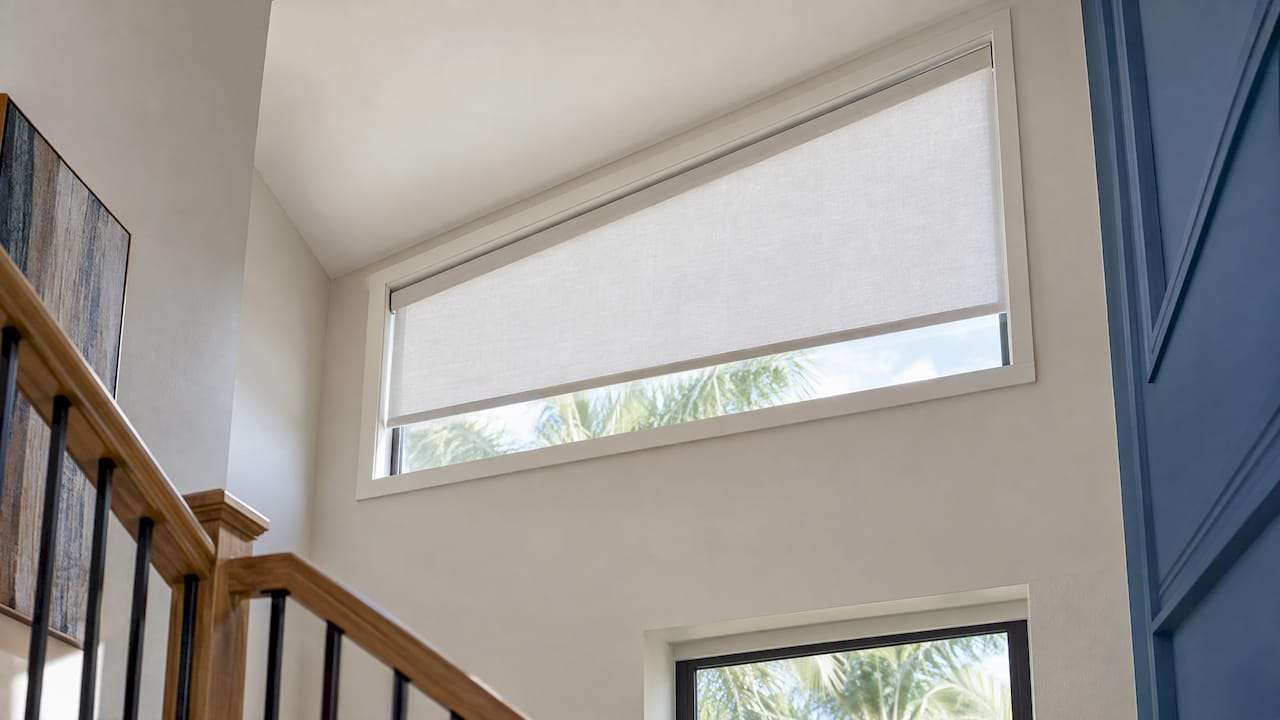
Shapes that are not rectangles
Many clerestories include arches, circles and angled tops that rise with a roofline. These need shades that are cut and built for that shape, and the way you measure is different. Our guide on measuring arch windows for custom treatments shows the steps.
Why motorization is the standard for high windows
A shade is only useful if it gets used. Windows you can’t reach get left open, and then the sun fades the floor, the couch and the art.
Motorized shades remove the problem. You can run them from:
- a handheld remote or wall switch,
- a smart-home app or voice assistant,
- a timer that lowers the west shades before the afternoon sun and raises them at dusk,
- a group setting, so a whole row of clerestory shades moves together.
Two power options cover most homes. Hardwired motors suit new construction and remodels where electricians can run power to the headrail. Battery operated motors suit existing homes where there is no wiring near the window, and we cover them in battery operated motorized shades. In both cases, a motorized shade means no cords hanging in a room with children or pets. For the full range we offer, see our page on motorized blinds and shades.
A shade on a timer also protects what’s in the room. Sun exposure is one of several things that wear on upholstery, and routine care such as keeping furniture clean with pets takes care of the rest. A shade that closes itself before the strongest sun arrives does the other part of the job.
Measuring and mounting high windows
High-window shades fail most often at the measuring stage. A few rules make the difference.
- Measure width at three points (top, middle, bottom) and use the narrowest figure for an inside mount. High frames are not always square.
- Measure height at the left, center and right. Settled framing can vary even on a short opening.
- Check the depth of the frame. The headrail and motor need enough depth to sit inside the opening, or the shade must be outside mounted.
- Note the power. Is there an outlet or a wire nearby, or does the shade need a battery wand or solar charger?
- Plan the stacking. Decide how much of the glass the stacked shade is allowed to cover when open.
- Record the shape. Photograph arches, angles and anything that interrupts the frame.
The work itself is where homeowners get hurt. Ladder safety advice for tall window treatments stresses keeping three points of contact, not standing on the top rung, keeping rungs dry and using an electronic stud finder to locate studs and live wires before drilling. That is a good list of what can go wrong, and for most high windows the practical answer is to have a professional installer do the measuring and mounting. We measure and install, and we remove old window treatments as a courtesy when we replace them. Our in-home consultations are described on our residential page.
Museums, galleries and collections
Shades for an art gallery or museum have a different job: protecting the objects. Light damage adds up, and it depends on how bright the light is and how long it lasts. The Center for Canadian Architectural Heritage explains that sensitive objects are generally recommended to receive 50 to 100 lux, and that actual illuminance should be measured. Its guidance also advises reducing daylight, using blackout shades or shutters when galleries are closed, and checking UV-filtering films periodically, giving about ten years as their lifetime.
What this means when you specify shades for clerestories in a gallery, a collector’s home or a showroom:
- Choose shades that can close completely. A blackout layer for closed hours matters as much as a filtering layer for open hours.
- Use a low-openness fabric for open hours to bring daylight down toward the level the work needs.
- Automate it. Motorized shades on a schedule keep the protection in place without relying on staff to remember.
- Layer where light needs fine control. At the Whitney Museum, motorized interior shades work alongside a glazing interlayer that filters more than 99 percent of harmful UV, and the façades use two shade layers: one for solar and glare control and another to diffuse transmitted light.
- Set levels for the specific work. Architectural Record describes a 75-lux maximum set for one fragile paper artwork, based on studies of its pigments and condition. A conservator should name the target for your objects.
For a home gallery wall, a restaurant with a feature piece or a lobby with a commissioned work, the same logic scales down: control the amount, limit the hours, and make the shade operate itself.
Commercial and multi-unit projects
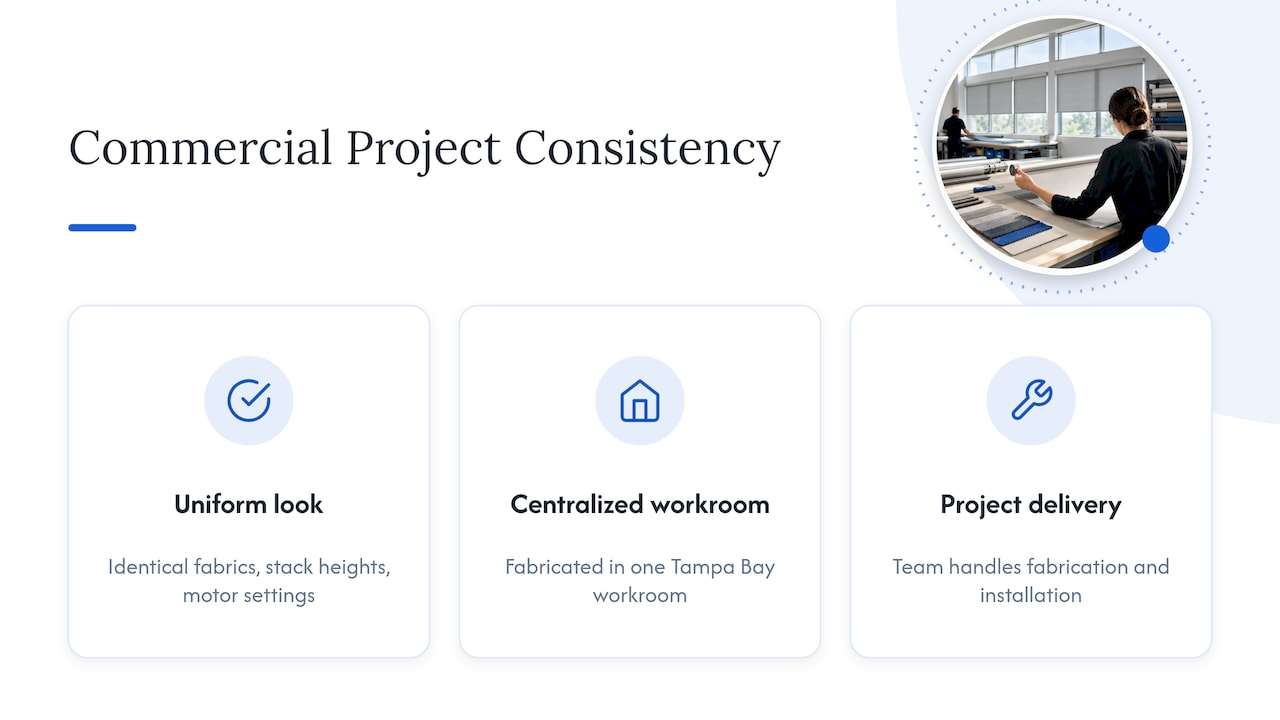
Property managers and designers dealing with a row of clerestories across many units or floors need consistency more than anything. Identical fabrics, identical stack heights and identical motor settings keep the building looking uniform from the street. We fabricate every product in our Tampa Bay workroom, so fit and materials are controlled in one place, and our team handles commercial window treatments for offices, retail and hospitality. See our commercial window treatments page for what we do for businesses. Interior designers who need a reliable custom fabricator can send drawings or dimensions, and we handle the fabrication and installation.
What affects the cost
We do not publish a price list, because high-window shades are priced by the opening, not by the shade. The main drivers are:
- Size and number of windows. Wider and taller means more fabric and a stronger tube or headrail.
- Shade type and fabric. Solar and blackout fabrics, cellular and Roman shades each cost differently.
- Operation. Motorized costs more than manual, but on a high window manual is rarely practical.
- Shape. Arches and angles need custom cutting.
- Access. Height can require scaffolding or lifts for installation.
- Power. Hardwired needs an electrician; battery operated does not.
Our page on window treatment cost factors explains how these affect a quote. The most reliable figure comes from a measured quote for your actual windows.
Our perspective
We see a clerestory as architecture, and the shade is the part that lets the architecture work. A high window with no treatment is bright but not comfortable. A high window with a shade nobody can reach is, in practice, the same thing.
That is why we build every shade in our own Tampa Bay workroom and fit it to the opening. When the same team designs, fabricates, measures and installs, the shade fits the frame, the motor fits the headrail and the fabric suits the exposure. We also remove the old treatments as a courtesy, so the job ends with a finished wall.
Our advice is simple. Decide what the window must do at 3 p.m. in August, choose the fabric for that, and make it motorized so it gets used.
The Drapery Company
Start with a measured consultation
If you have clerestory or other high windows in Tampa Bay, we can visit, measure the openings and recommend a shade and a power option for each exposure. Learn more about our custom window treatments, our shades, blinds and shutters or our custom roller, Roman and cellular shades, or call (813) 949-3100 to request a quote.
FAQ
What are the best window treatments for clerestory windows?
Motorized roller, solar, cellular or Roman shades made to the exact opening. Pick the fabric by exposure: low-openness solar fabric for west and south glass, and a light filtering or sheer fabric for north glass. Motorization means the shades get used every day.
How do I cover high windows I can’t reach?
Use a motorized shade controlled by remote, wall switch, app or timer. Hardwired and battery operated motors are both available, so even a retrofit with no nearby outlet works. This also avoids cords and ladder trips.
What is the difference between a transom window and a clerestory window?
A transom is a small window set directly above a door or another window, while a clerestory is a row of windows high in a wall that brings light deep into a room. The shades are similar, but clerestories are usually wider and higher, which makes motorization more important.
Can shades protect artwork from daylight?
Yes, as part of a lighting plan. Conservation guidance recommends limiting both brightness and exposure time, so shades with a blackout layer for closed hours and a low-openness fabric for open hours work well. A conservator can set the lux target for your pieces.
Do you cover commercial and multi-unit properties?
Yes. We make window treatments for businesses and property managers across the Tampa Bay area, including matching sets for repeated openings, with fabrication in our own workroom and professional installation.
Sources
- Clerestory Windows: Complete Guide to High-Placed Natural Light, Chairish
- Living the High Life: How to Safely Install Tall Window Treatments, RealtyTimes
- Light Exposure for Artifacts on Exhibition, CCAHA (2020)
- New developments in museum lighting design, The Construction Specifier (2017)
- Continuing Education: Daylighting in Museums, Architectural Record (2023)
- Keeping Furniture Clean with Pets