Garage Window Privacy: Blinds, Shades and Shutters That Work
November 23, 2026
Motorized Wood Blinds: How They Work and What to Know
November 25, 2026
A dual roller shade puts two roller shades on one window: a light-filtering layer for daytime and a blackout layer for privacy and sleep. Each layer has its own control, so you choose between a bright room with a view, a dim room with glare cut, or a dark room, without swapping treatments. Getting that to work well in a Tampa Bay home depends on fabric choice, mounting depth and an accurate measurement, and those are the details a custom workroom controls. At The Drapery Company we fabricate every shade in our Tampa Bay workroom, so the two layers are built to sit together on your window rather than adapted from stock parts.
TL;DR
- A dual roller shade (also sold as a double roller shade, dual roller blind or day-night roller shade) pairs a sheer or screen fabric with a blackout fabric in one bracket system.
- It suits bedrooms, media rooms, home offices and conference rooms, anywhere the same window needs a view by day and darkness or privacy later.
- Dual systems need more mounting depth and height than a single shade, so the measurement decides whether an inside mount works.
- Fabric opacity, operation (cordless, chain or motorized) and headrail style drive both the look and the price.
- Custom fabrication and professional measuring keep the two layers aligned and operating independently.
What a dual roller shade actually is
Think of two roller shades sharing one window frame. The front layer is usually a light-filtering or solar screen fabric. The back layer is usually a blackout or room-darkening fabric. They hang on a shared or paired bracket set, and each rolls up and down independently.
The names vary by retailer, but they describe the same idea:
- Dual roller shades and dual roller blinds are the general terms. “Blinds” is the common British and trade word; in American homes the product is normally called a shade because the fabric rolls onto a tube instead of being made of slats.
- Double roller shades is the same product described by its two rollers.
- Day-night roller shades emphasize the use: the filtering layer for day, the blackout layer for night.
Do not confuse any of these with a zebra or banded shade, which alternates sheer and solid stripes on a single fabric loop. A dual roller has two separate fabrics on two separate tubes, which means the blackout layer can be fully opaque and the screen layer can stay clear of it.
Why homeowners and businesses choose them
A single shade forces a compromise. A screen fabric keeps glare down and preserves your view, but after dark, interior lighting makes you visible from outside. A blackout fabric solves privacy and sleep but gives up the view and daylight. A dual shade removes the compromise.
Light control and privacy through the day
In the morning you can lower the screen layer to cut glare on a television or laptop while still seeing the yard, the canal or the street. In the evening you lower the blackout layer for privacy and darkness. In between, you can run both, or neither.
Heat and energy comfort
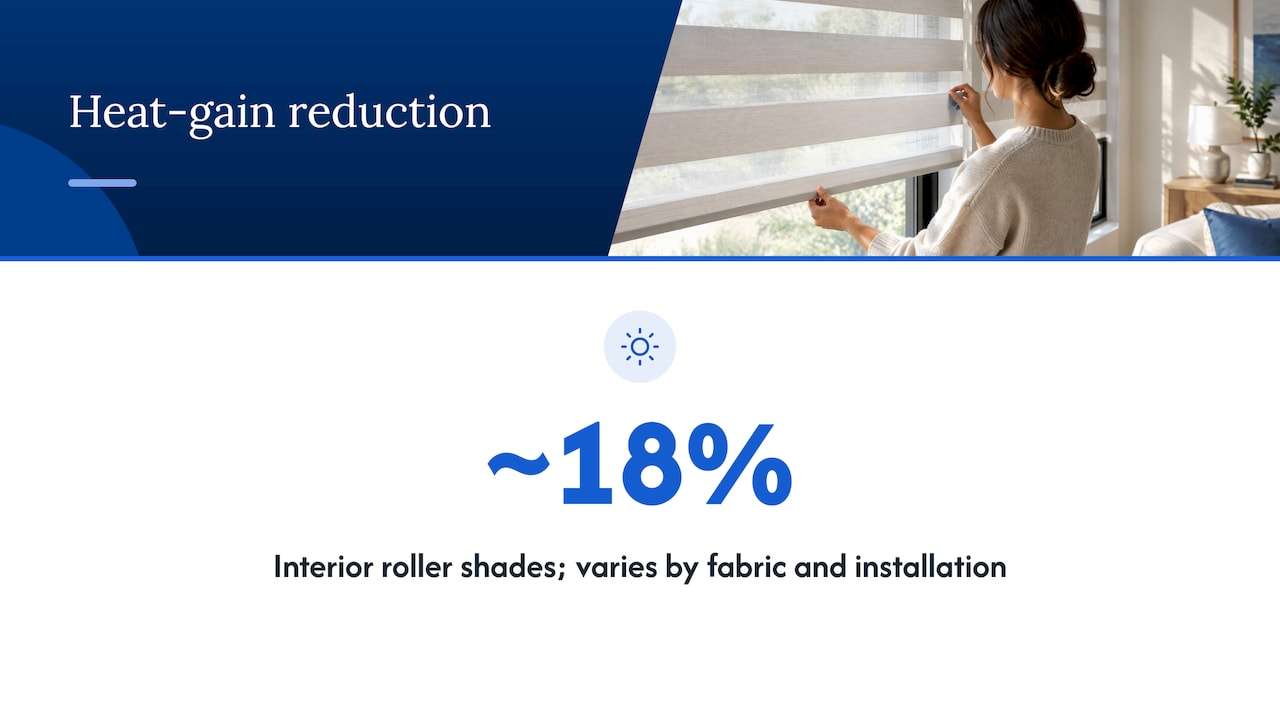
Tampa Bay sun is strong for most of the year, and western exposures can heat a room by mid-afternoon. Interior window attachments help here. Pacific Northwest National Laboratory’s building science resource notes that interior roller shades showed a heat-gain reduction of about 18% in the research it summarizes, with performance depending on the fabric and how the shade is installed. With two layers on a window, you have two fabrics doing that work, and you decide when each one is down.
Rooms where it earns its place
- Bedrooms: blackout at night, a softened view in the morning.
- Home offices and media rooms: glare control during work or viewing, full darkness on demand.
- Living rooms with large glass: screen fabric most of the day, blackout for evening privacy.
- Conference rooms and offices: presentation-ready darkness, then daylight and outward views for the rest of the workday.
- Multifamily and hospitality units: one specification that covers both privacy and room darkening on every window.
How dual roller shades compare with a single shade
The practical comparison comes down to function, appearance and space.
| Factor | Single roller shade | Dual roller shade |
|---|---|---|
| Light control | One fabric, one setting | Two fabrics, three or more settings |
| Day and night use | Screen or blackout, not both | Screen by day, blackout at night |
| Mounting depth | Shallow, often 3 to 7 inches of clearance | Deeper; Lutron lists 6 to 8 inches for dual mounts |
| Visual weight | Slim | Fuller headrail or cassette |
| Controls | One | Two, manual or motorized |
The depth row is the one that surprises people. If your window has a shallow recess, a dual system may need an outside mount, where the shades hang on the wall or trim above the opening. That is a perfectly good solution when the fabric edges are sized properly, and it often looks cleaner on windows with shallow casings.
Fabrics, opacity and design choices
Because the two layers do different jobs, you specify them separately.
The front layer: screen or light-filtering
Solar screen fabrics have an open weave that cuts glare and reduces solar heat while keeping an outward view. The openness of the weave determines how much view and light you keep and how much privacy you have in daylight. A tighter weave gives more glare control and a little more privacy; a more open weave gives a clearer view. Light-filtering fabrics, which are woven or coated to diffuse light, give a softer, brighter room with more daytime privacy and less view.
The back layer: blackout or room-darkening
Blackout fabrics are made to stop light. Room-darkening fabrics let a little through and feel softer. In a bedroom, the blackout fabric matters most. In a living room, a room-darkening layer may be enough, and it often looks better with the screen in front.
Color and finish
Most designers pick the front fabric first, because it is what you see from inside. The back layer is typically neutral and calm in tone, so that when both are down, the window still looks composed. If the shades face the street, remember that the blackout layer is what neighbors and passersby see from outside, so a white or off-white backing usually reads best on the exterior.
Hardware and headrail
The tubes, brackets and any cassette or valance cover are part of the design. A cover hides the rolled fabric and gives a tailored line, which matters on a dual shade because there is more to hide. Our guide to the parts of a roller shade explains the tube, brackets, clutch and hem bar so you know what you are specifying.
Operation: manual, cordless or motorized
A dual shade has two operating mechanisms per window, so the choice multiplies across a whole home.
- Chain or clutch: reliable and straightforward. On a dual system, two loops of chain can hang side by side, so placement and tidiness matter.
- Cordless: a cleaner look and a good fit wherever children or pets are in the home. You lift or lower the shade by hand.
- Motorized: each layer moves from a remote, wall switch, app or schedule. On large or tall windows, and on banks of windows in an office or multifamily building, motorization is the practical choice because you can set every shade to the same position. We offer motorized blinds and shades alongside our other custom window treatments, and the same idea of letting the sun schedule drive your coverings appears in this look at automatic sun protection for the home.
A useful rule: if you will use both layers every day, and especially if the window is hard to reach, motorize it.
How to measure for dual roller shades
Measuring is where a dual system is won or lost, because two shades stacked on one window leave less room for error than one.
Step 1: Decide inside or outside mount
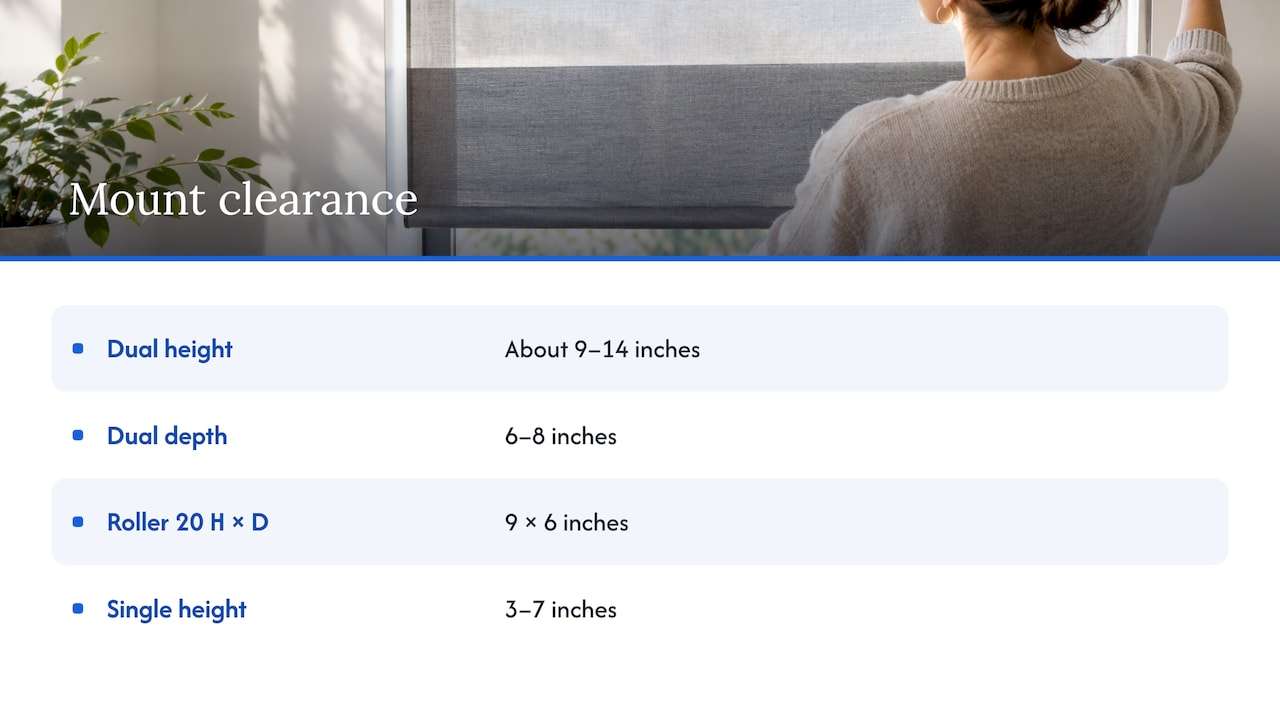
An inside mount sits within the window opening and looks the most tailored. An outside mount sits on the wall or trim around the opening and covers more of the surrounding area. Lutron’s shade measuring guidelines list dual-mount systems as needing about 9 to 14 inches of height and 6 to 8 inches of depth, depending on the system (a Roller 20 dual mount, for example, needs 9 inches by 6 inches), against 3 to 7 inches for a single shade. Check your window’s available depth against the system before you commit to an inside mount.
Step 2: Measure on site, at each window
Lutron advises taking final measurements at each window rather than working from drawings. Windows that look identical often differ by a fraction of an inch, and that fraction shows up as light gaps or a shade that binds.
Step 3: Use the smallest width for inside mounts
For an inside mount, measure the width at the top of the jamb, and use the smallest measurement if the opening varies with depth. Do the same check for height.
Step 4: Size outside mounts to the trim
For an outside mount, the fabric edges should line up with, or slightly overlap, the trim. On a dual shade this overlap also helps stop light leaking around the blackout layer at the sides.
Step 5: Record obstructions
Handles, cranks, latches, window locks, and the swing of a tilting sash all affect whether the two layers can drop cleanly. Note them.
If you want the general method before we visit, our guides to how to measure for blinds and measuring before installation walk through the same habits. When we come to your home, we take the measurements and handle the installation ourselves, and we remove your old window treatments as a courtesy.
What affects the price
We do not publish prices for dual roller shades, because the total depends on the specification of each window. These are the factors that move it:
- Size. Wider and taller shades use more fabric and heavier tubes.
- Fabric. Premium screens, blackout laminates and designer textiles cost more than basic fabrics.
- Operation. Cordless is typically simpler than motorized; motorized adds motors, controls and sometimes power work.
- Mount and hardware. Cassette covers, specialty brackets and outside-mount fascias add cost.
- Number of windows. A whole-home or building-wide project gives you consistent specifications across every opening.
- Measurement and installation. On a dual system, accurate measuring and installation prevent expensive remakes.
For a deeper look at pricing logic, see our page on window treatment cost factors.
Who this fits best
Homeowners and new homeowners. You get one window specification that handles glare, privacy and sleep. The in-home consultation lets us look at your actual light, which changes across rooms.
Interior designers. A dual shade gives you a clean, architectural window while leaving room for drapery on top. Custom fabrication lets you specify fabrics and finishes rather than choosing from a fixed catalog.
Businesses and property managers. Uniform shades on every window make a building look finished from the street. Motorization and consistent specifications make a large installation manageable, and we handle commercial window treatments as well as residential.
Our perspective
Most dual shade problems are not fabric problems. They are fit problems. Two layers on one window leave little tolerance: a quarter inch of drift at the bracket, or a recess that is a half inch shallower than expected, and the layers rub or leave a gap of light.
That is why we fabricate everything in our own Tampa Bay workroom. When the person who measures your window is working with the people who build the shade, a dual system can be sized to the opening and not forced into it. We have done this for more than 30 years, across thousands of projects, for homes and commercial spaces around the bay.
We also think of window treatments the way we think of architecture with fabric instead of drywall. A dual roller shade is a way of building the room’s light: bright and open when you want it, dark and private when you need it. We design it to your budget and your daily routine, then we measure, install and remove what was there before.
The result should be something you stop thinking about, because it simply works every morning and every night.
The Drapery Company
Working with us
If a dual roller shade sounds right for one room or for a whole building, start with a consultation. We come to your home or business, look at the light and the window depth, talk through fabrics and controls, and quote the project. You can see our full range of custom roller shades and other window shades, or book an in-home consultation for professional measurement and installation. Property managers and designers can also reach us through our commercial window treatments page.
FAQ
Are double roller shades the same as dual roller shades?
Yes. Double roller shades, dual roller blinds and day-night roller shades all describe two roller shades on one window, usually a light-filtering layer and a blackout layer. The wording differs by retailer and region, but the function is identical.
Can I use dual roller shades if my window recess is shallow?
Sometimes. Dual systems need more depth than a single shade, with Lutron listing 6 to 8 inches for its dual mounts, so a shallow recess often calls for an outside mount instead. That mount hangs the shades on the wall or trim, and it can look very clean when the fabric is sized to line up with the trim.
Do dual roller shades work well in a bedroom?
They are a strong fit. The blackout layer gives you darkness for sleep, and the screen or light-filtering layer lets you keep daylight and softer privacy in the morning. A motorized version lets you adjust both from the bed.
Should I motorize both layers?
If you use both layers daily, or the window is tall, wide or hard to reach, motorizing both is the most convenient setup. On a bank of windows, it also keeps every shade at the same height. We can talk through controls during your consultation.
Can dual roller shades go on commercial windows?
Yes. Offices, conference rooms and multifamily units often use them for glare control by day and darkness or privacy on demand. We design and install commercial window treatments across the Tampa Bay Area.
Sources
- Shade Measuring Guidelines and Best Practices (Lutron)
- Window Attachments for Solar Control and Energy Efficiency (Pacific Northwest National Laboratory)