Cornice Board Styles: Straight, Shaped and Upholstered
November 22, 2026
Dual Roller Shades: How They Work and How to Choose
November 24, 2026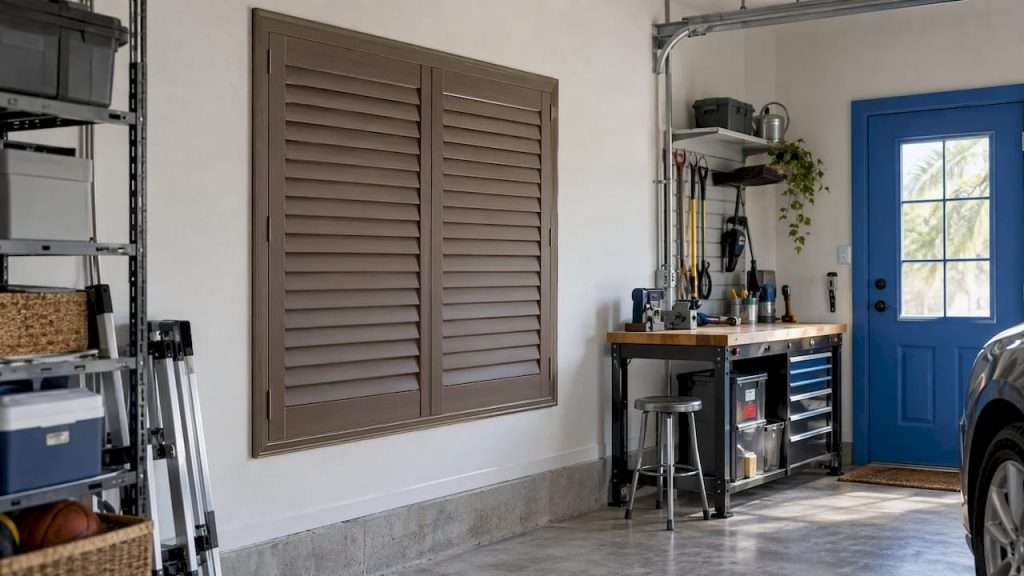
The best way to get privacy on a garage window is a fitted covering that you control: a metal or faux wood blind, a roller shade or a composite shutter, made to the exact size of the opening. In a Tampa Bay garage that hot, humid, bright room asks more of a covering than a living room does, and a made-to-measure treatment is what holds up. We fabricate blinds, shades and shutters in our own workroom and install them, so the covering you choose is cut to your windows rather than trimmed to fit.
TL;DR
- Choose by what the covering must survive: heat, humidity, bright sun and the hours you actually use the garage.
- Metal blinds, faux wood blinds, roller shades and composite shutters all suit garages. Real wood and soft fabrics that trap dust and odors do not.
- Reflective privacy film only works when it is brighter outside than inside. After dark with the lights on, the effect reverses.
- Measure the opening first. A half-inch error is the most common reason a blind sits crooked or leaves a gap.
- Custom fabrication and professional installation take the sizing risk off your hands, and removal of old coverings is part of our service.
Why garage windows need their own plan
Most people think about garage windows only when they notice someone looking in. A garage often holds tools, bikes, a workbench, a freezer, sometimes a car worth more than the neighbor’s. Windows along a driveway or side yard give a clear view of all of it, and a visible lit workshop at night tells passersby you are out there, or not.
The room itself is also different from the rest of the house. It usually has no air conditioning, so temperature and moisture swing widely. In Tampa Bay, summer garages get hot and damp, and sunlight through a west-facing pane can fade whatever sits near it. A covering chosen for a bedroom can warp, sag or mildew here within a season or two.
So the question is not only “how do I block the view?” It is four questions at once:
- Who can see in, from where, and when?
- How much daylight do you want to keep?
- What heat and humidity will the covering live in?
- How often will you open, close or clean it?
The rest of this guide works through those, starting with the choices that fit garages best.
The coverings that suit a garage
A media roundup of garage window covers describes the main categories well: curtains are cheap and easy but collect dust and absorb odors, metal or aluminum blinds withstand garage temperature swings, wood composite interior shutters are durable, and roller shades are simple. That matches how these materials behave in a hot, unconditioned space. Here is how we think about each.
Metal blinds
Aluminum blinds shrug off heat and humidity. They do not swell, warp or hold smells, and a wipe with a damp cloth keeps the slats clean. The slats tilt, so you can angle them to keep out the street view while still letting daylight in. For a utility garage where function comes first, they are a sensible default.
Faux wood blinds
If the garage doubles as a workshop, gym or hobby room and you want something warmer-looking, faux wood blinds give the look of wood without wood’s reaction to moisture. They are heavier than aluminum and offer a more finished appearance, a good match when the garage is visible from a lanai or the house interior. Real wood is the wrong choice in this room.
Roller shades
Roller shades are the cleanest, simplest profile: one flat piece of fabric that rolls up out of the way. They come in light-filtering weaves that keep the space private without darkening it, and in blackout fabrics for a garage that has become a home gym, studio or media room. One caution from the same roundup: roller shades can flap in moving air, which matters if you leave a garage door or window open. A properly measured and mounted shade, with side channels or a tight fit, keeps that under control.
For a garage that gets strong afternoon sun, solar shades are worth knowing about. Their fabric has an “openness” percentage, which is how much of the weave is open. Lower numbers block more sun and see-through. We explain why 3% to 5% openness balances privacy and daylight on our own site, and the same logic applies to a garage window facing the street.
Shutters
Interior shutters give a garage window a permanent, finished look, and their louvers let you angle light and views with one hand. The same media roundup notes that wood composite shutters resist moisture and warping, often carry built-in UV protection, and give winter thermal protection when closed. For garages that are used as real rooms, or that face the street, shutters are the most substantial option.
Curtains and drapery
Drapery softens a garage that has been converted to living space, such as a studio or a guest suite. In a working garage, fabric collects dust and odors, so we reserve it for finished, conditioned garage rooms. If that is your situation, our custom drapery is made for the exact window width and stack space.
Comparing your options at a glance
| Covering | Heat and humidity | Privacy control | Light control | Best for |
|---|---|---|---|---|
| Aluminum blinds | Very good | Tilt slats up or down | Adjustable | Working garages, side windows |
| Faux wood blinds | Good | Tilt slats, heavier look | Adjustable | Workshops, visible garages |
| Roller shades | Good with a fitted mount | Full cover when lowered | Light-filtering or blackout | Clean look, gym or studio use |
| Solar shades | Good | Daytime privacy, see-out view | Cuts glare and UV | Sunny street-facing windows |
| Composite shutters | Very good | Louvers angle precisely | Adjustable | Converted or finished garages |
The ratings above describe the material type in general. We recommend the specific product once we have seen the window and how the garage is used.
What privacy film does, and where it stops
People searching for garage privacy often run into adhesive film. It is worth understanding how it works, because the daytime result and the nighttime result are different.
Reflective, one-way film works only when the outside is brighter than the inside. At night with the interior lights on, the effect reverses and people outside may see in. Frosted and decorative films diffuse light and obscure the view in both directions, day and night, but they also stop you looking out. Another industry source adds that light transmission is not a privacy rating, so a film’s number tells you little about what a neighbor can see after dark.
That is the practical point for a garage. If you work out there in the evening, a covering that closes is what gives you privacy at the moment you need it. A blind, shade or shutter does that on demand, and it adjusts: open for daylight, closed when the lights come on.
Match the covering to how you use the garage
Privacy planning should follow the hours the room is used. A professional guide to nighttime privacy makes the same point for commercial spaces: a street-facing room, an office and a conference room may each need a different solution. In a home garage, the same idea breaks down like this.
Storage and parking only. You rarely stand in the room, and the goal is to hide contents from the street. A light-filtering roller shade or aluminum blind, set to a fixed position most of the time, handles it.
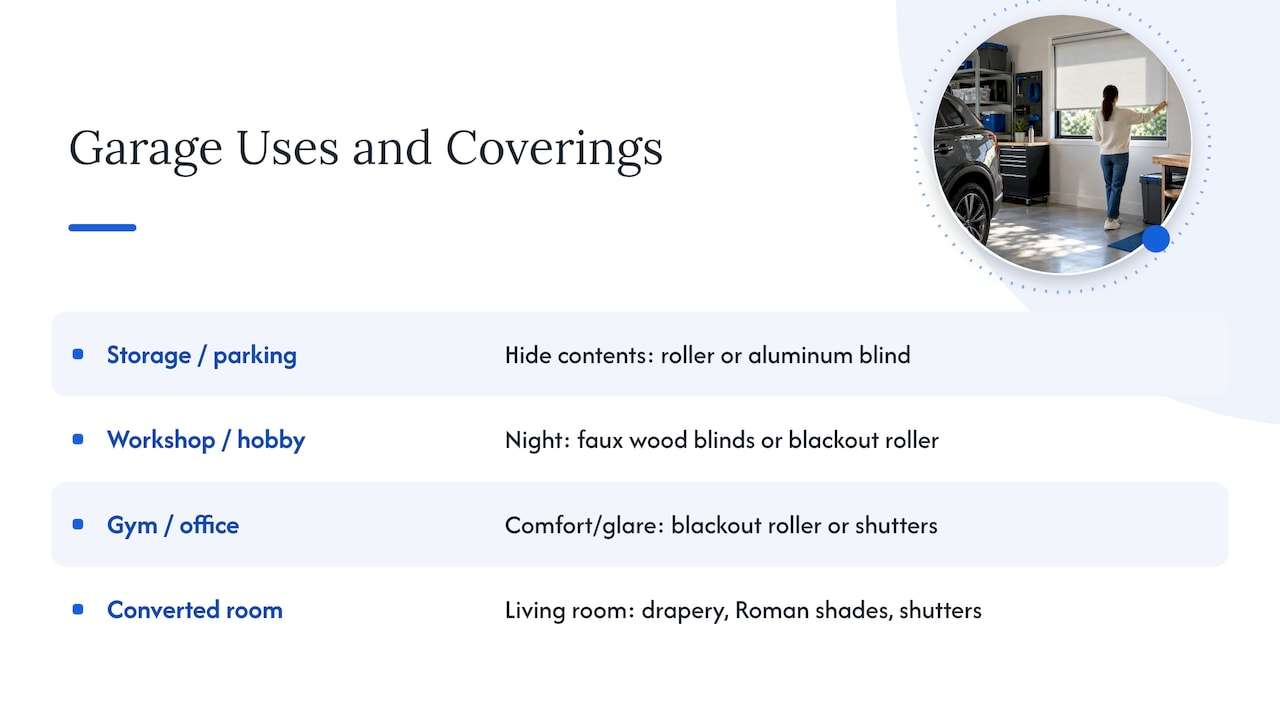
Workshop or hobby space. You are there evenings and weekends with the lights on. Choose something you can close fully at night: faux wood blinds or shutters with tilting louvers, or a roller shade with a blackout or tighter weave.
Gym, studio or home office. Comfort and glare matter as much as privacy. Blackout roller shades or shutters, possibly motorized so you can raise and lower them from the wall or a phone, suit this use. We offer motorized window coverings for exactly this kind of hard-to-reach or frequently adjusted window.
Converted garage room. Treat it as a living room. Drapery, Roman shades or shutters sized to the architecture, the same as any room of the house.
Florida conditions: heat, sun and storms
In Tampa Bay, three local factors shape the decision.
Heat. An uninsulated garage on a summer afternoon can be much hotter than the house. Fabrics with solar control and louvered shutters help reduce the sun’s direct hit on the glass, and cellular shades add an insulating air pocket. We offer cellular shades among our shade lines.
Humidity. Moisture is what ruins the wrong material. Choose metal, faux wood, composite or synthetic fabrics, and avoid untreated wood and heavy natural fabrics.
Storm protection. Window coverings are not storm protection. If your garage windows need hurricane protection, that is a separate question of impact glass versus hurricane shutters, and interior privacy treatments are chosen after that decision is made. An interior blind or shade does not replace code-approved opening protection.
How to measure garage windows for a covering
A made-to-measure covering is only as good as its measurements. This is the routine, and where it goes wrong.
- Decide on inside or outside mount. An inside mount sits within the window frame for a clean look and needs enough frame depth. An outside mount sits on the wall or trim and covers more of the opening, which helps with light gaps and with windows that have shallow frames. Many garage windows have shallow frames, so check the depth before deciding.
- Measure width in three places. Take the top, middle and bottom of the opening, and use the narrowest figure for an inside mount. Garage framing is rarely perfectly square.
- Measure height in three places. Left, center and right. For inside mounts use the shortest.
- Check for obstructions. Window cranks, latches, security sensors and door tracks can block a blind from hanging or rolling properly.
- Allow for manufacturer deductions. Sizing specs differ by type, brand and style, and often require adding or subtracting up to a half-inch. A mistake of that size shows up as rubbing, gaps or a blind that will not fit.
- Mind the warranty. The same guide warns that some companies do not honor warranties if blinds are not professionally installed, so read the fine print.
Our own guides cover the details: how to measure for blinds, how to measure windows for shutters, and how to hang blinds in an inside mount. In practice, with our in-home consultation we take the measurements ourselves and handle professional installation, and we remove your old window treatments as a courtesy. Because we fabricate everything onsite in our Tampa Bay workroom, the covering is built to the measured size instead of being cut down from a stock size.
Garage door windows and multi-window garages
The small panes in a garage door are the hardest to treat. The panels move, the panes are narrow and the door’s weight and track limit what can be mounted. A covering for those panes has to be light, mounted so that it does not interfere with door travel, and sized to each pane. Because every case differs, we look at the door before recommending a solution.
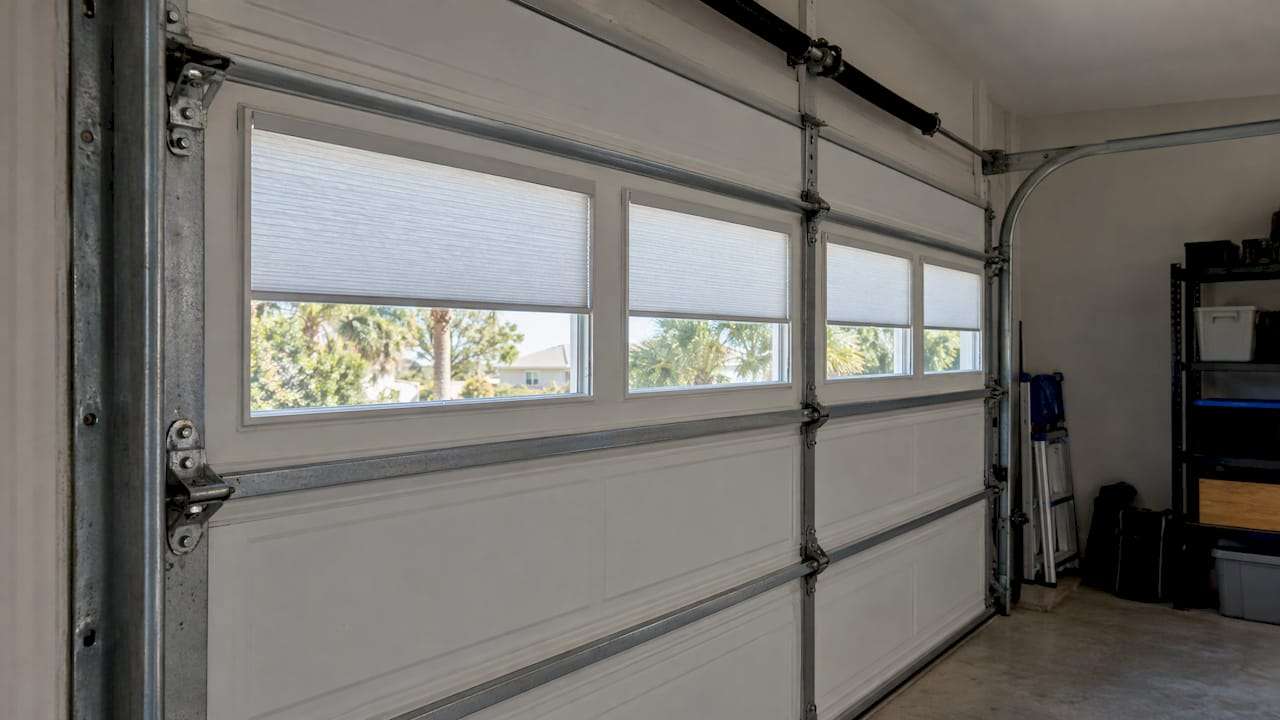
For property managers and commercial clients with many garage or service-bay windows, consistent sizing and a uniform appearance matter as much as privacy. We serve commercial spaces as well as homes, and fabricating onsite lets us make matching coverings across a run of windows.
What affects the cost
We do not publish prices, because the total depends on the project. In general the factors are:
- Number and size of windows. Larger windows use more material and more labor.
- Product type. Aluminum blinds, roller shades, shutters and motorized shades sit at different points on the scale.
- Fabric or material. Blackout, solar and insulating fabrics differ from basic weaves.
- Mount and obstructions. Unusual frames or door panels add fabrication work.
- Motorization. Powered operation adds hardware.
We explain these in more detail on our window treatment cost factors page. Our service is tailored to your budget and practical needs, so describing how you use the garage helps us propose the right level.
Our view: privacy that lasts is built to the window
We have spent more than 30 years making window treatments for Tampa Bay homes and businesses, and garage windows are a good example of why fit matters. The room is hot, humid and bright, and the windows are rarely standard. A covering built to the actual opening, from materials suited to the environment, does its job quietly for years.
That is why we fabricate every product in our own workroom. We control fit, materials and quality from the first cut, and we handle the process from design consultation through installation, including taking down what was there before.
Our advice is to decide first how the garage is used, then choose the covering that matches: blinds for adjustable daylight, shades for a clean profile and glare control, shutters where you want a permanent, finished result.
The Drapery Company
Talk to us about your garage windows
If you are a homeowner, property manager or designer in the Tampa Bay area, we can look at your garage windows, measure them and recommend blinds, shades or shutters that suit the way the room is used. Start with our blinds, shades and shutters page, or book an in-home consultation and we will take it from there. For a wider look at the topic, see our guide to window privacy treatments for Tampa Bay homes.
FAQ
What is the best window covering for a garage window?
For most Tampa Bay garages, aluminum or faux wood blinds and roller shades are the strongest choices, because they handle heat and humidity and let you control privacy and light. Composite shutters are the premium option for garages that are used as finished rooms. The best fit depends on how you use the space.
How can I see out of my garage window but keep people from seeing in?
During the day, a solar shade with a low openness percentage, such as 3% to 5%, keeps the outside view while limiting what people can see in. At night with the lights on, the effect fades, so a blind, shade or shutter that closes fully is what protects privacy after dark.
Do garage window blinds need to be custom made?
Garage windows often have shallow frames, cranks or odd dimensions, which is where made-to-measure coverings help. A covering built to the measured opening fits flush, closes evenly and avoids the gaps that stock sizes leave. We fabricate ours onsite and install them.
Can I cover garage door windows the same way?
Garage door panes need a lightweight covering that does not interfere with the door’s movement, sized for each pane. We review the door before recommending an option, because the right answer depends on the panel style and track.
Sources
- The Best Garage Door Window Covers To Increase Your Privacy, House Digest
- Privacy Window Film: How One-Way, Frosted, and Decorative Films Work, The Window Place USA
- Reflective Window Film Privacy: Day vs Night, Precision Film Systems
- The 15 Best Blinds, The Spruce
- Impact Glass vs. Hurricane Shutters