Avoid 4–8 Week Delays: AV Ready Conference Room Shades for Facilities
September 14, 2026
30 Years of Proof: Florida Drapery Fabrics for Sun, Salt, Humidity
September 16, 2026
Four solution categories solve privacy for floor-to-ceiling windows: motorized shades, smart glass or film, solar-control shades, and layered drapery. Each trades off differently between view, daylight, and full nighttime coverage, and retrofits (like applied film) rarely match what a professional installation delivers. The right pick depends on your exposure, your budget, and how much of that glass you actually want to keep visible after dark. The shortlist below breaks down which category fits which goal.
TL;DR:
- Motorized shades are recommended for tall or wide windows due to safety and reliability concerns over manual operation beyond 8 feet height.
- A professional measurement and installation are crucial for large glass walls to avoid costly mistakes and ensure a perfect fit.
- Smart glass options like PDLC are suitable for interior partitions requiring full opacity, while electrochromic and SPD glasses are better for exterior glare and heat control.
- Solar-control shades with low openness factors around 3% to 5% best preserve daytime views while reducing glare and heat in sunny exposures.
- Applying window film can be a budget-friendly retrofit, but it requires careful assessment of glass condition, pane size, and sun exposure for durability and effectiveness.
Which Privacy Solution Fits Your Goal?
Not every wall of glass needs the same fix. A street-facing living room and a second-story bedroom call for very different levels of coverage, and matching the goal to the right category saves you from an expensive do-over.
- Want to preserve the view during the day: solar-control roller shades with a low openness factor, paired with sheers.
- Need full privacy after dark, no exceptions: blackout drapery or a dual-roller system with a room-darkening shade behind a decorative panel.
- Have a hard-to-reach, oversized pane: motorized shades, since manual chains and wands become unsafe and unreliable above tall window heights.
- Want privacy on demand without any fabric at all: PDLC smart film or glass, best suited to interior partitions and bathrooms rather than full exterior walls.
- Working with a tight retrofit budget: applied window film, though it’s worth a professional consult first since not every pane is a good candidate.
Multi-panel and motorized setups almost always benefit from professional measurement, since a half-inch error on a 10-foot drop shows up immediately.
Motorized Shades for Tall and Wide Windows: Why They’re Often the Practical Pick
Once a shade climbs past roughly 8 feet, manual operation stops being a convenience issue and becomes a safety one. Chains and wands on that scale put strain on hardware and on whoever is pulling them, which is why motorized shades tend to be the default recommendation for true floor-to-ceiling glazing.
Fabric choice still drives the privacy outcome. Blackout roller fabric blocks sightlines completely, while a solar-openness fabric trades some nighttime privacy for daytime glare control and a preserved view.
Sizing matters just as much as fabric. Single motorized rollers scale reliably up to about 12 to 16 feet wide before tube torque and hem-bar weight require a multi-panel or shared-headrail approach instead. Power source is the other decision point:
- Hardwired motors are the most reliable for daily use but require electrical planning during installation.
- Rechargeable battery motors suit retrofits where running new wiring isn’t practical, with packs typically lasting a few years depending on shade size and usage.
- Solar-recharging kits keep batteries topped off automatically in a sunny climate, cutting down on maintenance visits.
Pro Tip: If your wall of glass is unusually wide, ask about a shared-headrail, multi-panel setup before you assume a single oversized roller will work. It usually looks cleaner and puts less strain on the motor.
Smart Glass and Switchable Film: Technology, Retrofit Options, and Limits
Smart glass falls into two camps that get lumped together but behave very differently. PDLC glass frosts to an opaque, milky white when powered off, making it the better choice when full privacy is the goal. SPD and electrochromic glass, by contrast, shift between clear and tinted states and prioritize solar control over true privacy.
That distinction matters when you’re deciding where to use each:
- PDLC works well for interior partitions, bathroom walls, and street-facing panels where you want privacy at the touch of a switch.
- SPD and electrochromic suit large exterior glazing where heat and glare management is the priority, not full opacity.
- Retrofit film is cheaper than full-glass replacement but comes with edge-sealing and durability tradeoffs over time.
Not every window is a good candidate for applied film. Glass condition, pane size, and sun exposure all affect how well film performs and how long it lasts, so a glazing consult before you commit is worth the extra step. Interior glass applications, like glass partition doors, face fewer of these constraints since they’re shielded from direct weather.
Solar-Control Shades and Reflective Film for Daytime Privacy
Openness factor is the number that decides whether a solar shade preserves your view or blocks it, and it’s measured as the percentage of fabric that’s actually open weave rather than solid material. A 1% openness fabric reads almost like a light-filtering shade, while 10% barely diffuses the sun at all. Most floor-to-ceiling installs land best around 3% to 5%, which cuts glare and heat while keeping the outdoor view intact during daylight hours.
- Reflective one-way films work in daylight because the mirrored coating bounces light back at anyone looking in.
- That same effect reverses at night: once interior lights are on, the reflective advantage disappears and the glass behaves like ordinary glass.
- South and west exposures get the most benefit from solar fabrics, since that’s where heat gain is worst.
- These fabrics need only occasional dusting or a damp wipe, making them low-maintenance for large expanses of glass.
Drapery and Layered Treatments: Soft, Full-Privacy Solutions That Scale
Custom drapery remains the most reliable way to guarantee total privacy on a floor-to-ceiling wall, and at this scale, fabrication precision is what separates a polished result from a visibly mismatched one. Panels need to come from the same fabric roll and dye lot, or seams and color shifts become obvious across a 10 or 12-foot drop.
Layering solves the view-versus-privacy tension better than any single treatment. A sheer paired with a solar roller behind it, or a dual-roller bracket holding both a solar and a blackout fabric, gives you daytime light with nighttime coverage on the same window.
- Humidity-prone rooms need lined fabric that resists sagging and warping over time.
- Recessed pocketing keeps hardware invisible for a cleaner architectural line.
- Drapery works where shutters simply can’t, since louvered panels rarely scale gracefully past 8 or 9 feet.
Sizing, Mounting, and Operation Rules for Oversized Glass
Getting the numbers wrong on a floor-to-ceiling window is expensive to fix after the fact, so a few rules are worth following before you order anything.
- Measure width in three places (top, middle, bottom) and always use the widest reading, since window openings are rarely perfectly square.
- Choose a mount type early: recessed pocket for a built-in look, surface ceiling mount for maximum drop length, or wall mount when ceiling access is limited.
- Plan for hardware load on wide spans by using multiple panels on a shared headrail instead of asking one oversized tube to carry the whole width.
- Route power in advance for any motorized system. Retrofitting an outlet or low-voltage line after drywall is closed up costs more than planning it during installation.
Materials and Performance Metrics Worth Comparing
Openness factor and Solar Heat Gain Coefficient (SHGC) are the two specs that actually predict how a fabric or film performs on a large window, and both are worth asking about before you buy.
- Openness factor: aim for 3% to 5% on most view-preserving installs; go lower only if daytime privacy matters more than the view.
- SHGC: lower values block more solar heat, which matters more on large glass than on a standard window because there’s simply more surface area absorbing sun.
- True blackout: requires side channels or fascia to block the light gaps that regular blackout fabric alone leaves at the edges.
- Hem-bar weight: heavier bars keep long drops hanging straight and prevent the fabric from curling at the bottom edge over time.
Design Tips for Keeping the View and the Minimalist Look
Privacy shouldn’t come at the cost of the architecture you’re trying to showcase. A recessed pocket or a slim, low-profile headrail keeps the hardware from competing with the window itself, and cutting every panel from the same fabric roll avoids the dye-lot mismatch that ruins an otherwise clean sightline.
Layering is still the smartest move for anyone unwilling to choose between daylight and nighttime coverage: a sheer for daytime softness, a solar or blackout shade behind it for control.
Pro Tip: If you’re already running a smart home system, ask your installer about integrating shade motors into it. Being able to schedule shades to close at dusk without touching a remote is a small detail that makes a big difference in daily use.
Legal and Building Code Considerations for Window Privacy
Floor-to-ceiling glazing runs into building code questions that smaller windows rarely trigger, and it’s worth knowing the basics before you finalize any treatment plan. Tempered or laminated safety glass is typically required for large panes near walkways or below a certain height from the floor, which is a glazing code issue rather than a window-treatment one, but it affects what film or smart-glass retrofits are appropriate for that pane.
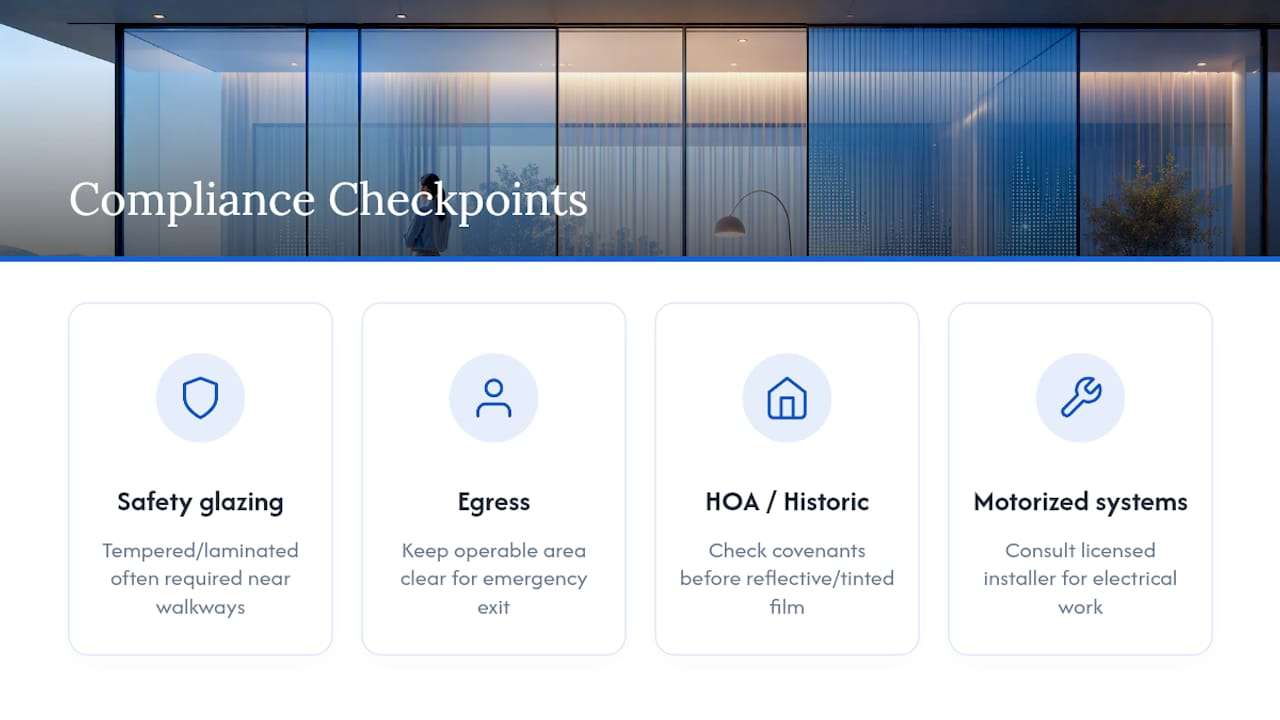
Egress requirements can also come into play if a floor-to-ceiling window doubles as an emergency exit in a bedroom. Motorized shades and drapery hardware generally don’t interfere with egress, but panel track systems or heavy multi-layer setups should leave the operable portion of the window clear.
Homeowners associations and historic districts sometimes regulate exterior-facing window treatments, particularly reflective films that change a building’s appearance from the street. It’s worth checking any HOA covenant before installing reflective or tinted film on a front-facing wall of glass.
None of this replaces a conversation with a local building official or a licensed installer familiar with your municipality’s code, especially for motorized systems that involve electrical work behind the wall. A quick call before a large purchase is far cheaper than a redo after installation.
Publisher Perspective: When Floor-to-Ceiling Glass Needs a Professional
The Drapery Company has fabricated custom window treatments onsite for over 30 years, completing thousands of installations across the Tampa Bay area. That volume of work makes one thing clear: floor-to-ceiling windows punish measurement mistakes far more than standard windows do.
A recessed pocket that’s off by even a quarter inch is visible from across the room. Motorized wiring run without a plan means an exposed cord along a 10-foot drop. Multi-panel installs need every seam and fold matched, which is nearly impossible to eyeball on-site without fabrication experience behind it.
DIY works for a quick film retrofit. It rarely works for anything involving motorization, recessed hardware, or multiple panels sharing a headrail.
— The Drapery Company
How The Drapery Company Helps With Large Glass Walls
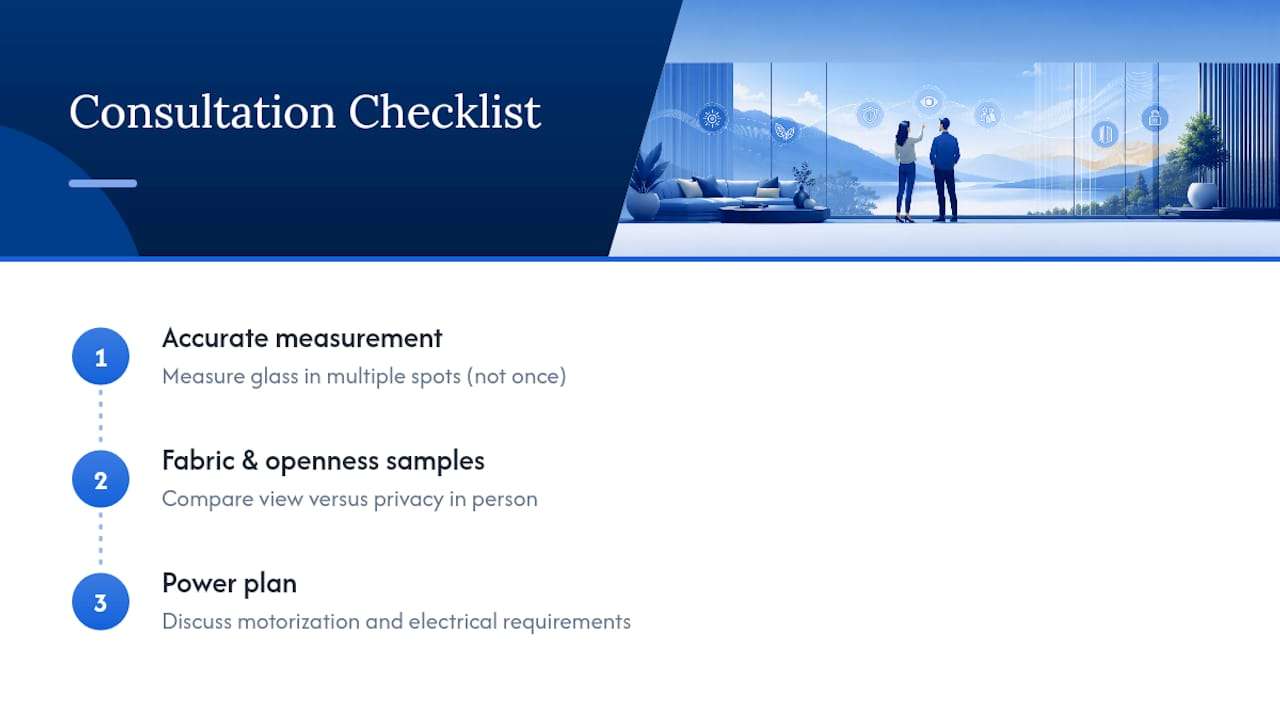
A professional window treatment company handles the parts of a floor-to-ceiling window project that are hardest to get right on your own: precise in-home measurement, onsite fabrication, and professional installation, including removal of existing treatments. A consultation typically covers three things: an accurate measurement of your glass (taken in multiple spots, not just once), fabric and openness-factor samples so you can compare view versus privacy in person, and a power plan if motorization is being considered. Unlike a big-box retrofit kit that assumes a standard window size, every panel and shade gets built to your actual glass, not a close approximation of it. If your living room or primary suite has a wall of glass that needs a real solution, start with the Window Solutions page to schedule a measurement and see fabric options in person.
Sources
For readers who want to go deeper on the technology side, the Smartglass World residential guide breaks down PDLC versus electrochromic glass in more technical detail than fits here. The Florida-specific oversized window guide covers openness factor and hem-bar weight considerations relevant to hot, sunny climates. Both sources back the technical claims made throughout this article.
- Design Experts Say “Smart Glass” Could Transform Privacy at Home
- Window Treatments for Floor-to-Ceiling Windows: A Florida Owner’s Guide
- Smart Glass Technology Privacy at Home: Benefits, Cost, Uses
FAQ
What can I put on windows so I can see out but people can’t see in?
A solar-control shade with a low openness factor (3% to 5%) or a reflective daytime film both let you see out while blocking the view inward during daylight hours; neither works the same way once your interior lights are on at night.
What do you call windows that go from floor to ceiling?
They’re most often called floor-to-ceiling windows, though architects and builders also use the terms “wall of glass” or “full-height glazing” for the same feature.
What are the pros and cons of floor-to-ceiling windows?
They flood a room with natural light and make small spaces feel larger, but they come with higher heat gain, harder-to-control privacy, and treatment costs that scale with the extra height and width. A layered approach of solar shades plus drapery is one of the more reliable ways to manage those tradeoffs.
What is the best window covering for floor-to-ceiling windows?
Motorized roller shades in a solar or blackout fabric are generally the most practical option for tall, wide glass, since manual chains become unsafe above roughly 8 feet; custom drapery layered behind them adds full nighttime privacy without sacrificing the daytime view.