Minimalist Window Treatments for Tampa Homes and Offices
November 16, 2026
Minimalist Window Coverings: Simple Styles for Tampa Homes
November 18, 2026
The best way to cover a glass block window is with a custom-fit shade, drapery panel or shutter that is mounted on the wall around the block, never on the block itself. It softens the grid, controls light and privacy, and leaves the glass free to breathe. In Tampa Bay, where sun is strong and humidity is high, that approach also protects the covering and the room. At The Drapery Company, we fabricate every product in our Tampa Bay workroom, then measure and install it, so a glass block opening gets a treatment built for its exact size.
TL;DR
- Glass block is part of the wall, so mount coverings on the surrounding wall or frame, not on the block or its mortar.
- Roller shades, cellular shades, Roman shades and shutters suit most glass block openings, and the right choice depends on the room and the sun exposure.
- Leave space around the glass and keep any vent panel clear, because trapped moisture is the main enemy in humid bathrooms and laundry rooms.
- Because glass block openings are often small, high or oddly proportioned, custom fabrication and professional measuring give a cleaner result than stock sizes.
- Motorized shades solve the hardest case: blocks set high on a wall or behind a tub.
Why glass block is not an ordinary window
Glass block was built to let light in while hiding what is on the other side. The NFRC Consumer Guide to Windows notes that glass block and frosted or patterned glass diffuse sunlight, and that they work well for windows that are not valued for their views, often set high on a wall near the ceiling. That is why you find them in bathrooms, basements, laundry rooms, stairwells and entryways.
That same construction creates the challenges when you add a covering:
- No frame to attach to. A glass block panel is a grid of solid blocks held together with mortar or sealant. Screwing a bracket into that mortar invites cracking, so the covering needs to attach to the wall or trim around the panel.
- A textured, uneven face. The surface is patterned and slightly recessed, which means anything that sits flat against it, like a tension rod, can press on the blocks.
- Limited ventilation. Many glass block windows do not open at all. Others have a small vent panel that has to stay usable.
- Odd proportions. Glass block openings tend to be wide and short, tall and narrow, or stacked in a half-wall, and standard shade sizes rarely match.
Glass block is also thick and visually strong. Treat it as an architectural feature that you dress, not a hole that you hide.
The main options, compared
The federal Efficient Window Coverings guide describes window coverings as elements added to existing windows to improve energy performance, reduce glare, provide privacy, or improve appearance and comfort. For glass block, these are the categories that matter most to our customers:
| Covering | Best for | What it does well | What to plan for |
|---|---|---|---|
| Roller shades | Bathrooms, utility rooms, basements | Clean, flat profile; privacy at night; very easy to operate | Choose a moisture-resistant fabric where humidity is high |
| Cellular shades | Bathrooms, bedrooms, basements | Soft diffusion of light, insulating air pockets, tidy stack | Mount above the frame so the shade clears the block |
| Roman shades | Kitchens, dining rooms, living spaces | Softens hard masonry with fabric; many custom textiles | Fabric weight matters for ventilation in damp rooms |
| Drapery panels | Living areas, entryways, large block walls | Adds height, color and warmth; frames the wall | Hang on a rod mounted on the wall, wide enough to clear the opening |
| Shutters | Living spaces, street-facing walls | Adjustable louvers for light and privacy; permanent look | Built to the opening, which is why measurements matter |
| Motorized shades | High blocks, tubs, hard-to-reach walls | Operate by remote or app without a ladder | Plan power or battery supply at the start |
We build all of these, from Roman, roller and cellular shades to draperies and blinds, shades and shutters, in our own workroom.
Choosing by room
The right covering for a glass block window depends mostly on what the room is used for. Bob Vila’s room-by-room window treatment guide recommends composite or top-down, bottom-up cellular shades for bathrooms, where humidity and wipe-cleanability decide the choice, and cellular or roller shades paired with drapery for bedrooms. Here is how we apply that to glass block.
Bathrooms
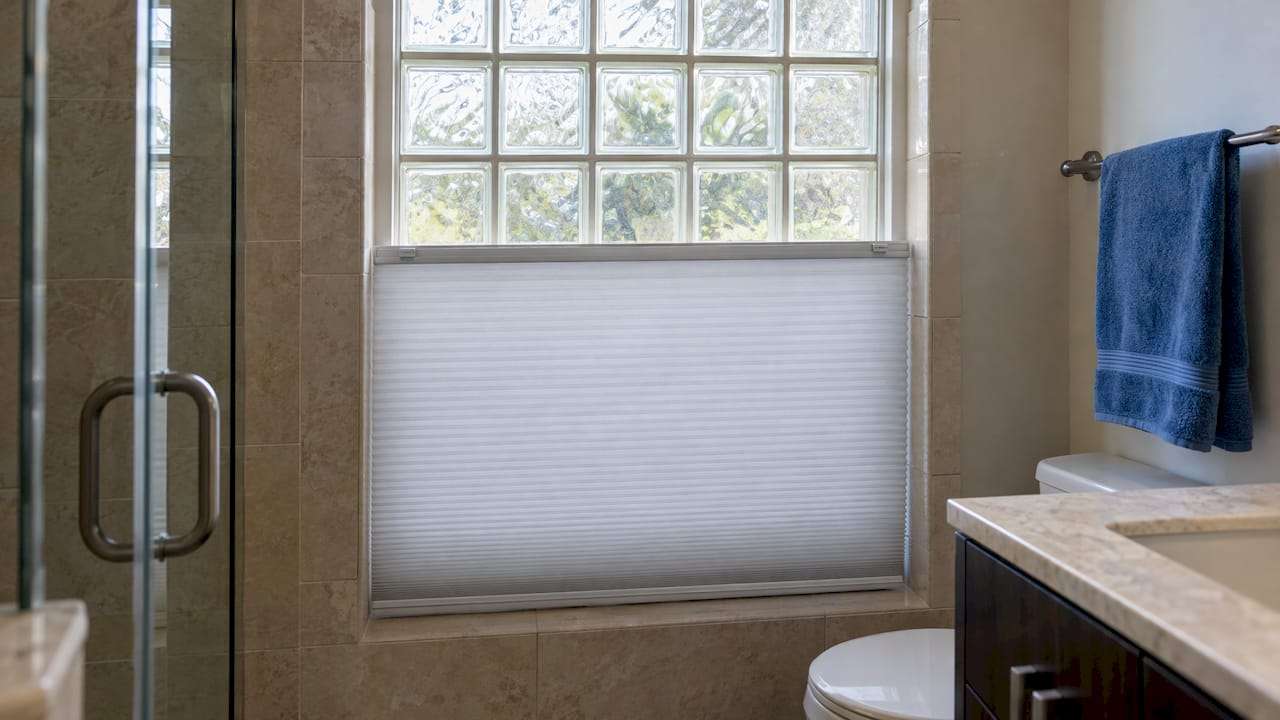
Glass block is most common here, and privacy is the goal. The glass already obscures, so you are really managing two things: nighttime privacy, when the bathroom light makes the window glow from outside, and moisture. A roller shade in a moisture-resistant fabric or a cellular shade with a wipeable surface handles both. A top-down, bottom-up cellular shade is a smart fit, because you can lower the top to let daylight in while the bottom stays closed.
Avoid heavy, full-length curtains. They hold moisture against the wall and the block, and in Florida’s climate that is how mildew starts.
Basements and laundry rooms
These are usually utility spaces, so a simple, wall-mounted roller shade that retracts fully out of the way is the practical answer. The goal is to cut glare and keep the opening tidy without adding anything that collects dust or humidity. In Tampa Bay, where many homes are slab-on-grade and basements are rare, this tends to apply to garages, laundry rooms and mudrooms.
Kitchens, dining rooms and living spaces
Here glass block is often a design feature, such as a block panel beside the front door or a wall of block between rooms. Fabric is the right counterweight to hard surfaces. A tailored Roman shade in a linen-look fabric, or drapery panels on a rod that extends beyond the opening, makes masonry feel like part of the room. Interior shutters are another strong option when you want adjustable light and a finished, architectural look.
Bedrooms and home offices
Glass block in a ground-floor bedroom or a street-facing office raises a different privacy question: daytime and nighttime behave differently. Layering works best. A light-filtering shade handles the day, and a blackout or room-darkening layer, or drapery, takes over at night.
Entryways and sidelights
A glass block panel beside a front door often provides light and some privacy at once. Sheer or light-filtering fabric lets that light continue into the foyer, and we recommend keeping the treatment light and simple so it does not fight the door.
Light, heat and privacy in a Tampa climate
Glass block diffuses light, which is a gift for privacy but also means it can pass a lot of heat when the sun is direct. The NFRC guide points out that light-colored, loosely woven drapes diffuse daylight while still offering privacy, and that blinds give more flexibility on east- and west-facing windows, because the sun moves from a high angle at midday to a nearly horizontal one in late afternoon and adjustable slats can follow it. It also notes that in hot climates like ours, north-facing windows give the highest quality light without excess heat.
Put that into practice:
- East and west exposures: choose an adjustable treatment, such as shutters or blinds, or a motorized shade that you can raise or lower as the day goes on.
- North exposures: light, sheer fabrics preserve the soft glow.
- South exposures: a shade with a tighter weave and a lighter, reflective backing reduces heat while keeping a pleasant light level.
As a rule, a shade with a 3% to 5% openness fabric lets daylight through while giving privacy; we explain how that works in our guide to daylight-friendly privacy. If heat is your main concern, our guide on how to block heat from windows covers fabric and shade choices.
Ventilation and moisture: the details that decide how long it lasts
Tampa’s humidity makes this the part most worth planning. Some rules we follow when a glass block opening is involved:
- Keep vent panels usable. If the opening has an operable vent, the covering should never block access to it. Position the shade or drapery so the vent still opens.
- Leave breathing room. Mount the covering on the wall above and beyond the frame, with a small gap between the fabric and the blocks, rather than pressing it against the surface.
- Match the fabric to the room. Moisture-resistant polyester and wipeable composite materials belong in bathrooms and laundry rooms. Natural linen and cotton belong in drier rooms.
- Do not drill into mortar. Fasten to the surrounding wall, trim or a proper mounting board so the panel is never stressed.
- Skip tight-seal thermal curtains on windows that need to dry out between uses.
On bathroom privacy, Bob Vila’s guide to bathroom window privacy recommends waterproof roller shades to minimize mold and mildew concerns in humid bathrooms, which lines up with what we specify.
What about window film?
Film is a common answer for glass block, and it deserves a straight explanation. Per the Efficient Window Coverings film guide, applied window film is the only window attachment rated by the NFRC (the National Fenestration Rating Council, which labels window energy performance), it can block 95 to 99.9% of UV, and it should be professionally installed and removed because removal requires special release agents. Film also has a limit on a glass block: This Old House describes one-way mirror film as providing privacy during daylight, which means it does less once the lights are on at night.
That is why we usually see film as a base layer, with a fabric shade in front when the room needs privacy after dark and a softer look. Fabric also adds what film cannot: texture, color and a finished edge.
Why custom beats stock for glass block
A stock shade assumes a standard window with a frame, a trim and a normal depth. Glass block seldom provides any of those. These are the places a stock product goes wrong:
- Width and height. A shade that is a half inch too narrow leaves light gaps; one that is too wide may hit a vent or run into the wall’s corner.
- Mounting surface. The shade has to be fastened to something other than the block. That means measuring the wall space, the casing, and where studs or backing exist.
- Proportion. A small block window under a wide stock shade looks like a patch. Custom sizing lets the treatment frame the opening on purpose.
- Fabric choice. With custom work, you pick the fabric for the room’s humidity, light and style, rather than accepting what the stock range offers.
Because we fabricate every product onsite in our Tampa Bay workroom, we control fit, materials and quality from the start. Our team provides professional measurement and installation, and we remove old window treatments as a courtesy, so replacing a dated cover on a block window does not leave you with a leftover to dispose of.
Motorized shades for blocks you cannot reach
Glass block is often set high, in a stairwell, a vaulted wall or beside a soaking tub. A cord or wand is awkward there. Our motorized blinds and shades raise and lower from a remote or phone, and battery-operated motorized shades are worth a look when there is no outlet near the opening.
Glass block in commercial and multi-unit settings
Glass block shows up in offices, restrooms, stairwells, salons and apartment buildings, where privacy and a consistent look matter more than individual taste. Property managers and designers usually need three things: uniform fabric and mounting across many openings, durable materials that stand up to frequent use, and installation scheduled with minimal disruption.
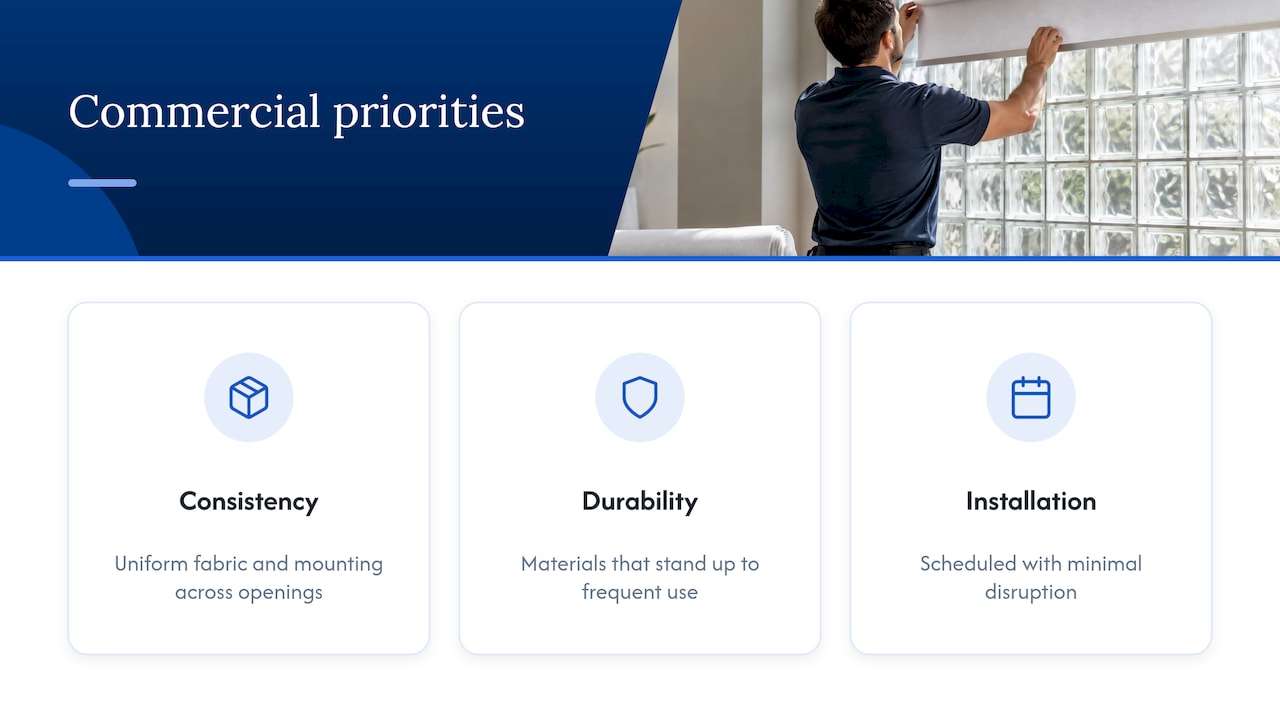
We serve commercial clients as well as homeowners, and our commercial window treatments include draperies and motorized coverings. If you are a designer specifying a treatment for a client, or a property manager outfitting a building, we can discuss fabric, operation and installation scale in the first consultation. For existing treatments that only need work, we also handle drapery repair, curtain repair and hemming.
What to settle before you order
Whatever you choose, answer these questions first. They save time at the consultation and keep the result from being a compromise.
- Does the window open? Note any vent panel and how it operates.
- Which direction does it face? This shapes the light control you need.
- What is the privacy goal at night? Daytime diffusion is built in; nighttime is the real question.
- How humid is the room? This decides fabric and whether the covering can sit close to the wall.
- Who will use it? A hard-to-reach block points toward motorization.
- What is the style of the room? Hard glass and grout reads as industrial, so decide whether you want to soften it with fabric or keep it crisp with shutters or a roller shade.
If the block panel was built to a plan, such as a new bathroom remodel, mention it too. Glass block panels have size limits by series and installation type, and Pittsburgh Corning’s planning guidance, for example, notes that a rough opening should be cut to fit the block rather than forcing the block to fit the space. A well-proportioned opening makes the covering simpler to design.
Get a glass block window covered the right way
If you have a glass block window in Tampa Bay that needs a real solution, our in-home consultation is the starting point. We look at the opening, the room and the light, talk through fabric and operation, then design, fabricate and install your treatment, removing the old one if there is one. Pricing is not published online, because each project is built to the opening, so a quote follows the consultation. You can also start from our custom window treatments page.
Our perspective: dress the wall, protect the glass
After more than 30 years of fabricating window treatments in the Tampa Bay area, we think of glass block the way an architect does: as a wall made of light. The mistake we most often see people want to make is to hide it, with something heavy and tight against the surface. The better move is to build a frame of fabric around it, the way custom curtains act as architecture with fabric instead of drywall.
That means a shade or drapery that is cut to the opening, mounted on the wall where it belongs, and made from a fabric that suits the room’s humidity. Because we make every product in our own workroom, we can adjust fullness, length and fabric weight to the exact opening, and we install it ourselves.
Glass block rewards a custom approach more than almost any other window type, because nothing about it is standard. When the covering is built for the opening, the result looks like part of the design instead of an afterthought.
The Drapery Company
FAQ
Can you put curtains over glass block windows?
Yes. Mount a rod on the wall above and wider than the opening, and choose a lightweight fabric so air can move around the block. Skip heavy, full-cover curtains in bathrooms and laundry rooms, where they trap moisture against the wall.
What is the best window covering for a glass block bathroom window?
A moisture-resistant roller shade or a wipeable cellular shade is the usual answer. A top-down, bottom-up cellular shade lets in daylight while keeping the lower portion closed for privacy, and Bob Vila’s guidance on bathroom window treatments favors this kind of shade for bathrooms.
Is it safe to drill into glass block or its mortar?
It is best avoided, because drilling into the mortar can stress the panel and cause cracks. Fasten the covering to the surrounding wall or trim instead. Our installers measure and mount around the panel, so the block itself is left untouched.
How do you cover a glass block window for privacy at night?
Glass block gives daytime privacy, but a lit room can make the window glow, so add a fabric layer. A roller shade, cellular shade or shutter closes the opening after dark, and a drapery panel can sit in front for extra softness.
Can motorized shades go on glass block windows?
Yes, and they are especially helpful when the block sits high or behind a tub. The shade mounts to the wall or ceiling above the opening and runs by remote or app, so no one has to reach it by ladder.
Sources
- Natural Light, NFRC Consumer Guide to Windows
- Overview: Deciding What to Do With Existing Windows, Efficient Window Coverings
- Applied Film, Efficient Window Coverings
- The Best Window Treatments for Every Room in Your Home, Bob Vila
- 10 Bathroom Window Privacy Ideas, Bob Vila
- Design Uses for Window Film and Appliques, This Old House