Commercial Motorized Shades: A Tampa Bay Buyer’s Guide
November 20, 2026
Cornice Board Styles: Straight, Shaped and Upholstered
November 22, 2026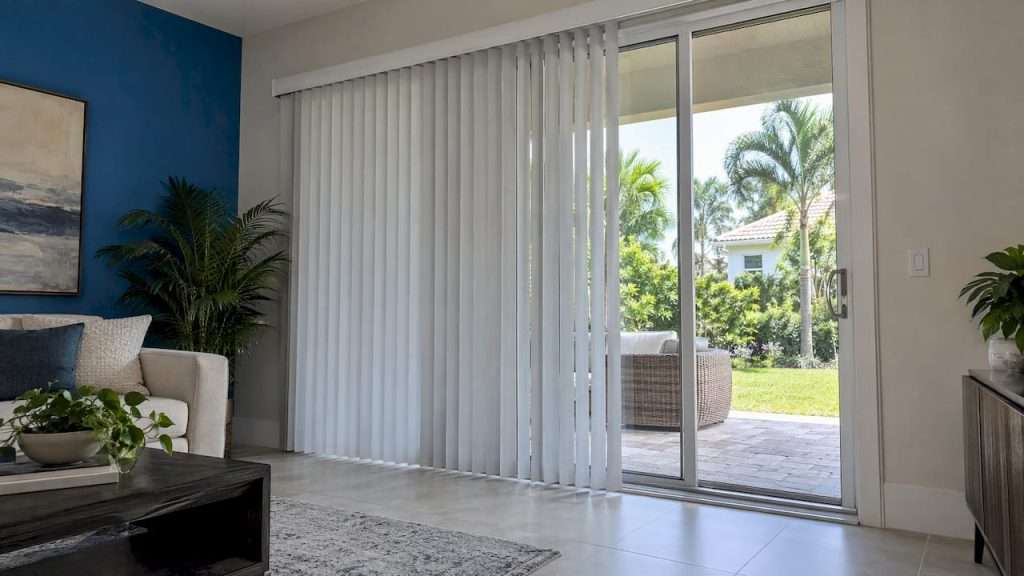
The best patio door covering is one built for your specific door: made to the exact opening, hung so the door slides or swings freely, and matched to how much light, heat and privacy the room needs. Vertical blinds, roller shades, solar shades, panel track shades and floor-length drapery can all do the job. Which one is right depends on how often the door is used, which way it faces and how the room is styled. Because every product we sell is fabricated in our own Tampa Bay workroom, we can build any of them to fit the door in front of you instead of asking the door to fit a stock size.
TL;DR
- Vertical blinds and panel track shades move the same direction as a sliding door, so they stay out of the way of daily traffic.
- Roller and solar shades give a clean, modern look and can be motorized for wide or tall glass.
- Drapery adds softness and the most design flexibility, but it needs stacking space beside the door.
- Handles, tracks and door clearance decide the mounting style, so settle them before you choose a fabric.
- A custom-made covering, measured and installed by a professional, avoids the gaps and rubbing that stock sizes often leave.
Why a patio door is harder to dress than a window
A window sits still. A patio door gets opened, closed, walked through and carried things through, often many times a day. Whatever covers it has to survive that traffic and stay out of the way of the handle, the lock and the track.
A patio door is also usually the largest piece of glass in the room. It lets in a lot of light and a lot of heat, and at night it turns into a large dark mirror facing the neighbors. That is why the keyword is so busy: people want privacy, glare control, a better look and a door that still works.
So before choosing a style, answer four questions:
- Is the door a slider, a hinged French door or a multi-panel glass wall?
- Which way does it face, and when does the sun hit it?
- How often is the door used, and by whom (children, pets, guests, staff)?
- Do you want to see out when the covering is down?
The rest of this guide follows from those answers.
The main options, side by side
| Option | Best for | Operation | Watch for |
|---|---|---|---|
| Vertical blinds | Wide sliders, easy daily access | Louvers rotate and stack to one side | Look dated if the material is dated, so fabric choice matters |
| Roller shades | Clean, minimal look | Lift from the top or motorized | Door handle clearance, full-width operation |
| Solar shades | Glare, heat and view | Roll up, fabric filters sun | Openness percentage, privacy at night |
| Cellular shades | Insulation and quiet look | Top-down or bottom-up | Weight on tall, wide doors |
| Panel track shades | Wide glass walls, modern rooms | Fabric panels slide and stack | Needs stacking room on the side |
| Drapery or curtains | Softness, style, sound | Slide on a rod or track | Needs stack space; moved for full access |
| Shutters | Permanent, tailored look | Hinged or track-mounted | Best planned with the door style in mind |
Below is how each one behaves in real use.
Vertical blinds for patio doors
Vertical blinds remain the default for sliding doors for a simple reason: they move in the same direction the door does. You can pull the louvers aside, step through and close them again without lifting anything over a handle. A design expert quoted by The Spruce describes them as a smart choice for larger spaces such as a sliding glass door overlooking a patio, noting they are more affordable and easy to repair, and that newer louver shapes and materials have brought fresh interest after their peak in the 1980s and 1990s.
That last point is the one to take seriously. The vertical blinds people remember were thin, rattling vinyl in builder white. Today you can choose fabric louvers in textured weaves, wider vane profiles and a range of opacities, and the result looks much closer to a tailored drapery panel than a rental-unit blind.
Vertical blinds suit you if:
- the door is used constantly and you want the simplest operation
- you want to control light by rotating the louvers instead of lifting the whole covering
- the opening is wide and you want a practical covering across the full span
We make blinds, shades and shutters for Tampa Bay homes and businesses, and for sliding doors we start with how the door actually gets used before we talk about fabric.
Roller shades and solar shades
Roller shades are the cleanest-looking option. One flat piece of fabric rolls into a slim headrail, and when it is up you barely notice it. They work best on sliders when the shade is sized to the full door opening, so you can raise it entirely and see out.
Width is where roller shades are limited, and where custom matters. One national guide to sliding door coverings picks a fully customizable roller shade that can be made up to 128 inches wide and 144 inches long. Even so, a very wide glass wall may be better served by several shades side by side or a motorized set that moves together.
Solar shades are roller shades woven to filter sunlight. They are rated by openness, the percentage of the weave that lets light and view through. A tighter weave blocks more glare and heat but gives you less view. If your patio door faces west and the afternoon sun makes the room unusable, a tighter weave is the sensible starting point. If you want to keep the view of a pool or garden, a more open weave keeps the outdoors visible. We cover the trade-offs in our guides to solar shades for sliding glass doors and rolling shades for sliding glass doors.
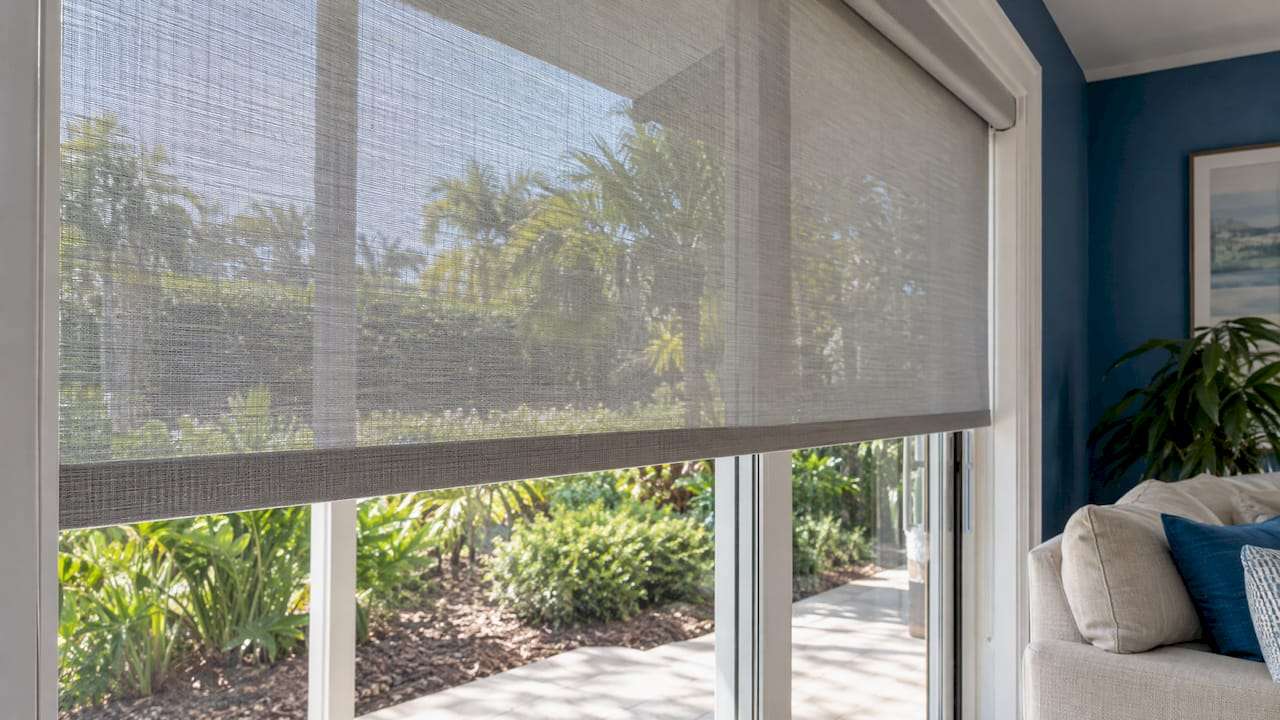
One caution applies to every light-filtering fabric: during the day it protects privacy from outside, but at night, with lights on inside, people outside can see in. If the door faces a street or a close neighbor, a room-darkening or blackout fabric, or a second layer, is the better choice.
Blackout and room-darkening for sliding doors
Bedroom sliders, home theaters and rooms where someone works night shifts all call for real darkness. There are three ways to get it:
- Blackout roller shades. A single opaque fabric in a tight, edge-to-edge fit. Light leaks at the sides are the most common complaint, so the width and the mounting style matter more than the fabric.
- Blackout drapery. Lined, full panels on a wide rod or ceiling track. Because the panels extend past the glass, they block light at the sides naturally.
- A layered approach. A light-filtering shade for the day and a blackout drapery panel for sleeping.
If you want a blackout look that also feels like part of the room, layering is the most flexible answer. See our ideas for sliding glass patio door curtains for how the layers can look.
Curtains and drapery on a patio door
Curtains give a patio door what shades cannot: softness, color, pattern and sound absorption on a large hard surface. A full-length panel on each side of a slider frames the door like a piece of architecture, with fabric instead of drywall.
The practical rules are straightforward:
- Plan the stack. Drapery needs room beside the door to rest when open. For a slider, that usually means mounting the rod or track wider than the frame, so the open panels sit on the wall and not over the glass.
- Mind the floor. Panels that clear the floor slightly, or just kiss it, move better than puddled fabric, which catches in the track and under feet.
- Choose the right fullness. Fullness is the extra fabric in each panel relative to the width it covers. Skimpy panels look flat and never close properly across a wide door. Generous fullness gives the rich, tailored folds.
- Use a track for wide doors. A ceiling-mounted track lets panels glide in one motion, which a rod with rings rarely does as smoothly across six or eight feet.
Curtains do need to be moved for full access, so for a door used all day we often pair them with a shade or choose a stacking panel track system. For ideas across styles, our guide to patio door window treatments shows how these combine with function.
Panel track shades and glass walls
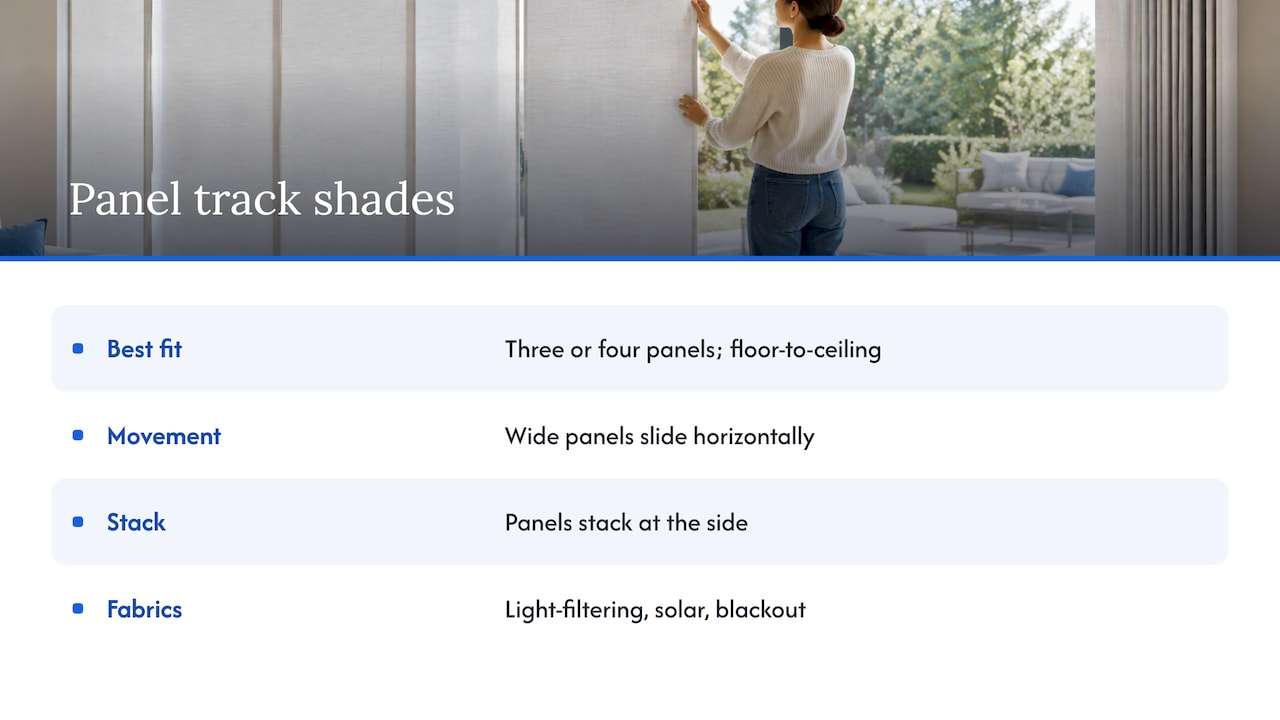
When a sliding door is really a wall of glass, with three or four panels or floor-to-ceiling dimensions, a panel track system is worth a look. Wide fabric panels slide horizontally on a track and stack in front of one another at the side. They give you the clean look of a roller shade with the sideways operation of a vertical blind.
They suit contemporary rooms and large expanses, and they can be made in light-filtering, solar or blackout fabrics. If your house has tall, wide glass beyond the door itself, our guide to privacy for floor-to-ceiling glass explains how openness percentages and professional help come into play.
French doors and hinged patio doors
A hinged door brings a different problem: the door swings, so anything hung over the glass has to move with it or stay clear of it. Here the best coverings are usually:
- Shades mounted directly on the door, sized to the glass so they stay put when it opens, and often held at the bottom so they do not swing.
- Cellular or Roman shades on the frame for a soft, finished look.
- Drapery on a rod or track above the door, which lets the door swing freely underneath.
- Shutters, which can be made to fit the door’s panes.
Smaller-slat or narrow-profile coverings are generally better for glass-paneled doors because they sit closer to the glass and leave the handle clear. When you have two doors side by side, treat them as a matched pair so the heights and lift lines align.
Settle these four details before you order
The covering that looks right in a photo can fail in a hallway of daily use if these details are skipped.
1. The handle and the lock
A slider’s handle often projects into the room. A shade hung flush against the glass can hit it, and a covering that sits just in front of the handle can pinch it. The mounting depth, a spacer or a different headrail style are the usual solutions, and this is what a professional measurement catches.
2. The track and the threshold
Bottom rails and drapery hems must clear the track. A shade that drags on the track wears quickly. A panel that is too long jams. Check how much room sits between the bottom of your covering and the floor or sill.
3. Inside mount or outside mount
An inside mount sits within the frame and looks tidy, but it needs enough depth. An outside mount sits on the wall or ceiling above the door, hides the frame’s gaps and can block more light. For doors, outside mounts are common because they leave room for handles and allow the covering to extend beyond the glass.
4. Stack and clearance
Vertical blinds, panels and drapery all stack to the side. Measure that space as well as the opening. Furniture, a light switch or a corner can force the stack to the other side or call for a split stack that opens from the center.
These are the points where stock coverings fall short and custom work earns its keep. Our in-home consultations include professional measurement and installation, so these checks happen at your door instead of on paper.
Motorization for large or busy doors
A very wide or very tall patio door means a heavy covering, and heavy coverings are harder to lift and straighten by hand. Motorized operation helps in three situations: oversized openings, hard-to-reach headrails and homes where you want shades on a schedule or from a remote or phone. It also removes cords, which keeps the area around a frequently used door tidy.
For details on how motorized shades work on sliders, see our guide to motorized roller shades for sliding glass doors or our overview of motorized blinds and shades.
For businesses, property managers and designers
A patio door at a restaurant, office, clinic or condo community is used far more than one in a home, and it usually has to look consistent across many units. The priorities shift:
- Durability and easy upkeep. Choose fabrics and hardware that handle daily operation.
- Consistency. Matching fabrics, headrail styles and mounting heights across a building looks professional and simplifies replacement.
- Scale and scheduling. Fabricating in one workroom means a single source for the whole job and one measurement process.
- Repair. Coverings that can be repaired, hemmed or adjusted are cheaper to keep than ones that must be replaced.
We serve both residential and commercial clients, including property managers who need coverings installed at scale and interior designers who need a reliable custom fabricator. Our commercial window treatments page covers the draperies and motorized options, and we also handle drapery and curtain repair and hemming.
Matching the covering to your room
If you want a quick shortlist, use this:
- Busy family slider, want simple: vertical blinds in a fabric louver, or a panel track shade.
- Modern room, clean lines: roller or solar shades, possibly motorized.
- Hot, sunny exposure, want to keep the view: solar shades with a suitable openness percentage.
- Bedroom or media room: blackout shade with drapery panels for layers.
- Traditional or softly styled room: floor-length drapery on a track, with a shade underneath if you want more control.
- French doors: door-mounted shades or cellular shades, with drapery above if you want the soft look.
A broader overview of patio and sliding door window treatment options can help when you are thinking about the covering alongside the outdoor space it opens onto. For our own walkthrough of the topic, read how to dress a sliding glass door.
Our perspective
A patio door is the one opening in your home that has to be both a window and a doorway. That is why we do not think of a covering for it as a product off a shelf. It is a piece of fitted architecture, with fabric instead of drywall.
In our Tampa Bay workroom we fabricate every product ourselves, so we control the fit, the materials and the quality from the first cut to the final hem. After more than 30 years and thousands of projects, we have learned that the details people forget, the handle, the track, the stack, the floor clearance, are exactly the details that decide whether a covering still looks right and works in five years.
That is why our service runs from design consultation through installation, including removal of your old treatments as a courtesy. We tailor the design to your budget and your practical needs, whether that means vertical blinds in a fabric you will love, solar shades that keep your view, or full drapery on a track.
The Drapery Company
Get a patio door covering made for your door
If you live or operate a business in the Tampa Bay Area, we can design, fabricate and install a patio door covering built around your door, your light and your budget. Our in-home consultation is where we look at the handle, the track and the stack, and show you fabrics in the actual light of your room. You can also explore our custom window treatments and window solutions to see the full range.
FAQ
Are vertical blinds still a good choice for patio doors?
Yes. They open in the same direction as a sliding door, tolerate heavy daily use and are easy to repair, which is why designers still recommend them for large sliding doors. Choosing a textured fabric louver and a custom fit gives them a modern, tailored look.
What is the best covering for a sliding door that needs total darkness?
A blackout roller shade made to the full width of the door works well, and pairing it with lined drapery panels blocks the light that leaks around the edges. Layering also gives you a softer look in the daytime. We can build both layers to match.
Can I use curtains on a patio door?
Yes, as long as you plan space for the panels to stack beside the door and keep the hem clear of the track. Mounting a rod or ceiling track wider than the frame keeps the glass fully open when the panels are drawn back.
Should I choose an inside or outside mount?
For most patio doors, an outside mount is the better fit because it clears handles, hides frame gaps and lets the covering extend past the glass. An inside mount works only when the frame is deep enough and nothing projects into it. A professional measurement settles the question for your specific door.
Can patio door shades be motorized?
Yes. Motorization is especially useful for wide or tall doors, high headrails and homes that want shades controlled by remote, schedule or phone. It also removes cords near a busy doorway.
Sources
- 16 Types of Blinds to Know Before Buying, The Spruce
- The Best Window Treatments for Sliding Doors, Bob Vila