Patio Door Blinds: How to Choose What Works for Your Door
November 21, 2026
Garage Window Privacy: Blinds, Shades and Shutters That Work
November 23, 2026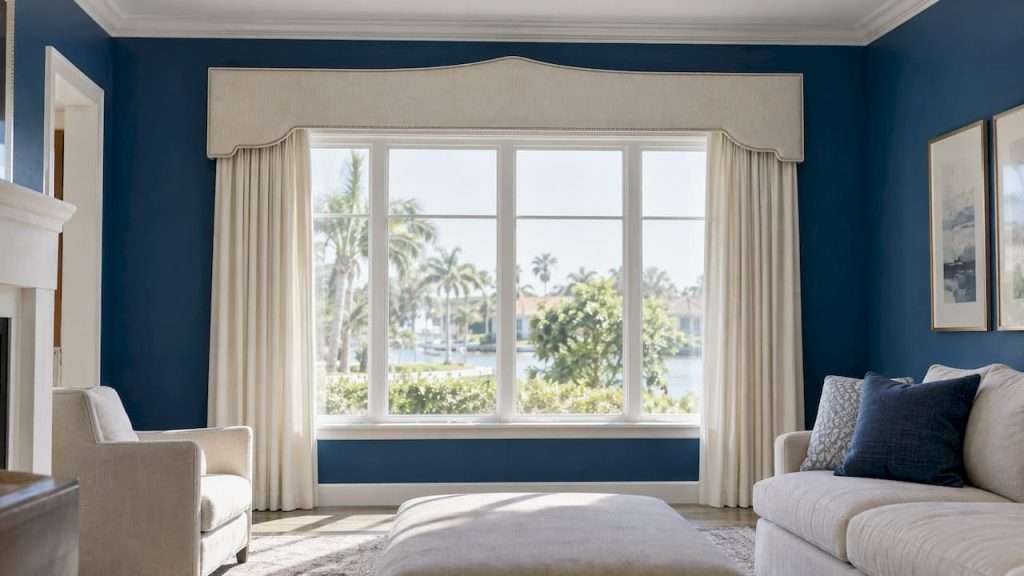
A cornice board is a hard-top window treatment: a wood structure, usually upholstered in fabric, that sits across the top of the window and hides the hardware behind it. The style you choose comes down to three decisions: the shape of the bottom edge (straight, arched, scalloped or layered), the finish on the face (fabric, trim, paint), and whether it stands alone or crowns drapery. This guide walks through each decision so you can describe what you want to a workroom, or recognize it when you see it.
We build window treatments in our own Tampa Bay workroom, and cornices are some of the most architectural pieces that come out of it. The notes below come from that point of view.
TL;DR
- Five shapes cover most cornice boards: simple box, curved, scalloped, layered and fabric-covered, according to This Old House.
- Straight, slim cornices read modern. Shaped edges, trim and rich fabrics read traditional.
- Fabric, trim and proportion matter more than the shape alone. A light linen and a heavily trimmed velvet make the same board look like two different rooms.
- Designers are seeing old-school cornice boards return, so the style is current when it is cleanly built and sized to the window.
- A custom cornice is built to your exact window, with the hardware hidden and the fabric matched to the rest of the room.
What a cornice board actually does
HGTV describes a window cornice as typically wood upholstered in fabric, a hard-top treatment that encases the top of the window to hide hardware and gives the window a polished look. That one sentence explains why people choose them.
A cornice does three jobs at once:
- It hides the working parts. Rods, brackets, shade headrails and the top of the panels disappear behind a clean face.
- It adds structure. Soft drapery falls in folds. A cornice is rigid, so it gives the top of the window a defined line, almost like architecture made with fabric instead of drywall.
- It sets the style. Because it sits at eye level for anyone entering the room, the cornice carries the personality of the window treatment.
If you want the basics first, our guide to what a cornice board is and how it changes your windows covers them in more detail. Here we stay with styles.
The main cornice board styles at a glance
This Old House names five popular styles. The table adds what each tends to suit.
| Style | What it looks like | Typically suits |
|---|---|---|
| Simple box | Straight lines, flat bottom edge | Modern and transitional rooms, wide windows, offices |
| Curved | A gentle arc along the bottom | Softening square rooms, arched or traditional spaces |
| Scalloped | Decorative curves repeating along the edge | Traditional dining rooms, bedrooms, formal spaces |
| Layered | Several tiers of molding stacked | Rooms with crown molding and high ceilings |
| Fabric-covered | Wood structure wrapped in fabric | Nearly any room; the fabric sets the mood |
The five descriptions come from This Old House’s guide to building a window cornice. The “typically suits” column is our own read from fitting treatments in Tampa Bay homes.
Note that “fabric-covered” is less a shape than a finish. Most of the other styles can be covered in fabric too, which is why upholstered cornices are so common.
Straight (simple box) cornices
The straight cornice is the workhorse. It is a rectangular box with a flat bottom edge, and its strength is restraint. It is the easiest shape to coordinate with everything else in the room.
Where it works best:
- Wide windows and sliding doors. A long, level line makes a wide opening feel intentional rather than empty.
- Rooms with strong horizontal lines, such as kitchens with a run of cabinets or an open living area.
- Commercial spaces. Offices, lobbies and restaurants usually want a tidy, consistent top line across a bank of windows, and a straight cornice delivers that without fuss.
The tradeoff is that a straight edge shows everything. A slightly off level, a seam that does not line up or fabric that puckers is more visible on a flat face than on a shaped one. That is a workroom-quality question, and it is one reason we fabricate our treatments onsite where we can control fit, materials and finish.
Curved and arched cornices
A curved cornice has a gentle arc, either dipping toward the center or rising to it. It softens the hard corners of a room without introducing pattern.
Use an arch when:
- The room is full of right angles (boxy furniture, rectilinear windows) and needs one soft line.
- The window itself is arched or has a transom. An arch can echo it.
- You want a traditional feel without the busyness of scallops.
Keep the curve shallow if the window is small. A deep arc on a narrow window can look top-heavy and steal the visible glass. If your windows are small, our drapery ideas for small windows walk through proportion in more detail.
Scalloped and shaped cornices
Scalloped cornices repeat a curve along the bottom edge. Shaped cornices go further, with points, steps, cutouts or a center peak. These are the most decorative options, and they are the ones people picture when they think of a traditional cornice.
HGTV notes that traditional cornices allow ornate fabrics and shapely silhouettes, citing a pagoda-inspired chinoiserie dining room as one example. That is the sweet spot for shaped boards: rooms where the window treatment is allowed to be a feature.
Things to decide with a shaped cornice:
- Scale of the repeat. Large, slow scallops look calm. Small, tight ones look fussy on a wide window.
- How the pattern lands at the corners. A good layout ends the pattern symmetrically at both ends. This is a pattern-making detail that is easy to get wrong without a template.
- Whether the shape competes with the fabric. A bold print and an intricate edge usually fight. Pick one to lead.
Layered cornices
A layered cornice stacks tiers of molding or boards, so the top is built up like a small piece of millwork. This Old House lists it among the five popular styles, and describes a custom wood cornice built from poplar boards and primed-pine crown molding as adding architectural character while concealing drapery hardware.
Layered boards are usually painted or stained rather than upholstered, so they read as part of the room’s trim. They suit homes with substantial crown molding and taller ceilings, where a flat, fabric-covered box could look slight by comparison.
Upholstered cornice designs: fabric, padding and trim
Upholstered cornices are the most flexible category because the fabric does the styling. A few things shape the result.
Fabric
Choose the fabric for the room first, then for the cornice. Architectural Digest reports designer Susan Spath of Kern & Co. noting that clients want light, airy fabrics like linens for a softer, less heavy window look. A linen cornice over matching panels is calm and current. If you are pairing a cornice with sheer or natural-fiber panels, browsing natural linen curtain panels is a quick way to see how the textures will sit together.
HGTV also recommends coordinating the cornice fabric with bedding or Roman shades, or mixing fabric cornices with woven grass or bamboo shades. The same idea works with our custom bedding: a cornice and a duvet in the same fabric family tie a bedroom together.
Padding
A thin layer of batting under the fabric gives a soft, slightly rounded face and hides the edges of the wood. This Old House describes the method: wrap batting slightly larger than the cornice front and sides, staple it to the back, stretch the fabric over it, and cover the stapled edges with coordinating fabric or ribbon. Padding is what separates an upholstered look from a board with fabric glued on.
Trim and details
This Old House lists a range of finishing touches: wood appliques or carved elements applied before painting, metallic paint or gilding, trim or braid along the bottom edge, and stenciled designs. On fabric cornices, the usual trims are:
- Welting (piping) along the edges for a crisp outline.
- Nailhead trim for a tailored, classic look.
- Contrasting banding at the bottom edge to add a second color without a second fabric across the whole face.
- Braid or fringe for formal, traditional rooms.
One trim is usually enough. Layering welting, nailheads and fringe on the same board tends to look dated faster than a single, well-chosen detail.
Re-covering instead of replacing
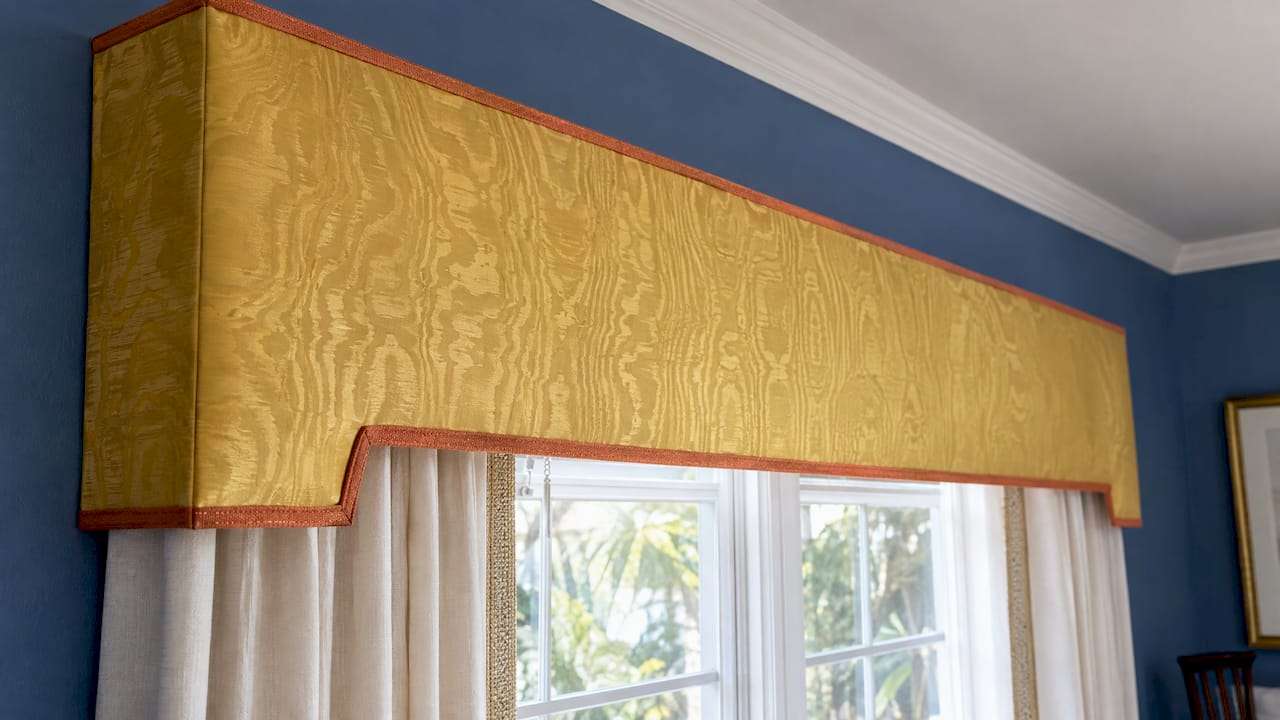
A cornice is a durable structure, and the fabric can change while the board stays. Birmingham Home & Garden describes designer Danielle Balanis re-covering existing dining room cornice boards in mustard moiré edged in persimmon tape trim, part of a bold, maximalist room. If you have cornices that fit your windows but not your taste, a new fabric can change the room without new construction.
Modern cornice boards
Modern cornices follow a few consistent habits, and they are easy to apply:
- Slim profile. A shallower, narrower board looks lighter than a deep, boxy one.
- Straight or very shallow lines. Skip the scallops and keep the edge crisp.
- Solid or subtly textured fabric. Linen, a woven neutral or a tone-on-tone solid. Let texture, not pattern, do the work.
- No trim, or one thin accent. A thin contrast band at the bottom edge is enough.
- Often no side panels at all. HGTV’s examples include streamlined modern cornices without curtain panels, where the board and a shade or blind carry the window.
That last point is a practical one. A slim cornice over a Roman, roller or cellular shade gives you a finished top, hidden headrail and full control over light and privacy. Our Roman shade styles pair naturally with a straight cornice.
Are cornice boards still in style?
Yes, with a caveat about execution. Architectural Digest quotes Dallas designer Eddie Maestri of Maestri Studio seeing a triumphant return of old-school cornice boards, alongside new takes on balloon shades and micro-shutters. The same piece notes that drapery is a major budget item, so designer Smith cautions against overdoing patterns or detailing you will tire of in a few years.
Both points lead to the same advice. Choose a clean shape, a fabric you can live with and one meaningful detail. A cornice dates when it is overloaded, not because it is a cornice.
How to choose a cornice style for your room
Work through these questions in order.
- What is the room’s style? Modern or transitional: straight or very shallow curve. Traditional or formal: scalloped, shaped or layered.
- What is under it? A cornice over floor-length drapery needs enough projection to clear the panels. A cornice over a shade can be slimmer. Our guide to cornices for windows explains how the pieces work together.
- How wide is the window, and how high is the ceiling? Wide windows take a straight line well. Taller ceilings can carry a deeper board or a layered build.
- Is it a bay window or an unusual shape? Bay and bow windows need boards cut to the angles, and the planning matters more than the style. See our window treatment ideas for bow windows.
- Is it a home or a commercial space? In offices, restaurants and multi-unit buildings, consistency matters. One board style repeated across every window, built from the same fabric lot, gives a uniform result.
Construction matters as much as style
Two cornices that look identical in a photo can behave very differently on the wall. The National Upholstery Association’s July 2026 webinar recap with Robin Matthews describes the open-frame method: instead of a heavy plywood face, a lighter frame construction makes cornices easier to handle in the workroom, less expensive, and a breeze to install on site. It is a good reminder that how a board is built affects cost and installation as well as appearance.
The parts that decide how a cornice looks years later are:
- Square, true joints so the face does not twist.
- Even padding and tight fabric so there are no ripples.
- Accurate measurements, since a cornice cannot be trimmed on site the way a rod can be adjusted.
- Secure mounting that suits the wall and the board’s size.
This is why we fabricate in our own workroom and install the finished piece ourselves. Fit and finish are decided at the bench, and measuring, building and mounting by one team keeps them connected.
Getting a custom cornice in Tampa Bay
The Drapery Company has more than 30 years of experience designing custom window treatments for homes and commercial spaces across the greater Tampa Bay Area. Every product is fabricated onsite in our workroom, which gives us control over fit, materials and quality.
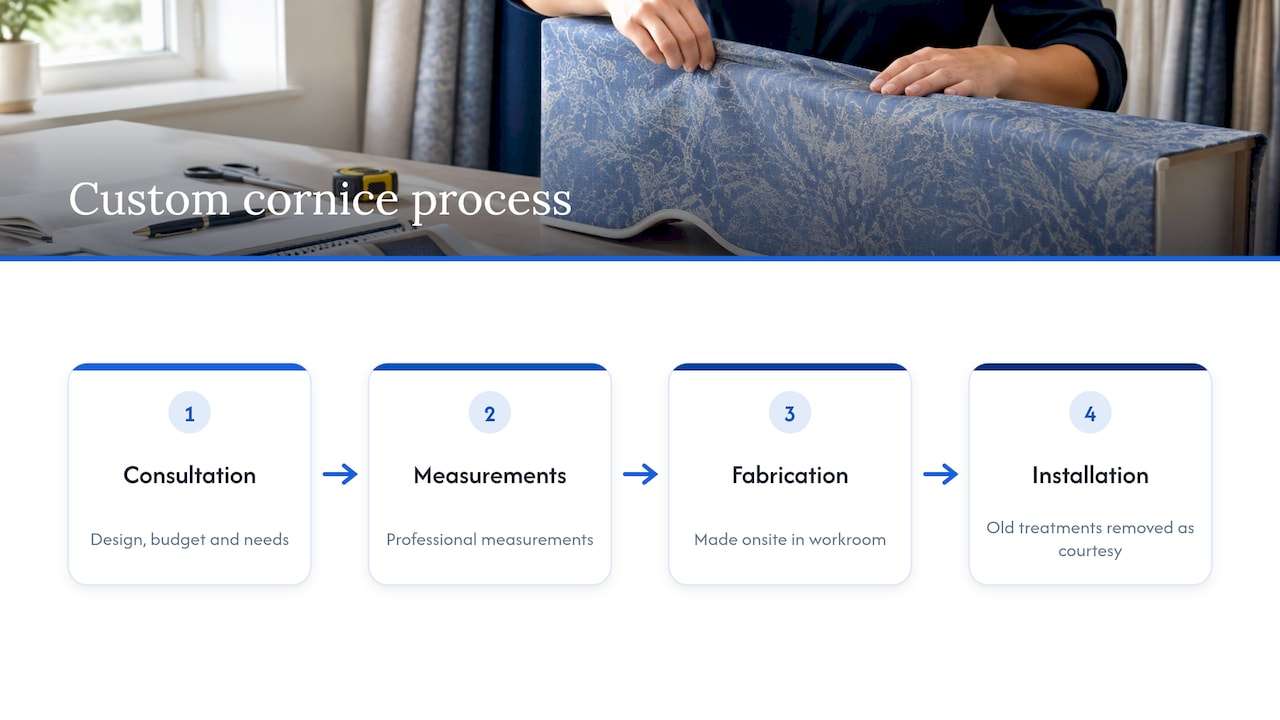
The process is simple: we start with a design consultation, take professional measurements, fabricate your treatment and install it, removing your old window treatments as a courtesy. It is tailored to your budget and practical needs, and we can pair a cornice with drapery, shades, blinds or shutters in the same design. To start with an in-home visit, see our residential services page. Interior designers and property managers can bring us a spec or a building full of windows through our commercial window treatments team.
Our perspective
We think of a cornice as the one window treatment that behaves like architecture. It is built, not draped, so it has to be right the first time: the right depth, the right height, the right fabric on the right face.
Most of what makes a cornice look expensive is not decoration. It is proportion, clean corners, even padding and a fabric chosen to suit the room. That is workroom work, and it is why we build everything in our own Tampa Bay workroom rather than assembling it from parts.
Our advice is to decide the shape last. Start with how you want the window to feel, light or formal, quiet or bold, then let the cornice follow. A straight board in a good linen and a scalloped board in a rich damask are both right, in the right room.
When a cornice is designed together with the shades, drapery or bedding around it, the room looks finished. That is the work we do every day, from the first consultation through installation.
The Drapery Company
FAQ
What are the three types of cornices?
The simplest grouping is straight, shaped (curved, arched or scalloped) and layered or molding-style. Upholstered is a finish that can be applied to the first two. This Old House lists five popular styles in all: simple box, curved, scalloped, layered and fabric-covered.
Do people still use cornice boards?
Yes. Architectural Digest cites designer Eddie Maestri seeing old-school cornice boards return. They work best with a clean shape, a restrained trim and a fabric chosen for the room, so they feel current rather than heavy.
What is the difference between a cornice and a valance?
A cornice is a rigid box, usually wood covered in fabric, with a defined shape. A valance is soft fabric that hangs in folds or pleats. Cornices give a structured, architectural line, while valances give a softer look.
Can a cornice board go over blinds or shades?
Yes, and it is a popular pairing. The cornice hides the headrail and brackets, and the shade or blind handles light and privacy. A slim straight cornice over a Roman or roller shade is a common modern look.
Can I change the fabric on an existing cornice?
Often you can. If the board fits the window and is in good condition, re-covering it in new fabric updates the look without rebuilding the structure. Designers do this on dining room cornices to refresh a room’s palette.
Sources
- Comprehensive Guide To Building a Window Cornice, This Old House
- 15 Stylish Window Cornice Ideas, HGTV
- 33 Stylish Window Treatment Ideas, Architectural Digest
- Designer Danielle Balanis Creates a Bold Maximalist Oasis, Birmingham Home & Garden
- News and Blog, National Upholstery Association